Quick Summary
A small MOQ hijab manufacturer gives emerging modest fashion brands a practical path between generic stock and high-volume factory commitments. This factory story explains how our team uses optimized digital printing equipment, modal and jersey expertise, and flexible short-run scheduling to support pilot collections from 100 pieces per colourway. It covers the production decisions that protect print stability, the technical checks used to evaluate wash durability, and the commercial planning that helps brands test demand before scaling. The result is a more controlled route from artwork brief to repeatable finished hijabs.
Introduction: Why Short-Run Manufacturing Matters to New Hijab Brands
A new modest fashion label often has a clear creative direction but limited evidence about which colours, prints, and fabric weights customers will actually buy. The conventional response from large textile mills is to request a substantial order before production becomes commercially efficient. That model may suit established retailers, but it can force a young brand to place too much cash into an untested collection.
A small MOQ hijab manufacturer offers a different route. Instead of treating a first collection as a miniature version of a mass-market order, the factory designs the process around controlled pilot quantities. The goal is not to remove every cost associated with manufacturing. It is to let a brand test its product idea with a manageable commitment while preserving the technical discipline expected from finished retail goods.
At our Yiwu facility, our team focuses on the production realities behind custom printed modal hijabs, printed jersey hijabs, private label work, and OEM development. Our production experience allows brands to begin with a focused range, review physical results, collect customer feedback, and then scale the designs that show genuine demand.
Part 1: The Buyer Problem -- Too Much Inventory Before Product-Market Evidence
The first problem is financial exposure. Ordering a large quantity in every proposed colourway can leave a brand with slow-moving stock before it has learned which shades its audience prefers. This is especially difficult for Instagram and TikTok sellers whose sales are influenced by campaign timing, creator content, and fast changes in visual trends.
The second problem is that a low quantity does not automatically mean a low technical risk. Short runs can expose weak suppliers because the production team may rush setup, substitute fabric, skip a meaningful strike-off, or treat the final inspection as optional. A brand then receives a small shipment with the same problems found in larger orders: uneven edges, unstable print colour, inconsistent hand feel, or wash-related bleeding.
The third problem is the gap between a digital design file and a wearable hijab. A screen image can look correct while the physical result changes because modal and jersey absorb ink differently, stretch under feed tension, and respond differently to steaming and washing. Buyers need a supplier that explains those differences instead of promising that one setting works for every fabric.
Part 2: Industry Trend -- Capsule Drops Replace Large Seasonal Bets
Social commerce has changed how many modest fashion brands plan collections. Rather than waiting for two large seasonal launches, smaller labels increasingly build attention through limited capsule drops. A capsule may contain a small number of complementary solids, a signature print, or a short colour story tied to a campaign. The value comes from coherence and timing, not from carrying every possible option.
This model makes production flexibility commercially important. A brand needs enough quantity to photograph, promote, and fulfil early orders, but not so much that a slow design consumes the budget for the next release. A pilot quantity of 100 pieces per colourway can create useful market evidence while keeping the range narrow enough to manage.
The trend also increases the importance of repeatability. If a colour sells through, the next order must resemble the original rather than becoming a different product. That requires archived approvals, stable fabric sourcing, documented colour handling, and a factory willing to keep the first sample as a working reference.
Part 3: Technical Knowledge -- Why Modal and Jersey Need Different Settings
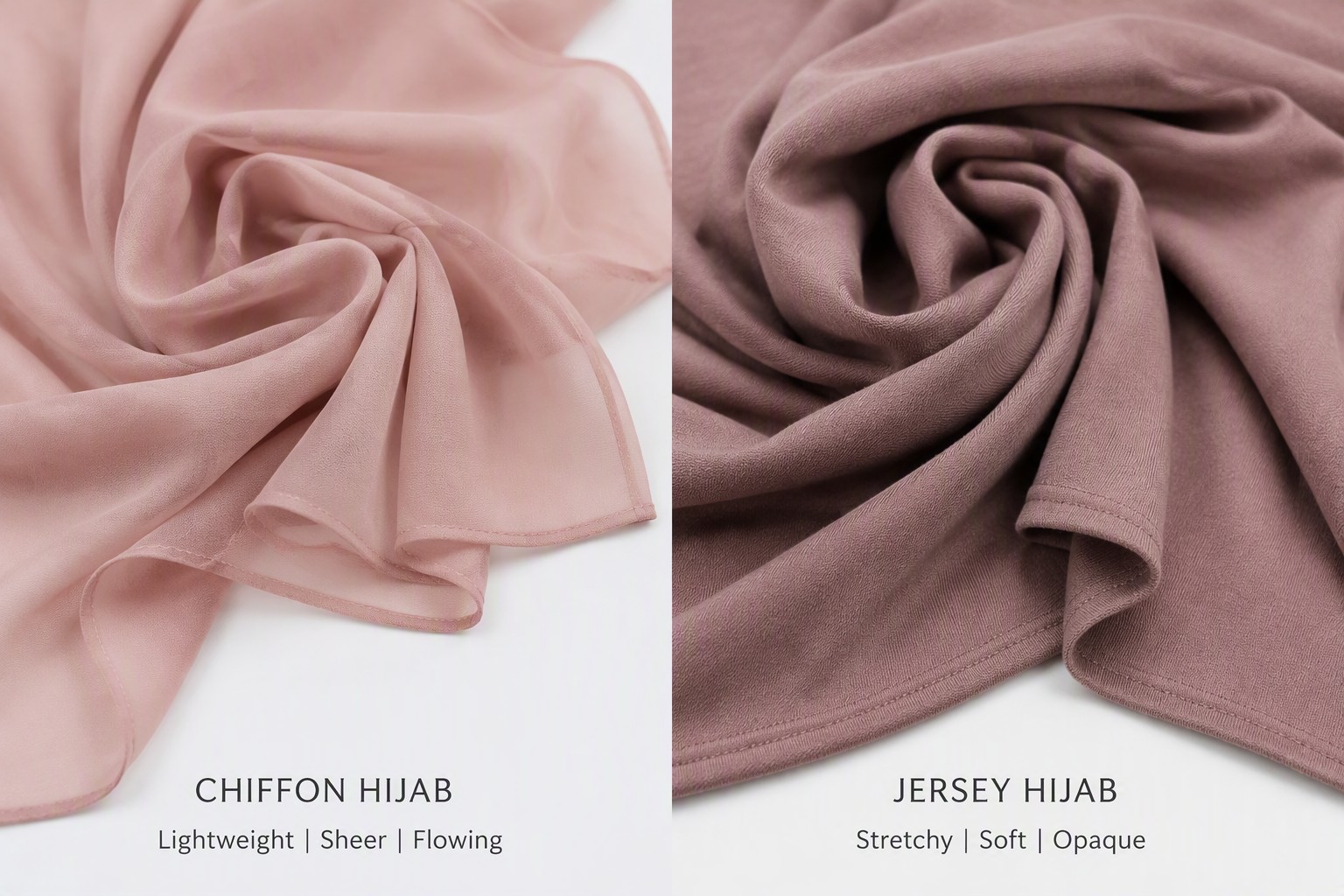
Modal is valued for its soft hand feel, fluid drape, and comfortable contact with the skin. Its surface and absorbency make it attractive for detailed reactive prints, but the same softness means that uncontrolled feed tension can distort the artwork or stretch the cut edge. A production team must stabilize the fabric before printing, manage the web through the machine, and allow the finishing process to restore the intended handle.
Jersey behaves differently because its knitted loop structure has natural stretch and recovery. The print process must account for the fabric's movement, while cutting and hemming must avoid creating a permanently wavy edge. A jersey hijab that looks acceptable on a table can lose its shape if the operator uses unsuitable feed pressure or fails to set the fabric correctly before finishing.
Our technical workflow therefore separates fabric-specific decisions from the shared brand brief. The artwork, dimensions, and label position can be standardized, but the pre-treatment, colour profile, machine tension, fixation, and hemming settings are confirmed for the selected modal or jersey quality. This is how small-batch flexibility can coexist with consistent output.
Short runs also make nesting and changeover discipline important. The technician plans the print sequence to reduce avoidable lead-in waste, checks the first section of the run before continuing, and records the selected settings. These details help a 100-piece order remain a controlled production job rather than an improvised sample-room exercise.
Part 4: Our Factory Capability -- Optimized Equipment for Controlled Short Runs
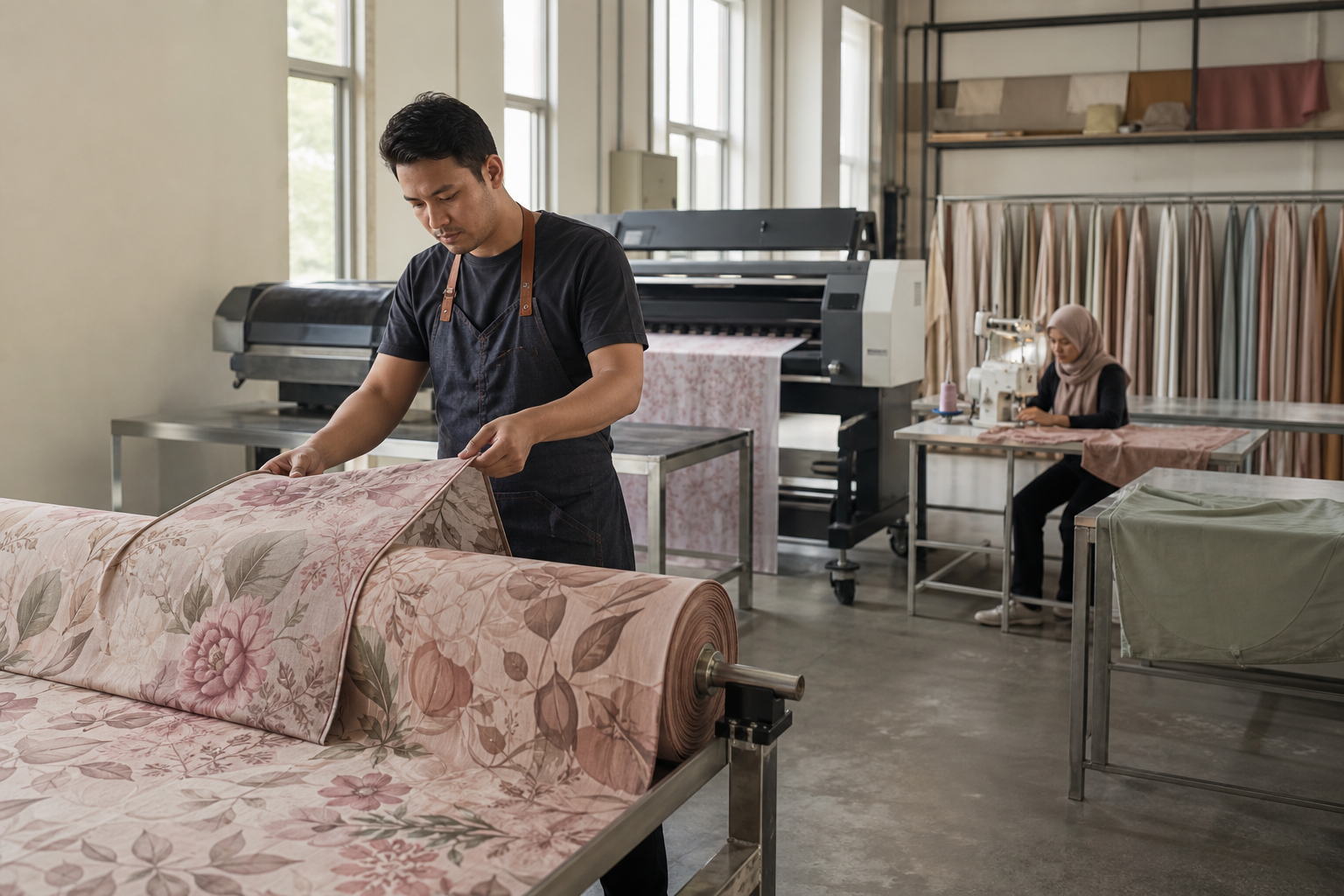
Our equipment strategy is built around the fact that emerging brands need flexibility without giving up print definition. We use digitally controlled textile printing equipment with adjustable feed tension, fabric-specific colour profiles, and repeatable fixation settings. The machines are not treated as automatic substitutes for technical judgment; they are tools that our operators calibrate around the substrate and artwork.
For modal projects, the team checks the prepared fabric surface, print alignment, ink delivery, and fixation response before the full run moves forward. For jersey projects, operators pay closer attention to stretch, recovery, and the way the knitted structure enters and leaves the print path. Our self-optimized equipment settings are designed to reduce banding, edge movement, and unnecessary colour variation during short production windows.
The finishing area is organized to support custom baby hemming and private label details without routing every small order through an unrelated bulk line. Operators can confirm the approved hem width, thread colour, label position, and packaging instruction from the production brief. This matters because a brand's perceived quality is often judged at the edge, the label, and the unboxing moment rather than by the print alone.
OEM and ODM projects also benefit from this equipment approach. A buyer may bring original artwork, a reference sample, a fabric requirement, or a packaging concept. Our team can translate those inputs into a documented production route, identify where the fabric needs a different setting, and flag a risk before the pilot order becomes bulk inventory.
Part 5: Quality Control -- Wash and Rubbing Stability Before Shipment
For a short-run brand launch, a quality failure can be disproportionately damaging. A small first shipment may be the exact stock used for launch photography, influencer seeding, and early customer reviews. Our QC process therefore includes three stages: material checks before production, process checks during printing and finishing, and outgoing checks before packing. This article focuses on the final technical question that buyers often ask: will the colour remain stable after normal use?
Our laboratory evaluates printed samples under ISO 105-C06 washing conditions. The test compares colour change on the printed area and staining on adjacent fabric. Samples are handled with a standardized detergent and controlled temperature so the result is comparable between development and production checks. Dark grounds, strong borders, and high-contrast artwork receive particular attention because visible bleeding can affect both the scarf and neighbouring garments.
We also use ISO 105-X12 rubbing checks for designs where dry or wet friction could transfer colour. This is relevant to deep shades that contact the face, neck, undercap, or light clothing. A result is not treated as a substitute for the customer's care label or market-specific testing requirement, but it gives the production team a repeatable way to identify unstable colour before shipment.
The approved test result is connected to the production record, including the fabric quality, colour reference, sample date, and corrective action if a result needs investigation. When a repeat order is planned, the archived approval becomes a comparison point. This document trail supports the strict QC three-stage process and gives B2B buyers a clearer basis for approving the next run.
Part 6: Brand Development Advice -- Use the First Order as a Learning Programme
A low MOQ works best when the brand treats the first order as a structured learning programme rather than simply a cheaper bulk order. Start with one primary fabric, one recognizable print language, and a limited set of colourways. Keeping the variables controlled makes customer feedback more useful and makes it easier to identify whether a result came from the design, the fabric, or the campaign.
Before approval, prepare a concise design brief. Include the intended fabric, finished dimensions, artwork files, colour references, hem preference, label placement, packaging direction, and target launch date. A clear brief helps the factory identify technical gaps early and gives the brand a record against which the physical sample can be reviewed.
After the pilot launch, compare sell-through by colourway, customer comments about drape and opacity, return reasons, and content performance. Use those observations to decide which styles should be repeated, adjusted, or retired. The purpose of small-batch production is not to guess perfectly; it is to create a lower-risk feedback loop that improves the next manufacturing decision.
When a design proves demand, scale it through a controlled reorder. Keep the approved sample, colour reference, fabric quality, and finishing specification unchanged unless the brand intentionally requests a revision. This protects the identity of the product while allowing the quantity to grow. Our production experience allows brands to move from pilot quantities to larger OEM or private label programmes without abandoning the documentation built during development.
Conclusion: A Practical Factory Route for Emerging Modest Fashion Brands
Small MOQ manufacturing is valuable when it is supported by real textile knowledge, not when it is used as a reason to lower standards. Modal and jersey require different handling, custom printing requires colour discipline, and every finished hijab still needs a meaningful QC process. A factory that combines optimized equipment, experienced operators, fabric-specific settings, and wash testing gives emerging brands a more dependable starting point.
If you are planning a capsule collection or reviewing a supplier for OEM, ODM, or private label hijabs, send us your design brief with the artwork, fabric preference, colour references, and target quantity. Our technical team can review the brief, identify production considerations, and outline a practical sample-to-pilot route before you commit to a larger collection.
Frequently Asked Questions
What MOQ can a small MOQ hijab manufacturer support?+
Our structured pilot programme starts at 100 pieces per colourway or print design, subject to fabric and finishing requirements. This lets brands test a focused capsule before committing to larger replenishment quantities.
Is small-batch production suitable for custom printed modal hijabs?+
Yes. Digital reactive printing is well suited to short custom runs because it avoids the screen setup required by traditional rotary printing. Modal still needs careful pre-treatment, tension control, fixation, and washing to protect softness and colour depth.
How long does a pilot production order usually take?+
A physical strike-off or development sample normally takes 5 to 7 working days after artwork and fabric approval. An approved pilot order of 100 to 500 pieces generally requires about 12 to 15 working days before freight, depending on print complexity and packaging.
How do you keep colour stable between a sample and a repeat order?+
We archive the approved physical sample, colour references, print profile, fabric lot, and fixation settings. Before a repeat run, technicians compare a new strike-off with the archived standard under controlled lighting and investigate any visible deviation before bulk production proceeds.
Can small brands order modal and jersey hijabs from the same factory?+
Yes. Our team works with both modal and jersey qualities, but each substrate receives its own print, tension, finishing, and handling settings. Treating the two fabrics as identical is a common cause of inconsistent drape and colour results.
What wash testing is used for printed hijabs?+
Production samples are evaluated under ISO 105-C06 washing conditions for colour change and staining. We also use ISO 105-X12 rubbing checks when a design has dark or high-contrast areas. The approved result is recorded with the production documentation before shipment.
Need a quote for your next order?
Free samples available. MOQ from 100 pieces. Ships to 50+ countries.
Request a Quote