Quick Summary
A small MOQ hijab manufacturer allows growing brands to validate designs at 200-piece run sizes before committing to volume inventory, building colour standard records and construction specifications that support consistent reorders as the brand scales. The economic structure of small MOQ production reflects fixed setup costs amortised across fewer units, not higher margins -- brands that understand this use multiple small validation runs to build a commercially proven product range efficiently. Our production process handles small MOQ custom printed hijab orders from fabric incoming inspection through inline colour verification, outgoing QC, and full batch documentation, with a first-order lead time of 25 to 35 days and a reorder lead time of 18 to 25 days. Brands that establish their supplier relationship during the small MOQ validation stage arrive at the scaling stage with a documented product range and a proven supply chain, which reduces quality risk and lead time at volume.
Introduction: What a Small MOQ Hijab Manufacturer Actually Offers a Growing Brand
Small MOQ hijab manufacturing is not a niche service. It is the supply chain model that most growing hijab brands need at the stage when they are building their product range and testing which styles and designs perform with their audience. The alternative -- committing to large minimum orders before the brand has validated its product -- creates inventory risk that can damage a brand financially before it has reached the scale where volume purchasing makes sense.
This brand guide explains what a small MOQ hijab manufacturer can realistically offer, what the production constraints are at small run sizes, and how brands can use small MOQ production strategically to build a product range that is commercially validated before it scales. We also explain how our production process handles small MOQ orders from the first inquiry through to final delivery.
Part 1: Buyer Problem -- Why Small MOQ Sourcing Is Harder Than It Looks
Brands searching for a small MOQ hijab manufacturer quickly discover that the market is fragmented. Large factories with established production systems typically require minimum orders of 500 to 1,000 pieces per design, which is too high for a brand validating a new design. Small factories or home-based producers can accommodate very small runs, but they often lack the production consistency and documentation practices that a brand needs when it is ready to scale. The brand ends up choosing between volume risk with a large factory or quality inconsistency with a small producer.
A second problem is the relationship between price and run size. Per-unit cost at 200 pieces is higher than per-unit cost at 1,000 pieces because setup costs -- print colour development, first-article checks, cutting templates -- are amortised across fewer units. Brands that do not understand this relationship often interpret the higher per-unit price as a factory margin issue rather than a structural cost reality, which leads to unproductive sourcing conversations with factories that cannot reduce their setup cost allocation.
A third problem is documentation. Small MOQ production is only valuable to a brand if the production records from the small run can support a consistent reorder when the brand scales. A factory that produces 200 pieces with no colour standard documentation, no construction specification, and no QC records cannot support a predictable reorder. The brand is essentially starting the development process again with each order, which eliminates the efficiency advantage that a validated product should provide.
Part 2: Industry Trend -- Small MOQ Is the Growth Stage, Not the Permanent State
The modest fashion market has produced a consistent pattern over the past five years: brands that launch with small validated runs and scale their best-performing designs grow more sustainably than brands that launch with large stock commitments. The small MOQ stage is not a permanent operating model -- it is the validation phase that precedes scaling. A brand that manages the small MOQ stage well arrives at the scaling stage with a clear picture of which designs have commercial traction, which fabric and colour combinations their audience prefers, and which supplier can maintain quality at higher volumes.
The factories that have invested in small MOQ capability -- flatbed digital print systems that do not require minimum print run lengths, cutting rooms that can handle multiple SKUs efficiently, and QC processes that are calibrated for small sample sizes -- are positioned to serve this market across the full growth curve from initial validation through to scale. The brand that builds its supplier relationship during the small MOQ stage has a significant advantage when it moves to higher volumes, because the supplier already holds the colour standard records, construction specifications, and QC benchmarks for all validated designs.
Part 3: Technical Knowledge -- What Makes Small MOQ Hijab Production Economically Viable
The economic viability of small MOQ production depends on two factors: setup cost management and production efficiency at small run sizes. Setup costs for a custom printed hijab include print colour development, first-article confirmation, and cutting template preparation. These costs are fixed regardless of the run size -- a 200-piece order and a 1,000-piece order both require the same setup work. At 200 pieces, the setup cost per unit is five times higher than at 1,000 pieces, which is the structural reason why small MOQ pricing is higher per unit.
Factories that manage small MOQ production efficiently do so by batching setup work across multiple brands where possible, by maintaining a library of colour standards for active brand accounts that eliminates the colour development stage on reorders, and by using production scheduling that minimises the changeover time between different brand accounts running through the same production equipment. These efficiency measures reduce the setup cost burden without compromising the production quality standards that each brand account requires.
Our minimum order quantity of 200 pieces per design reflects the point at which we can offer competitive per-unit pricing while covering the full cost of setup, production, QC, and documentation. For brands ordering multiple designs in a single production run, the setup costs for each design are shared across the total order value, which improves the per-unit economics on each individual design without requiring the brand to commit to larger quantities on any single style.
Part 4: Our Factory Capability -- The Complete Production Chain From Inquiry to Delivery
Our production process for small MOQ orders follows the same chain as our volume orders, from fabric incoming inspection through to final packing. The steps are: fabric sourcing and incoming inspection, print colour development and first-article approval, bulk production, inline QC checks, outgoing inspection, and packing for shipment. Each step is documented and the documentation is retained in the brand account record.
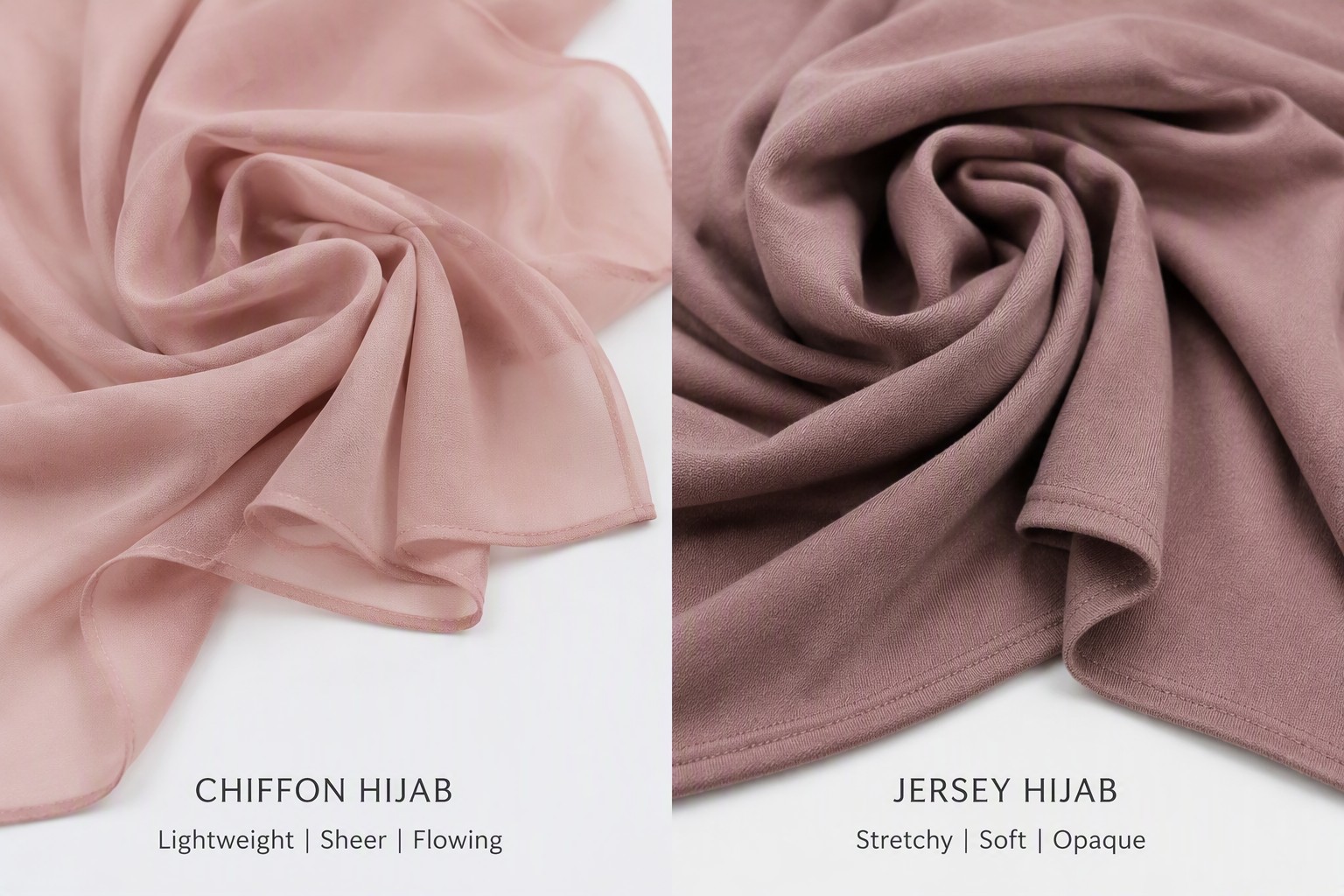
Fabric sourcing: for custom printed hijabs, we source modal and jersey fabric from our established supplier network. For each new design or reorder, we inspect the incoming fabric batch for GSM, colour consistency, and surface quality before releasing it to print production. This inspection ensures that production variations caused by fabric batch differences are caught before they enter the production run.
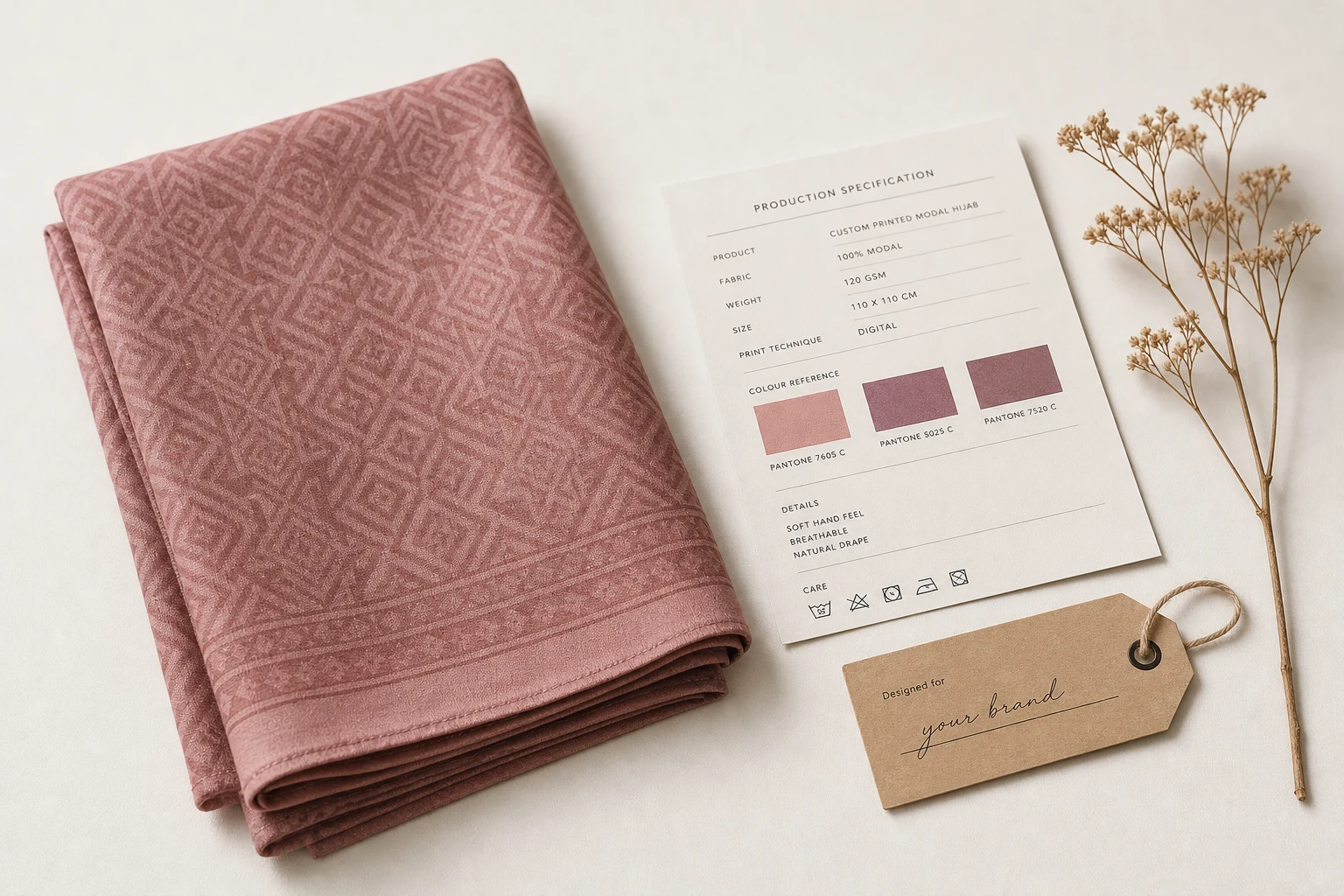
Print colour development: for a new design, we produce a print strike-off on the actual production fabric, measure the delta-E against the brand colour reference, and send a physical strike-off to the brand for approval before proceeding to bulk production. For reorders, we produce a reorder strike-off and compare it against the colour standard record from the approved first order. If the reorder strike-off is within the accepted delta-E tolerance, we proceed to bulk production without requiring a new brand approval cycle, which reduces the reorder lead time to 18 to 25 calendar days.
Inline QC and outgoing inspection: our production team performs inline checks at the cutting stage (dimension verification against the approved construction specification) and at the sewing stage (seam quality, hem finish, and label placement). Our outgoing inspection checks a sample of the completed order against the AQL standard appropriate for the order size and documents the results in the batch quality record.
Part 5: Quality Control -- Inline Colour Verification During Production
For small MOQ orders, inline colour verification is the QC checkpoint that most directly protects brand quality. A 200-piece print run that drifts in colour between the first 50 pieces and the last 50 pieces -- a common failure mode in reactive printing on stretch fabrics -- delivers a batch that looks inconsistent in photography and creates customer perception of quality variation even when the individual pieces are within acceptable tolerances.
Our inline colour verification process checks printed fabric against the approved strike-off at regular intervals during the print run. For modal fabric, we check colour consistency at 50-metre intervals using a D65 standard illuminant lightbox and a handheld spectrophotometer. The delta-E measurement is recorded in the production log for each run. If a measurement exceeds our accepted tolerance of delta-E 2.0, we pause the print run, adjust the ink delivery parameters, and verify the correction before resuming production.
For jersey fabric, the inline colour check interval is 30 metres because jersey stretch behaviour creates more variability in ink absorption across a print run than modal. The tighter check interval reflects the higher inherent variability of the substrate rather than a lower production capability -- the goal is to catch drift earlier and correct it with a smaller adjustment, which produces a more consistent final batch than a wider check interval that catches larger drift requiring a larger correction.
The inline colour verification records are included in the batch quality documentation for each order and are available to brand partners on request. Brands that maintain colour standard records across multiple orders can use the delta-E measurement history to track fabric batch variation over time and make informed decisions about when to request a new colour development round.
Part 6: Brand Development Advice -- Use Small MOQ Production to Build a Validated Product Range
The most effective use of small MOQ production is systematic design validation. Rather than launching one design and waiting for sales data before developing the next, brands can use small MOQ production to run three to five designs simultaneously at 200 pieces each, collect sales and engagement data across all designs in a single season, and use the data to determine which designs to scale in the following season.
This approach requires a supplier that can handle multiple designs in a single production order efficiently. Our production scheduling allows multiple brand account designs to run through our print and sewing capacity in overlapping production windows, which means a brand ordering four designs at 200 pieces each can expect a similar total lead time to a brand ordering one design at 200 pieces, rather than four times the lead time.
The documentation advantage of systematic small MOQ validation is significant. After validating three to five designs across one or two seasons, the brand has colour standard records, construction specifications, and QC benchmarks for all designs on file with us. When one of those designs scales to 500 or 1,000 pieces, the first large-volume order benefits from the same documentation infrastructure that the small MOQ orders established, which reduces the quality risk at the scaling stage.
Brands that arrive at scale with this documentation infrastructure in place are better positioned to manage their supplier relationship because both sides have a shared reference point for what the product should look like. Disputes about colour variation or construction differences are resolved against documented standards rather than recalled expectations, which reduces both the frequency and the cost of quality disagreements.
Conclusion: Small MOQ Is the Foundation of a Scalable Brand, Not a Compromise
Small MOQ hijab manufacturing is not a fallback for brands that cannot afford volume orders. It is the production model that allows brands to build a validated, documented product range before committing to the capital risk of volume inventory. The brands that use small MOQ production strategically -- validating designs, building colour standard records, and establishing the supplier relationship before scaling -- are better positioned at scale than brands that skip the validation stage.
If you are at the stage where you need a supplier who can support your brand from first validation through to scaling, we welcome an inquiry. Share your brand direction, your design concepts, and your timeline with us, and we will walk you through the complete production process from inquiry to delivery -- covering fabric options, pricing at your run size, lead times, and the documentation we provide with each order. That conversation is the starting point for a production partnership that can grow with your brand.
Frequently Asked Questions
What is your minimum order quantity for a new custom printed hijab design?+
Our standard minimum order quantity for a new custom printed hijab design is 200 pieces. This applies to both modal and jersey fabrics. For plain colour or single-colourway styles without a custom print, we can accommodate runs from 150 pieces. The 200-piece minimum for printed designs reflects the point at which we can offer competitive per-unit pricing while covering the full production cycle including print colour development, first-article confirmation, bulk production, QC, and documentation.
Why is per-unit pricing higher for small MOQ orders?+
Per-unit pricing at small run sizes is higher because setup costs -- print colour development, first-article checks, cutting template preparation -- are fixed regardless of the run size. These setup costs are amortised across fewer units at 200 pieces than at 1,000 pieces, which increases the per-unit cost proportionally. This is a structural cost reality in custom garment manufacturing, not a margin decision. Brands ordering multiple designs in a single production run benefit from shared scheduling efficiency that partially offsets the per-design setup cost allocation.
What documentation do you provide with a small MOQ order?+
We provide a batch quality record for each order that includes the colour standard record (delta-E measurement against the approved strike-off), the construction specification used for production, the inline QC measurement log, and the outgoing inspection result. For orders that include wash-fastness testing, the test result is included in the batch quality record. All documentation is retained in the brand account file and is available for reorder reference, which eliminates the colour development stage on reorders and reduces the reorder lead time to 18 to 25 calendar days.
Can you handle multiple designs in a single production order?+
Yes. Our production scheduling allows multiple brand account designs to run through our print and sewing capacity in overlapping production windows. A brand ordering four designs at 200 pieces each can expect a total lead time that is similar to a single design order, rather than four times the lead time, because the designs are scheduled to run in parallel where production capacity allows. Each design carries its own minimum order quantity and its own setup process, but the scheduling efficiency reduces the total calendar time for a multi-design order.
How do you ensure colour consistency between a small MOQ first order and a later volume reorder?+
Colour consistency between a first order and a reorder is managed through the colour standard record created during the first order. This record captures the reactive ink formulation, fixation parameters, and delta-E measurement against the approved colour reference for the specific fabric batch used. For reorders, we produce a reorder strike-off on the reorder fabric batch, measure it against the colour standard record, and only proceed to bulk production when the measurement is within our accepted delta-E tolerance of 2.0. The brand does not need to re-approve the colour if the reorder strike-off is within tolerance, which reduces the reorder lead time significantly.
What is the lead time for a first order versus a reorder?+
Our standard lead time for a first order with a new design is 25 to 35 calendar days from approved artwork and confirmed deposit to ex-factory. This covers fabric incoming inspection, print colour development (typically two rounds of strike-off approval), bulk production, QC, and packing. For reorders of previously approved designs, the lead time is typically 18 to 25 calendar days because the colour standard record already exists and the approval stage is reduced to a reorder strike-off check rather than a full development process.
Need a quote for your next order?
Free samples available. MOQ from 100 pieces. Ships to 50+ countries.
Request a Quote