Quick Summary
Most private label hijab brands place their first OEM order without visiting the factory in person. Remote verification -- combining document review, video factory tours, and a structured test order -- can give brands reliable evidence of a manufacturer's capability before a full commitment. Key data to request includes incoming fabric inspection records (GSM consistency, colour ΔE, defect rate), production scheduling transparency, and a sample package with the full quality documentation trail. Our team supports remote verification with structured video tours of our printing, steaming, and QC stations, and we provide a complete documentation package with every sample order.
The Remote Verification Problem in Private Label Hijab Manufacturing
Most independent hijab brands placing their first OEM order are working across a significant distance. The factory is in Yiwu or another Chinese textile hub. The brand is in London, Toronto, Amsterdam, or Dubai. A site visit before the first order is possible but expensive and logistically complex for a brand that is still validating whether the private label model is right for them. Most brands skip the visit and rely on samples, which tells them what the factory can produce under controlled sample conditions but very little about what they will receive in bulk.
This information gap is one of the main reasons first OEM orders disappoint. Not because the factory is dishonest -- most are not -- but because the brand had no way to understand the factory's actual production system before committing to it. A factory that produces excellent samples through manual attention to each piece may not be able to maintain that standard across a 500-piece run. A factory with strong production systems but imperfect sample presentation may be a far more reliable partner. Without the right evidence, brands cannot tell the difference.
The solution is a structured remote verification process: a combination of document review, a video factory tour with specific checkpoints, and a test order treated as a quality evidence exercise rather than just a product procurement. This guide covers each of these steps and what they should reveal about a private label hijab manufacturer.
Part 1: The Buyer Problem -- Samples That Mislead and Bulk That Disappoints
The pattern is familiar to brands that have been through a difficult first OEM order. The sample arrives and it is good. The colour matches the brief, the drape is right, the hem is clean. The order is placed. The bulk arrives and something is different. The colour is slightly off -- not dramatically, but noticeably. Some units have a hem that is slightly wider or narrower than the sample. A few units have a minor print registration issue that would not matter on a scarf but is visible on a hijab where the wearer looks at the hem alignment.
What happened is that the sample was produced by one or two experienced people paying close attention. The bulk was produced by a production line running at normal speed under normal conditions. The gap between those two production modes reveals whether the factory has documented systems that transfer sample quality to bulk, or whether sample quality depends on individual attention that is not systematically applied to production.
The brands that avoid this experience are the ones that verify production systems before ordering, not just sample quality. They ask to see the factory's incoming fabric inspection records, not just the samples. They request a previous order's strike-off and inspection documentation, not just a price list. They treat the test order as a quality evaluation exercise and document exactly what they find -- so they have evidence to reference if issues arise on the full commercial order.
Part 2: Industry Trend -- Remote Sourcing Has Become the Standard for Independent Modest Fashion Brands
The independent modest fashion brand ecosystem has developed around remote sourcing from China, Turkey, and other manufacturing hubs. The brands building sustainable businesses in this space are not the ones flying to Asia for every supplier evaluation -- they are the ones who have developed effective remote verification processes that give them confidence in a supplier's capability without requiring physical presence.
Video communication tools have made remote factory verification significantly more practical than it was five years ago. A structured video tour that shows specific production areas in operation now provides more useful evidence than a written factory audit from a third-party inspector who spent two hours on site. The brand can ask follow-up questions in real time, request to see specific areas or processes, and watch how factory staff respond to technical questions -- all of which reveal more about the operation's actual quality than a static audit checklist.
The brands that use remote verification most effectively treat it as an ongoing relationship practice, not just a pre-order exercise. They schedule periodic video check-ins with their manufacturing partner during production, request documentation updates at key production milestones, and treat transparency as a core selection criterion when evaluating new suppliers. A factory that is comfortable with frequent remote contact during production is demonstrating operational confidence, not just sales enthusiasm.
Part 3: Technical Knowledge -- What Incoming Inspection Records Reveal About a Factory
The most revealing production documents a private label hijab manufacturer can share are their incoming fabric inspection records. These records show what the factory checks when fabric arrives and whether those checks are systematic enough to catch the fabric lot variations that cause bulk quality inconsistency.
The key metrics in a useful incoming inspection record are: GSM measurements taken at multiple points across the fabric roll (ideally five to seven measurement points), recording whether the fabric is within ±5% of the nominal specification; colour lot consistency, showing the ΔE measurement between rolls from the same dye lot (important for multi-roll orders where lot-to-lot variation can cause visible colour differences across the order); and defect rate, recording the number of visible surface defects per linear metre and whether any defects exceed the threshold that would cause the roll to be rejected or quarantined.
A factory that does not have incoming inspection records does not have this information. They are starting production with an unknown fabric input, which means any quality variation in the fabric goes directly into the finished product. A factory with systematic incoming inspection can identify problematic fabric lots before they affect production and make the calibration adjustments needed to maintain output quality despite input variation. This is the difference between a factory that manages quality and one that hopes for it.
Part 4: Factory Capability -- What a Video Tour Should Show You
Our team offers video tours of our production facility as a standard part of the new brand evaluation process. We have structured these tours around the areas that provide the most useful evidence of production capability, rather than the areas that look most impressive on camera.
The tour starts at our fabric storage and incoming inspection area. We show how rolls are labelled by lot number and inspection status, how the GSM measurement equipment is used, and how the inspection records are filed. We show the light box used for colour lot comparison and explain what ΔE thresholds we apply before accepting or rejecting a fabric delivery. This part of the tour takes about ten minutes but gives brands more confidence in our quality system than any amount of finished sample presentation.
We then move to the printing line and show the roll-to-roll feed system running on an active production order. We show the tension control monitors and explain how the operators read and adjust them for different fabric weights. We explain our ink formulation documentation -- how each colourway is recorded and stored for consistency across repeat orders. We show the steaming line and explain the calibration approach for different design types.
The final section of the tour covers our QC inspection station: the D65 light box, the spectrophotometer, the measurement tools, and the inspection table where finished units are assessed before packing. We show a completed inspection report and explain how to read it. Brands that have seen this tour before placing an order consistently report that the test order results match their expectations more closely than orders placed without a structured verification process.
Part 5: Quality Control -- Incoming Fabric Inspection as the Foundation of Output Quality
Our incoming fabric inspection process covers three measurement categories for every fabric delivery. GSM measurement is taken at seven points across each roll: two edges, two quarter-width positions, and three centre positions. A roll where any measurement falls more than 5% outside the nominal specification is quarantined for review before committing to a production order. In practice, rolls with GSM variance above 3% are flagged for discussion with the brand, since the variance can affect drape and hand feel even if the colour result is correct.
Colour lot consistency is checked by measuring the ΔE between rolls from the same dye lot designation. For orders that use more than one roll of fabric in the same colourway, lot-to-lot colour consistency is more important than the absolute colour of any individual roll. Our threshold for lot mixing is ΔE ≤ 1.0 between rolls. Lots with higher variation are kept separate and flagged -- we will use them for single-colourway orders where the entire order comes from one lot, but we will not mix them with other lots in a multi-roll order.
Surface defect inspection covers visual defects including weave irregularities, snags, holes, and contamination at a rate of 100% inspection for the first two metres of each roll and then systematic spot-checking through the roll. Rolls with a defect rate above 2 defects per linear metre are returned to the supplier or quarantined for cutting around the defect zones. This inspection step adds time to incoming fabric processing but eliminates the risk of defective fabric reaching the printing stage, where defects become embedded in the finished product.
Part 6: Brand Development Advice -- How to Use a Test Order as a Quality Evidence Exercise
The most effective way to use a test order is to treat it as a structured quality evaluation, not just a product procurement. This means specifying exactly what quality standards you expect before the order starts, requesting the full documentation package (incoming inspection records for the fabric lot, strike-off approval record, first-piece confirmation, and pre-shipment inspection report), and documenting your own assessment of the finished goods when they arrive against each of these documented checkpoints.
The documentation you collect on the test order becomes the quality reference for every subsequent order. If you received 150 pieces and found two units with a hem width outside the specification, you have a documented baseline: 98.7% hem conformance on test order. On the next order, you can request the inspection report's hem measurement results and compare. If they decline, that is informative. If they match or improve, you have confidence data.
For brands considering a private label hijab programme, starting with a small test order of 100 to 150 pieces is the most evidence-efficient path to a confident full-scale commitment. The test order costs a fraction of a commercial order, generates the quality data you need to evaluate the manufacturing partner, and produces finished goods that can be used for photography, pre-launch marketing, and early customer feedback. If the test order results support it, scaling to a full commercial order is a data-backed decision rather than a leap of faith. Our team is set up to support this approach: we handle test orders with the same process documentation as full commercial orders, which is the clearest evidence we can offer of how our quality system operates.
Frequently Asked Questions
What documents should I request before placing a first private label hijab order?+
The most informative pre-order documents are: incoming fabric inspection records from recent production batches (showing GSM measurements, colour lot consistency, and defect rates), a sample of the strike-off approval record from a previous order (showing how colour matching is handled before bulk), and a pre-shipment inspection report from a completed order (showing the AQL sampling result and dimensional checks). These documents reveal whether the factory has systematic quality processes or is producing to a variable standard.
Can I verify a private label hijab manufacturer remotely without visiting China?+
Yes, and most brands do exactly this for their first order. A structured video tour that covers the printing station, steaming line, and QC inspection area -- with the camera showing the actual equipment in operation rather than an empty showroom -- provides more useful evidence than a static factory brochure. Asking to see a production run in progress, even briefly, shows you how the facility operates under normal conditions rather than prepared-for-visit conditions.
What should a video factory tour cover for a hijab printing facility?+
The tour should cover at minimum: the fabric storage area (showing how rolls are organised by lot and how incoming inspection records are maintained), the pre-treatment station (showing the equipment and, if possible, a technician explaining the calibration process), the printing line (showing the roll-to-roll feed mechanism and the tension control setup), the steaming or curing area (showing the equipment used for dye fixation), and the QC inspection table (showing the light box setup and measurement equipment). A factory that is reluctant to show any of these areas during a video tour is worth treating with caution.
How does a test order help me evaluate a private label hijab manufacturer?+
A test order of 100 to 200 pieces gives you evidence that the factory can deliver what the sample promised at a production run scale. The key quality indicators to check on a test order are: colour consistency across all units in the run (not just the units pulled for inspection), dimensional consistency across the size specification, hem quality across the full quantity, and whether the factory provides the same documentation package (strike-off record, first-piece confirmation, pre-shipment inspection report) that you would expect on a full commercial order. A factory that treats a test order with the same process discipline as a large order is demonstrating its actual operating standard.
What is the typical timeline for a private label hijab test order?+
A test order from a factory with existing fabric stock typically runs 18 to 28 days from order confirmation to finished goods. This includes the pre-treatment setup and strike-off approval (3 to 5 days), the bulk production run (7 to 12 days), and the outgoing inspection and packing (2 to 3 days). If the fabric needs to be sourced specifically for the order or if the design requires a new ink formulation, add 5 to 7 days to the pre-production phase. Factories that cannot give you a specific timeline range for your order size are a scheduling risk.
What private label packaging options are available for a hijab OEM order?+
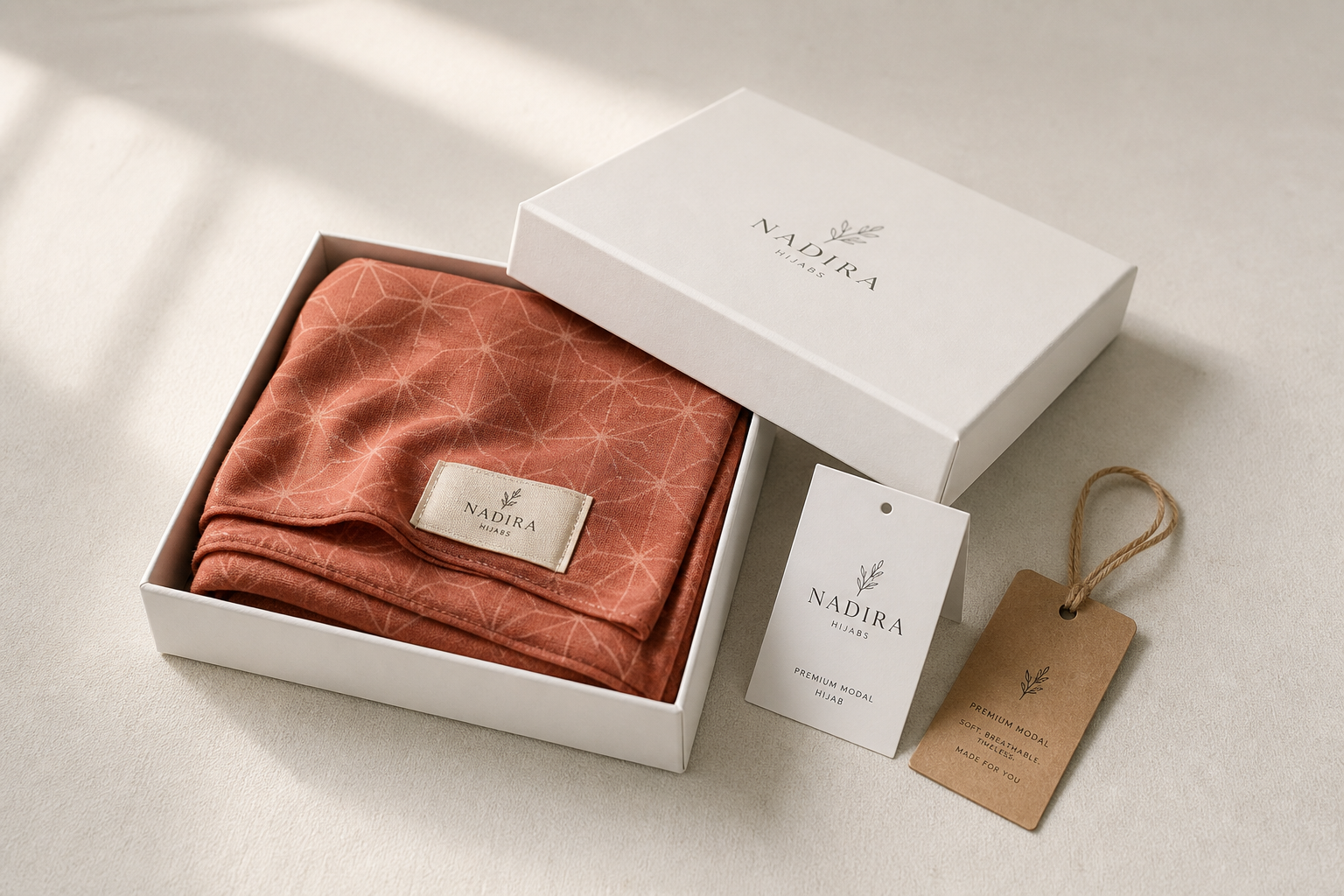
Standard private label packaging options include: woven brand labels sewn into the hem or fold of the hijab, printed hang tags with brand artwork (kraft paper or coated card, with or without custom die-cut), and retail-ready boxes or drawstring pouches in plain or custom-printed versions. For first orders, we recommend starting with woven labels and hang tags -- these are low minimum quantity, relatively fast to produce, and make the most consistent brand impression at the most affordable per-unit cost. Branded boxes and custom pouches are more cost-effective at higher volumes.
Need a quote for your next order?
Free samples available. MOQ from 100 pieces. Ships to 50+ countries.
Request a Quote