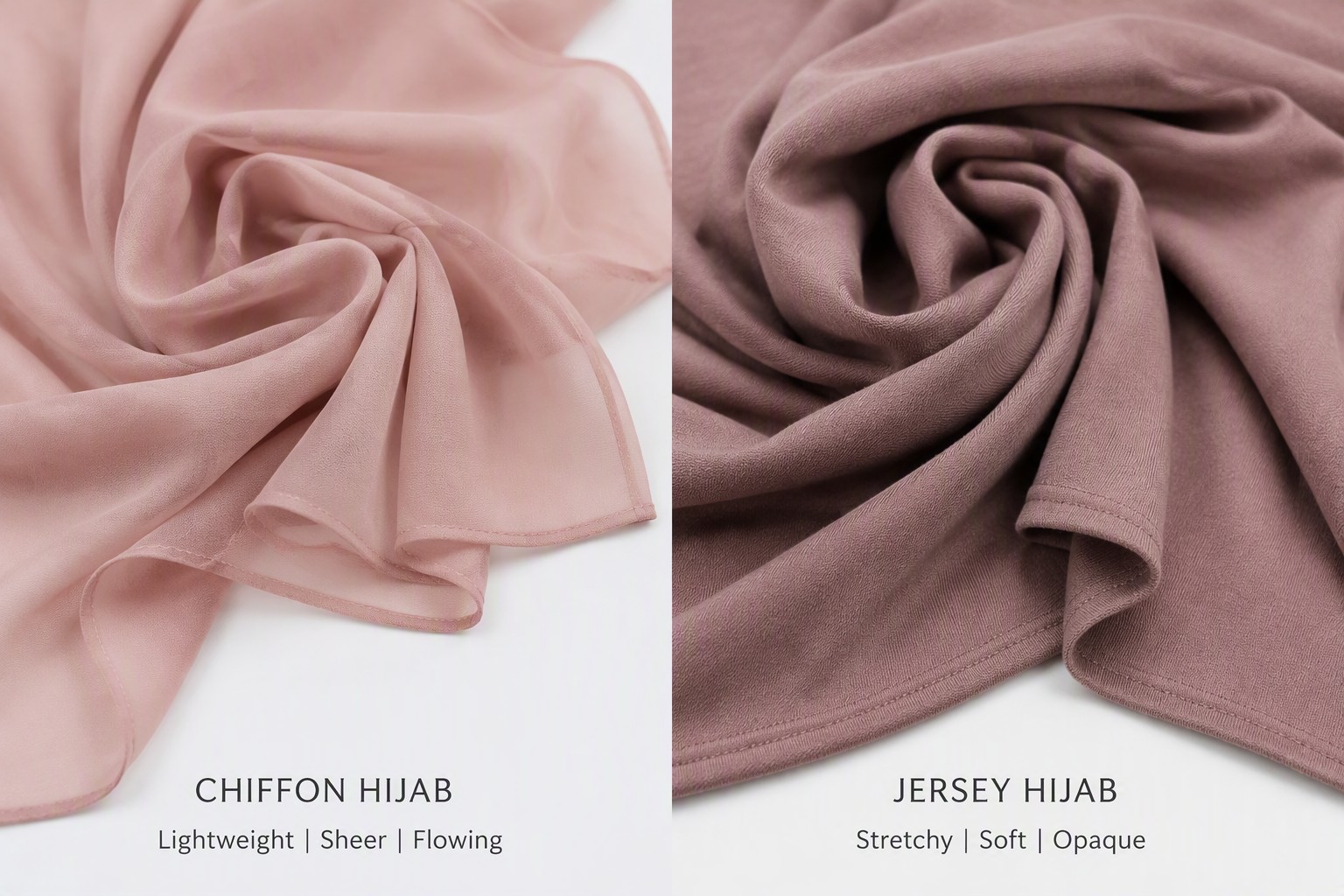
Quick Summary
Private label hijab manufacturing is not simply printing a logo on a stock product -- it is a coordinated production process that begins with fabric specification and ends with documented outgoing inspection. The brands that build the most durable private label collections choose manufacturers whose end-to-end process is built around custom output rather than adapted from a volume wholesale line. This article walks through the complete production chain at a specialist private label hijab factory, from fabric lot receipt to finished goods AQL check, so brand owners understand exactly what they are buying when they place a private label order. Understanding the process is the fastest way to ask better questions, evaluate factory responses accurately, and build a supply relationship that holds quality across seasons.
Introduction: What Private Label Hijab Manufacturing Actually Means
The term private label is used loosely in the hijab industry, covering everything from a stock product with a hang tag attached to a fully specified garment manufactured to the brand's exact requirements. For brand owners building a collection they intend to sell at a premium, hold to consistent quality, and reorder season after season, only the second definition is relevant. This article is about that definition.
Private label hijab manufacturing, done properly, is a coordinated production process with defined stages, documented checkpoints, and a clear handoff between each step. Understanding the process helps brand owners evaluate factories accurately, ask better questions during qualification, and set up the approval workflow in a way that protects quality across every order -- not just the first one.
What follows is a walkthrough of the production process at our factory for a private label modal or jersey hijab order. The steps are described in sequence, with the quality control points that occur at each stage and the decisions that have the biggest impact on finished goods consistency.
Part 1: The Buyer Problem -- Why Private Label Orders Fail Without Process Clarity
The most consistent pattern in private label hijab orders that go wrong is not a factory quality problem at the root -- it is a process visibility problem. The brand owner places an order, approves a sample, and does not engage again until the goods arrive. By that point, any deviation from the approved sample has been replicated across the entire production run, and the remedies available are limited and expensive.
Deviations that accumulate invisibly during production include fabric lot substitution -- a different fabric batch used because the originally specified lot ran short -- print colour drift caused by a dye batch variation that was not caught at the pretreatment stage, and dimensional inconsistency introduced by a sewing setting that was not confirmed against the approved sample before bulk cutting began. Each of these is preventable with the right process; none of them requires exceptional factory quality to avoid.
The brand owners who have the fewest quality disputes with private label factories are the ones who understand the production sequence well enough to know where problems originate and to ask for checkpoints at those stages. This understanding does not require textile expertise -- it requires knowing which questions to ask and at what points in the production timeline to ask them.
Part 2: The Private Label Hijab Market in 2026 -- Where Independent Brands Are Winning
The independent private label hijab brand segment has expanded significantly in the past three years, driven by the combination of accessible social media marketing channels and lower minimum order quantities at specialist manufacturers. Brands that would previously have needed to order 500 or 1,000 units to access custom production can now build a label with 100 to 200 pieces and validate market response before committing to volume.
The brands gaining the most traction in this space in 2026 share a recognisable operational pattern. They have a clearly defined fabric specification that does not change between seasons. They develop two or three new colourways or prints per season rather than attempting a wide catalogue. And they invest in the relationship with one manufacturing partner deeply, building shared knowledge of their production preferences, rather than sourcing from multiple factories simultaneously.
This operating model works because it accumulates compounding advantages over time. The factory holds the brand's colour archives, fabric preferences, and label specifications. Reorders become faster and more accurate with each cycle. The brand's quality consistency builds customer loyalty in a market segment where consistency is genuinely rare -- most consumers in the modest fashion space have had the experience of reordering a favourite hijab and receiving something subtly different.
Part 3: Technical Knowledge -- The Fabric Foundation of a Private Label Hijab
The fabric specification is the most consequential decision in a private label hijab project, because every subsequent production step -- pretreatment chemistry, dye formulation, print settings, sewing parameters, finishing -- is calibrated to the fabric. A specification that is vague at this stage creates compounding uncertainty at every subsequent stage.
For modal hijabs, the relevant specification points are: fibre purity (modal content percentage), fabric weight in GSM, surface finish (brushed or unbrushed), and knit density if the fabric is a jersey knit construction. Modal is available in multiple quality grades; the grade affects hand feel, drape, and print receptivity. A fabric described as "modal" without further specification could land anywhere across a wide quality range.
For custom printed private label hijabs, the print method selection should be part of the technical specification rather than left to the factory's preference. Reactive digital printing on modal or cotton-blend fabrics produces the best combination of colour depth, print resolution, and wash fastness for brand-quality output at low MOQ. Screen printing is more cost-effective at very high volumes but requires a minimum of one screen per colour and adds setup cost that makes it impractical for short runs or designs with more than four colours.
The finishing specification -- hemming style, hem width, any hand-rolled or machine-rolled edge -- is the detail most commonly overlooked in first private label briefs and the detail most visible to end customers. A misspecified hem style produces a garment that looks and feels different from the sample that the purchasing decision was based on, even if fabric and print are correct.
Part 4: Inside the Production Chain -- How a Private Label Hijab Order Moves from Fabric to Finished Goods
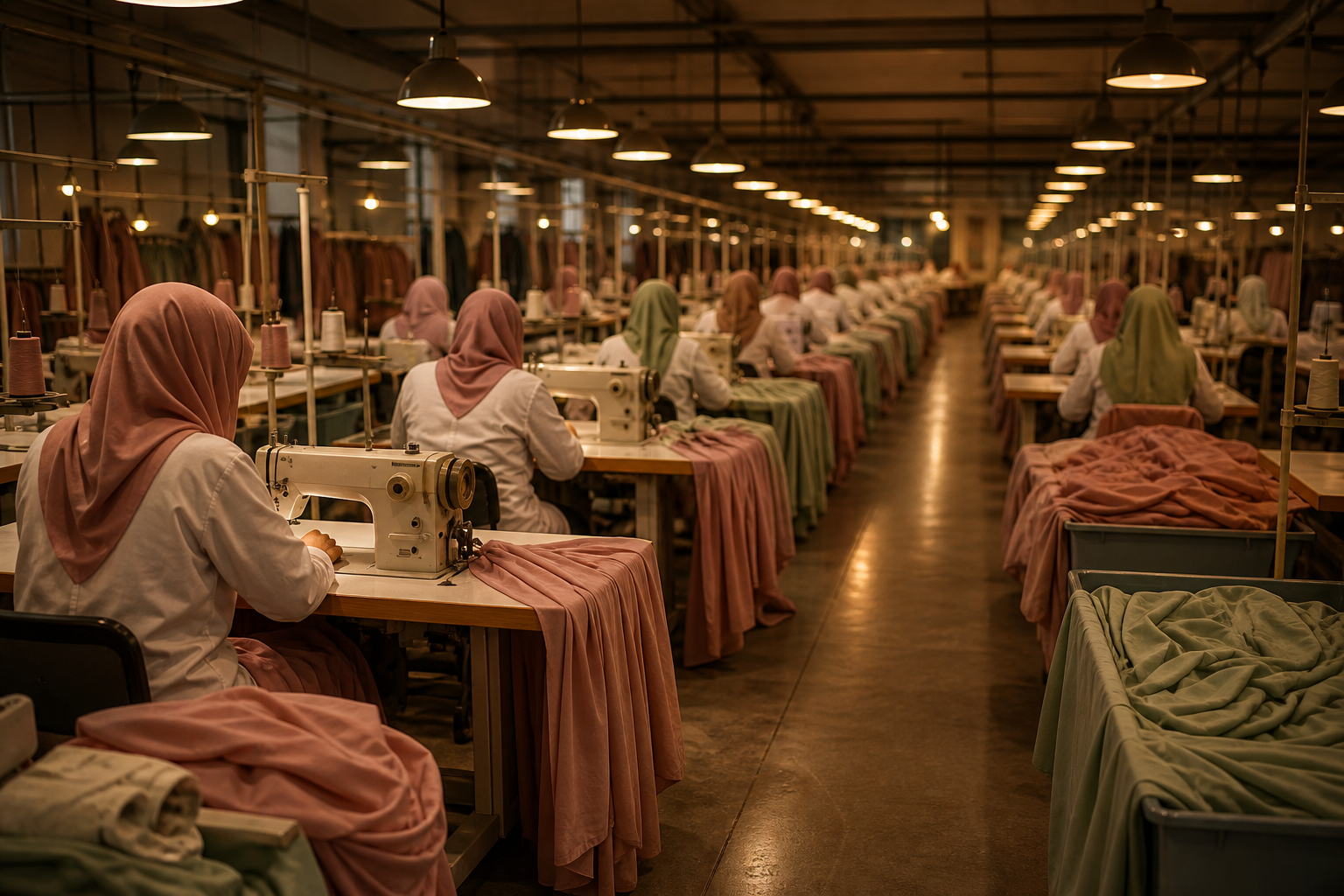
A private label hijab order at our factory follows a defined sequence of stages, each with a documented checkpoint before the order progresses to the next step. Understanding this sequence gives brand owners a framework for knowing where to request updates and what to look for at each stage.
Stage one is fabric procurement and incoming inspection. Once the order is confirmed, fabric is sourced against the approved specification -- fibre composition, GSM, and surface finish. When the fabric lot arrives, our incoming inspection team measures a sample from the lot against the specification: GSM is measured with a calibrated gram scale on a standardised cutting area, fibre composition is verified against the supplier certificate, and the fabric surface is inspected for weaving defects, shade variation across the roll width, and any damage from transport. Lots that do not meet specification are returned before any further processing begins.
Stage two is pretreatment. Modal and cotton-blend fabrics must be scoured to remove surface finishes applied during weaving, then treated with an alkali solution that opens the fibre structure for reactive dye bonding. The concentration and temperature of the pretreatment bath are calibrated to the specific fabric weight and fibre composition of the approved lot. Our team has built pretreatment protocols for the modal and jersey grades we work with most frequently, which means the parameters are established from experience rather than derived each time from general guidelines.
Stage three is printing and fixation. Digital print files are colour-managed against the approved reference before the print run begins, and a strike-off -- a test print on the production fabric -- is produced and reviewed before the full print run proceeds. After printing, the fabric enters a fixation wash that bonds the reactive dye to the fibre and removes unfixed colour. The wash programme is calibrated to the dye load of the specific design and the fabric weight, with water temperature and cycle duration adjusted accordingly.
Stage four is cutting, sewing, and finishing. Printed fabric panels are cut to the approved template dimensions, sewn with the specified hem style, and finished to the agreed edge specification. Our production experience allows brands to specify unusual hem styles -- hand-rolled edges, narrow machine-rolled hems, or contrast-thread finishes -- with confidence that the specification will be held consistently across the production run rather than interpreted differently by individual operators.
Part 5: Quality Control -- Outgoing AQL Inspection Before Every Shipment
The final quality gate in our private label production process is a documented AQL outgoing inspection conducted on the finished goods before packing and shipment. AQL 2.5 is the standard applied for private label orders -- a statistically determined sample is drawn from the production lot and each piece in the sample is inspected against a defined checklist.
The outgoing inspection checklist covers: finished dimensions measured against the approved template (length, width, and diagonal measurements to confirm squareness); print registration checked against the approved strike-off (placement tolerance within plus or minus 5mm from the agreed position); colour assessed under D65 standardised lighting against the approved physical reference; seam quality across all hem lines; label placement and attachment conformity; and packaging to the agreed polybag or tissue wrap specification.
Dimensional tolerances for our private label hijab orders are specified at the order confirmation stage: plus or minus 1cm on length and width for standard sizes, tighter on request for brands with precise size-graded specifications. Any piece outside tolerance is pulled from the lot before packing. If the number of defects in the AQL sample exceeds the acceptance threshold, the full lot is 100 percent inspected before shipment.
The AQL inspection report is generated for every private label order and provided to the client as part of the shipment documentation. The report records the sample size drawn, the defects found by category, the pass or fail determination, and the actions taken on any rejected pieces. For clients building a quality history with our factory, these reports form a running record of production consistency that is available for their own quality management documentation.
Part 6: Brand Development -- Using the Production Process as a Competitive Advantage
The brands that communicate most effectively about their private label hijabs are the ones who understand enough about the production process to explain why their product is different. Fabric sourcing decisions, pretreatment protocols, dye chemistry, and finishing specifications are not just manufacturing details -- they are the factual basis for product claims that hold up to scrutiny from informed buyers.
A brand that can explain why its modal hijab maintains colour better after washing -- because the factory uses reactive dyes with a verified wash fastness grade rather than direct dyes that look vibrant in photography but fade quickly -- is communicating a value proposition that competitors selling stock products cannot match. This kind of content performs well both in social media explanation formats and in the FAQ and product description content that supports SEO and conversion.
The other brand development advantage that comes from understanding the production process is the ability to iterate intelligently. Brands that know their current fabric specification, print settings, and hem style can brief a new season's development with precision rather than starting from scratch. Each season's approved specifications become the baseline for the next, and the collection develops a consistent technical identity that customers experience as reliability.
If you would like to see the production process in person or via a scheduled video walkthrough of our production floor, our team is glad to arrange either. A factory visit -- whether in person at our Yiwu facility or via a structured video call with our production team -- gives brand owners a direct view of the stages described in this article and the opportunity to ask technical questions at the point in the process where they are most relevant. Reach out to arrange a time that works for your schedule.
Frequently Asked Questions
What is the difference between private label and OEM hijab manufacturing?+
Private label manufacturing means the factory produces a product to your brand specifications -- fabric, dimensions, colourway, print -- and attaches your brand label, hang tag, and packaging. OEM (Original Equipment Manufacturer) is often used interchangeably, but in some contexts OEM implies the factory also holds the product tooling or design template. For practical purposes in hijab manufacturing, both terms describe the same production model: you own the brand, the factory produces to your spec. The important variable is how thoroughly your specifications are documented and held across production runs.
What minimum order quantity should I expect from a private label hijab manufacturer?+
Specialist private label hijab manufacturers working with independent and growth-stage brands typically accept first orders from 100 to 200 pieces per colourway. This threshold covers the minimum fabric lot and dye batch required to produce a consistent result. Factories with a volume-first model often require 500 pieces or more. If a factory quotes a very low MOQ -- say 30 to 50 pieces -- it is worth asking how they manage fabric procurement and colour consistency at that volume, since very small runs often compromise either quality or reproducibility.
How long does private label hijab production take from order confirmation to shipment?+
A well-organised private label hijab order typically runs 25 to 35 days from confirmed purchase order to ex-factory for a first-time order including colour development and strike-off approval. Repeat orders with previously approved colourways and specifications complete in 18 to 22 days. Rush production on repeat orders with no colour development may be achievable in 12 to 15 days for quantities under 500 pieces, depending on the factory's production calendar at that time.
What labelling and packaging options are available for private label hijab orders?+
Standard private label options include woven neck labels, printed or woven care and composition labels, hang tags, and custom polybag or tissue wrap packaging. Most specialist factories can source or produce each of these components within the same production workflow. For brands selling into regulated markets -- particularly the EU and UK -- the care label must include fibre composition percentage, country of origin, and care symbols compliant with the relevant standard. Confirm labelling compliance requirements with the factory before sampling, not after.
How do I ensure colour consistency across private label reorders?+
Colour consistency across reorders depends on three things: a physical reference sample held at the factory, a spectrophotometric colour measurement taken from each new fabric lot, and a documented Delta E tolerance agreed between brand and factory before the first order ships. If any of these three elements are missing, reorder colour drift is a predictable outcome rather than a supplier failure. Factories that maintain a physical swatch archive for each client account and measure incoming fabric against that archive before production begins are the ones that hold colour accurately across seasons.
What does an AQL outgoing inspection cover for a private label hijab order?+
AQL (Acceptable Quality Level) outgoing inspection is a statistically determined sampling of finished goods before shipment. For most private label hijab orders, AQL 2.5 is applied -- this means inspecting a defined sample size from the production lot and accepting or rejecting the lot based on the number of defects found in the sample. Inspectors check finished dimensions against the approved spec, print registration, colour match under a standardised light source, seam quality, label placement, and packaging conformance. A factory that conducts AQL inspection internally and shares the report with the client provides a paper trail that is valuable both for resolving disputes and for tracking quality trends across orders.
Need a quote for your next order?
Free samples available. MOQ from 100 pieces. Ships to 50+ countries.
Request a Quote