Quick Summary
A private label hijab manufacturer produces finished hijabs to your specifications -- fabric, colour, print, label, and packaging -- under your brand name. The minimum order for private label typically starts at 100 to 200 pieces per style. Working with an experienced manufacturer reduces development risk through sample revision rounds, three-stage QC, and documented production standards. For Instagram and TikTok fashion brands, private label hijabs create product exclusivity that stock suppliers cannot match. The full timeline from brief to bulk delivery runs 35 to 50 days depending on print complexity.
Building a hijab brand in 2026 means competing on identity, not just product. The brands gaining ground on Instagram and TikTok are the ones with exclusive colourways, consistent aesthetic, and packaging that photographs as well as the hijab itself. None of that is possible with stock product sourced from a generic supplier.
Private label manufacturing is the path that makes it possible. This guide explains what private label hijab manufacturing actually involves, what questions to ask before choosing a manufacturer, and how to move from your first sample to a scalable collection.
Part 1: The Buyer Problem - Why Stock Product Limits Brand Growth
The most common mistake new hijab brands make is starting with stock product. Stock means your supplier sells the same hijab, in the same colours, to every other buyer on their list. Your competitor in the same market is selling an identical product, often at a lower margin because they bought more volume.
This creates a ceiling on brand value. Customers who find the same product cheaper elsewhere have no reason to return. There is no story to tell, no aesthetic that is uniquely yours, and no reason for a boutique buyer to take a meeting.
Private label breaks this ceiling. Your colourway is exclusive to your order. Your label and packaging create a first impression that stock product cannot. Your print, if you develop one, cannot be replicated by a competitor ordering from the same factory. The product becomes the brand.
Part 2: Industry Trend - Why Private Label Is Now Accessible to Small Brands
Three years ago, private label hijab manufacturing was largely the domain of established brands with capital to support MOQs of 500 to 1,000 pieces per style. The economics of digital printing and the emergence of manufacturers willing to work with smaller initial orders have changed this.
Today, brands launching on Instagram or TikTok can access private label production at 100 to 200 pieces per style. This is enough to test a colourway, generate content, and read demand before committing to scale. The development cost is proportionally higher per unit at small quantities, but the market risk is contained.
The shift has also been driven by platform economics. On Instagram and TikTok, visual content is the primary acquisition channel. A brand with four exclusive colourways and consistent packaging generates content that a stock reseller cannot produce. The investment in private label pays back in organic reach, not just margin.
Part 3: Technical Knowledge - What Private Label Actually Covers
Private label in hijab manufacturing covers several layers. At the product level, it means specifying your own fabric, GSM, dimensions, and finish. At the design level, it means your own colourways or print patterns. At the brand level, it means your own woven label, hang tag, poly bag, and outer carton.
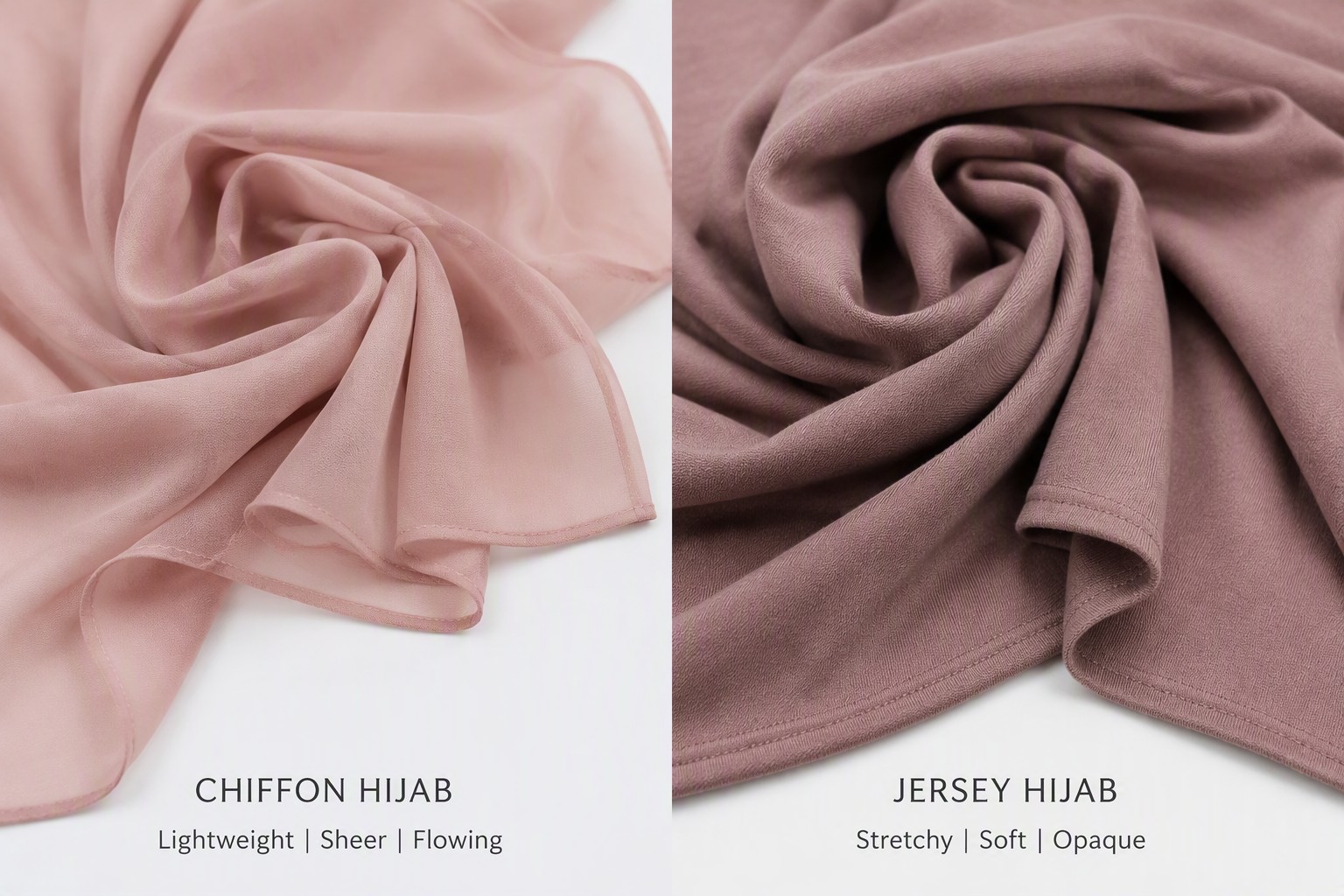
Fabric choice is the foundation. Modal and jersey are the two fabrics most premium private label brands work with. Modal at 160 to 180 GSM produces a silkier hand feel and photographs with a more luxurious appearance. Jersey at 200 to 240 GSM offers better opacity and stretch recovery for everyday wear. Your fabric choice should align with your brand positioning and your target customer's wearing context.
Print development is where most brands underestimate the timeline. A custom print requires artwork preparation, print calibration on your chosen fabric, a sample print for approval, and potentially one revision round before bulk. Brands that provide complete artwork files in the correct format at brief stage reduce this timeline by five to ten days.
Labelling adds brand touchpoints without adding product complexity. A woven label with your brand name inside the hijab, a hang tag with care instructions and fabric composition, and a branded poly bag create a retail-ready product from the first delivery.
Part 4: Factory Capability - What to Look for in a Private Label Manufacturer
Not all manufacturers that offer private label have the same capability. The distinction that matters most for printed collections is whether the manufacturer controls the printing process in-house or outsources it to a third-party printer.
In-house printing gives the manufacturer direct control over colour management, tension calibration, and curing temperature. Our team runs separate print protocols for modal and jersey, adjusting ink viscosity and substrate pressure based on each fabric's GSM and fibre composition. This precision is what prevents print cracking on jersey and colour shift on modal after washing.
Our production experience allows brands to develop prints that maintain colour accuracy across bulk runs, not just samples. We test each print batch against the approved sample under standardised lighting before any bulk run proceeds, and we retain colour reference data for reorders.
For labelling and packaging, the capability that matters is whether the manufacturer can coordinate all elements in a single production window. Separate suppliers for fabric, print, labels, and packaging multiply the coordination points and the opportunities for delay. An integrated facility delivers a complete retail-ready unit from one production order.
Part 5: Quality Control - The Three Stages That Protect Your Brand
Private label orders carry reputational risk that stock orders do not. When your label is on the product, any quality issue is a brand issue, not a supplier issue. This makes QC documentation more important in private label than in any other sourcing model.
Our QC protocol runs three stages for every private label order. Stage one is incoming material inspection: fabric GSM, colour consistency, and surface defect rate checked against the approved standard before any cutting or printing begins. Stage two is in-line inspection after the first 20 pieces of each bulk run, comparing print registration, colour match, and stitching quality against the approved sample. Stage three is a final AQL inspection before packaging.
Brands receive a production report documenting each stage. This report gives you traceability for your own records and documentation you can share with retail buyers or platforms that require supplier quality evidence.
Part 6: Brand Development Advice - How to Structure Your First Private Label Order
The most common mistake in a first private label order is trying to launch too many SKUs. A debut collection of eight colourways in two fabrics requires capital, content production, and inventory management that most new brands are not ready for. Three to four exclusive colourways in one fabric, developed with full label and packaging, is a more manageable and more focused launch.
Start with your hero piece - the one colourway and fabric combination that represents your brand most clearly. Develop it fully, generate content with it, and read the market response before expanding. The second colourway is easier to justify when you have sell-through data from the first.
MOQ at 100 to 200 pieces per style keeps initial capital requirement contained while giving you enough product to run a proper launch. Price the product based on landed cost including development fees, freight, and duty, not just the unit cost. Private label product commands a margin premium - use it.
Whether you are launching a first private label run or expanding an existing collection, our production team can advise on fabric, print process, and packaging from your first inquiry.
Frequently Asked Questions
What does a private label hijab manufacturer do?+
A private label hijab manufacturer produces hijabs to your exact specifications -- fabric type, GSM, dimensions, colour, print pattern, woven label, hang tag, and packaging -- and ships the finished product under your brand name. You own the brand; the manufacturer owns the production process.
What is the minimum order quantity for private label hijabs?+
Most private label hijab manufacturers require a minimum of 100 to 200 pieces per style per colourway. Custom prints with screen or roller setup typically require 200 to 300 pieces to cover the setup cost. Digital print processes can accommodate smaller quantities from 100 pieces.
How long does private label hijab production take?+
The full timeline from approved brief to bulk delivery typically runs 35 to 50 days. This includes sample development (7 to 10 days), revision round if needed (5 to 7 days), bulk production (15 to 25 days), and shipping. Brands that prepare detailed briefs upfront reduce development time significantly.
Can I order custom printed hijabs with my own design for private label?+
Yes. Private label manufacturers that specialise in printed hijabs can apply your exclusive pattern via digital heat transfer or reactive dye printing. The print is developed to your artwork, Pantone references, and scale requirements. You own the design exclusivity for your order quantity.
What information do I need to provide to start a private label hijab order?+
A complete brief includes: fabric type (modal, jersey, chiffon, satin), GSM, finished dimensions, colour references (Pantone or physical swatch), print artwork files (vector or high-resolution raster), label design, hang tag design, and packaging specification. The more complete your brief, the fewer revision rounds are needed.
How do I verify the quality of a private label hijab manufacturer before placing a bulk order?+
Request a pre-production sample and evaluate fabric hand feel, GSM accuracy, colour match to your reference, print sharpness and edge definition, stitching quality, and wash fastness after three machine washes. Ask for the manufacturer's QC documentation and whether they provide a production report with each bulk order.
Need a quote for your next order?
Free samples available. MOQ from 100 pieces. Ships to 50+ countries.
Request a Quote