Quick Summary
A private label hijab manufacturer that treats specification documentation, colour management, and first-article confirmation as standard practice -- rather than premium services -- provides brand buyers with the foundation for a consistent, scalable product programme. This brand guide covers the complete production sequence from brand brief to packaged product, explains how to structure a private label specification that supports accurate reordering, and describes the inline QC process that maintains colour consistency across collections. Our production experience allows brands to build private label hijab collections that grow cleanly from a 200-piece test order to a multi-collection product line without renegotiating the production standard at each stage.
Introduction: What It Means to Build a Brand Through a Private Label Hijab Manufacturer
A private label hijab manufacturer is not simply a factory that sews garments. It is a production partner that translates a brand identity -- a colour direction, a fabric standard, a packaging concept -- into a physical product that carries the brand name and supports the brand promise. The difference between sourcing a generic hijab and building a private label hijab programme is the difference between reselling and brand building.
For modest fashion brands at the growth stage, this distinction determines whether the business can develop long-term product equity or remains dependent on whoever offers the lowest sample price in any given season. Brands that invest in private label manufacturing own their product specification, their supplier relationship, and their repeat-order economics. Brands that do not are permanently exposed to specification drift and supplier substitution.
This guide covers how to evaluate and work with a private label hijab manufacturer -- what to look for at each stage of the relationship, what the process looks like from brand brief to packaged product, and how to structure the partnership so that early collections become the foundation for a scalable product programme.
Part 1: Buyer Problem -- Why Most Private Label Attempts Stall Before the Second Order
The most common failure point in private label hijab development is not the first sample. It is the second order. A brand receives an acceptable first sample, approves it, places an initial production run, and receives the goods. Then the season ends, the brand wants to reorder, and the supplier delivers a product that is noticeably different -- slightly different colour, different fabric weight, different label placement.
This is not accidental. It reflects a structural problem in how many brands set up their first private label relationship. Without a formal product specification document, without a reference fabric sample retained at the factory, and without a documented colour standard, each production run is essentially a new production decision. The factory is not reproducing a specification -- it is approximating a memory of the last order.
The second common failure point is scale readiness. A brand places a small test order of 200 pieces, which the factory produces carefully. The brand then wants to scale to 800 pieces. The factory cannot commit to the same lead time, or the same quality standard, or the same unit economics at the larger volume. The private label programme stalls because the supplier relationship was built on a sample, not on a production system.
Both of these failure points are avoidable. They require choosing a private label hijab manufacturer that treats specification documentation and scalable production as standard practice, not optional add-ons for large accounts.
Part 2: Industry Trend -- Private Label Is Moving Downstream to Smaller Brands
Private label manufacturing was once the domain of established retailers and brands with the buying power to justify minimum order quantities above 1,000 pieces per style. The economics of private label have shifted over the past four years. OEM factories capable of producing custom woven labels, branded packaging, and documented colour standards are increasingly accessible to brands with order quantities starting at 200 to 300 pieces.
This shift is being driven primarily by the growth of Instagram and TikTok as brand-building platforms. A modest fashion creator with 50,000 followers can launch a private label hijab collection, sell through it in a week, and need a reliable manufacturer for the reorder. The brand is real, the demand is real, and the supplier relationship needs to function like a professional manufacturing partnership from the first order.
The supply side has responded. More OEM hijab factories now offer private label services with lower minimum quantities because the aggregate demand from smaller brands represents a commercially significant volume. The factories that serve this market well are the ones that have systematised the private label process -- documentation, colour management, label production, packaging coordination -- so that a 300-piece order gets the same structural attention as a 3,000-piece order.
For brand buyers, this means the evaluation criteria for a private label hijab manufacturer have changed. Price per piece matters, but it is secondary to documentation discipline, colour repeatability, and the ability to scale an approved specification across multiple production runs at growing quantities.
Part 3: Technical Knowledge -- What a Private Label Specification Needs to Include
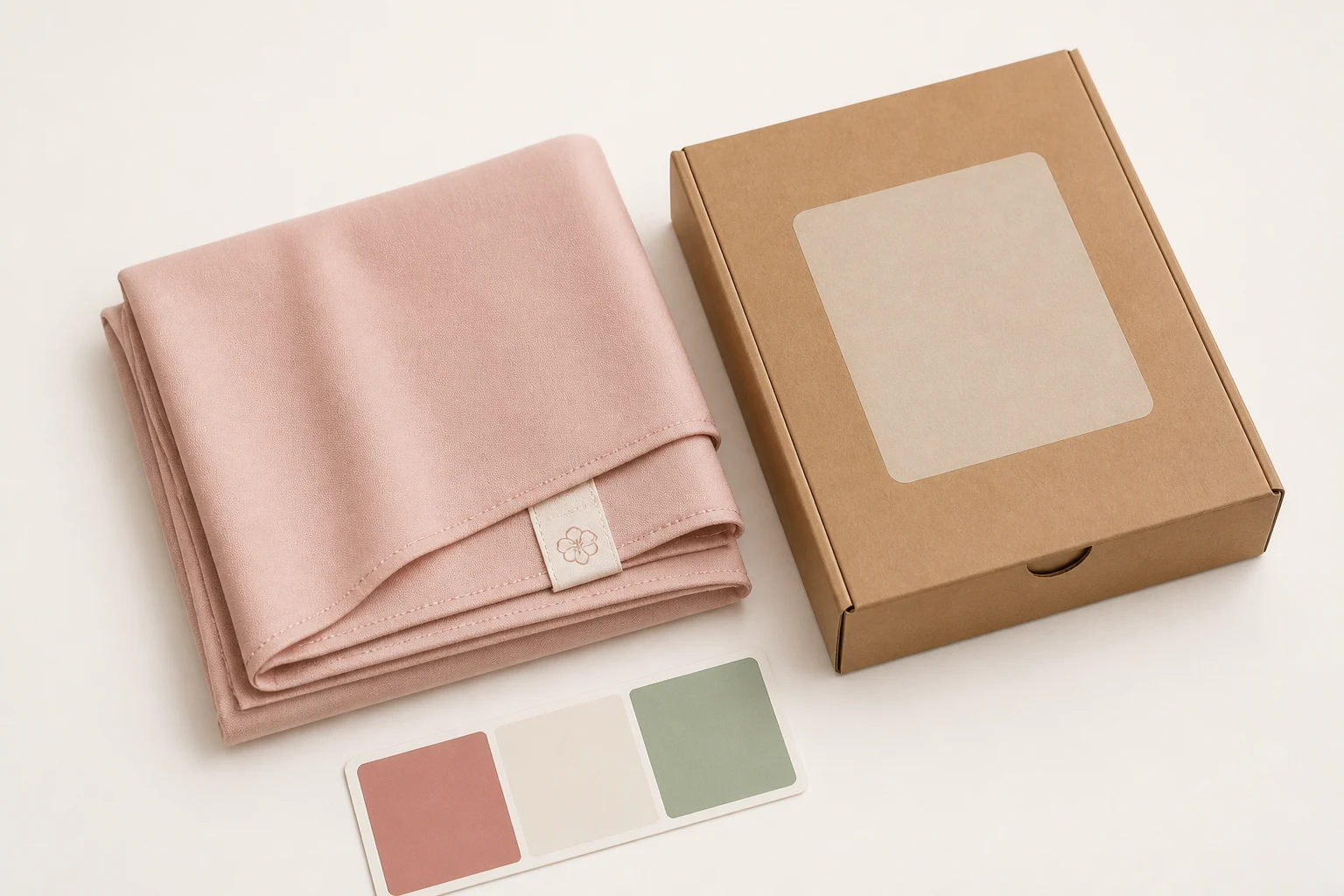
A private label hijab specification is the document that makes repeat orders possible. Without it, every reorder is a negotiation. With it, every reorder is an instruction. The minimum contents of a workable specification are: fabric composition and GSM range, print or colour standard with a reference sample, finished dimensions with tolerances, construction details (hem type, width, edge treatment), label specification (woven or printed, position, content), and packaging requirements (folding method, poly bag, box or hang tag).
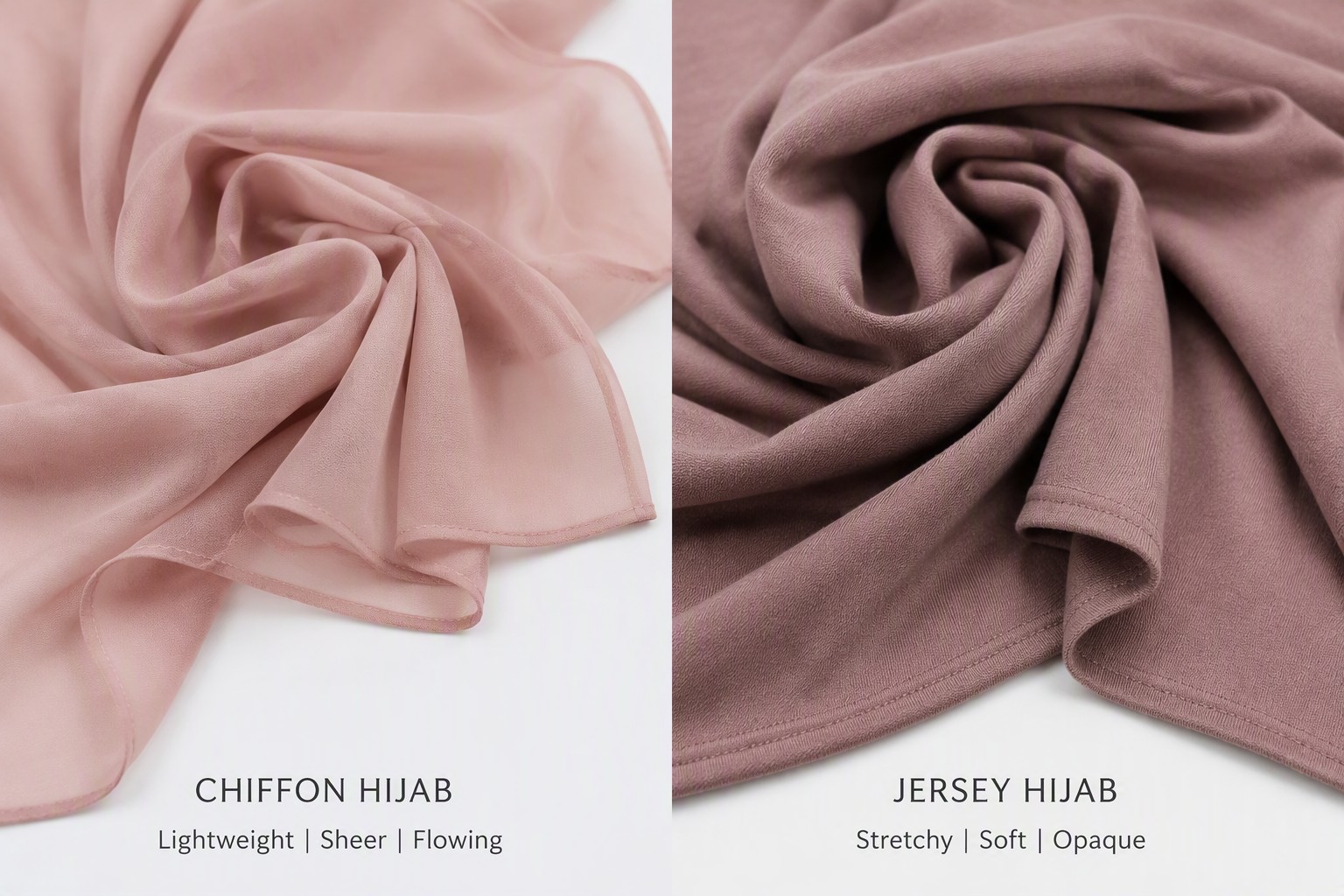
Fabric specification is the most critical element. Modal and jersey hijabs behave differently in production -- different shrinkage characteristics, different print ink absorption, different hem tension requirements. A specification that says only 100 percent modal without a GSM range and a shrinkage tolerance is not a specification; it is a starting point for a conversation. A workable specification defines the fabric to a level that allows the factory to reject incoming materials that do not meet the standard.
Colour standard is the second most critical element for printed private label hijabs. A colour reference that exists only as a JPEG file is not a reproducible standard. A colour reference that includes a physical Pantone chip or a signed-off printed fabric swatch retained by both the brand and the factory is a reproducible standard. The difference between these two approaches is the difference between a print that looks approximately right and a print that matches the approved reference.
Label and packaging specifications are often treated as details, but they are the most visible indicators of brand quality to the end customer. A woven label with a brand name and care symbols is a physical commitment to the product. A brand that skips label specification in the first order and tries to add it in the second is creating an inconsistency in the product line that existing customers will notice.
Part 4: Our Factory Capability -- From Brand Brief to Packaged Product
Our production process for private label hijab orders follows a defined sequence from brand brief to packaged product. Understanding this sequence helps brand buyers plan realistically and identify where their input is needed at each stage.
The process begins with fabric sourcing and specification confirmation. When a brand provides a fabric reference or a fabric type direction, our team sources candidate fabrics, measures GSM and composition, and provides physical swatches for brand approval before any production fabric is purchased. This stage takes 3 to 5 working days and prevents the most common source of quality variance -- production fabric that does not match the sample fabric.
After fabric approval, the print or colour development stage begins. For printed private label hijabs, our team prepares a digital colour proof and, where colour accuracy is critical, a printed strike-off on the approved fabric. The brand reviews and approves the strike-off before bulk printing proceeds. This stage takes 4 to 7 working days for a new design and 1 to 2 working days for a repeat design already in our production library.
Cut and sew follows fabric and colour approval. Our production team works from the approved specification document, not from a verbal brief or a memory of the last order. Hem width, label placement position, folding method, and finishing steps are defined in the specification and checked at the first-article stage before bulk production runs. This stage takes 8 to 14 working days depending on order quantity and construction complexity.
Packaging coordination runs in parallel with production. If the brand provides custom boxes, hang tags, or poly bags, the packaging components are received and inspected before the production batch completes, so that the packing stage does not delay the shipment. Our team can also coordinate standard kraft packaging or poly bag solutions with brand-specific printing for brands that have not yet developed custom packaging components.
Part 5: Quality Control -- First-Article Confirmation and Inline Colour Checks
For private label hijab orders, our quality control process includes two stages that are specific to brand consistency: first-article confirmation and inline colour checks during bulk printing.
First-article confirmation means that the first finished piece from each production batch is checked against the approved specification and the approved sample before bulk production continues. The checker verifies finished dimensions against the specification tolerance, label placement against the specification position, hem width and edge quality, and colour against the approved strike-off or colour reference. If any element does not conform, production pauses and the issue is resolved before bulk output continues. This stage adds 2 to 4 hours to the production schedule but prevents the far larger cost of a non-conforming batch.
Inline colour checks are performed at the print stage using a lightbox and the approved printed reference. For reactive-printed modal hijabs, ink density and colour balance are checked every 50 to 100 linear metres of fabric during the print run. Variations that exceed a delta-E of 1.5 against the reference trigger a print parameter adjustment. This standard is tighter than is strictly required for most markets, but it is what makes the tenth reorder look the same as the first.
For brands that supply their own Pantone references, our team maps the Pantone colour to the nearest achievable result on the specific fabric being used and documents the achieved colour standard as a production reference. This documented mapping becomes the reorder standard, so that future production runs start from a known point rather than approximating the original colour from memory.
Part 6: Brand Development Advice -- Structure the Relationship Before You Scale
The most important decision in a private label hijab programme is not which factory to work with. It is how to structure the relationship before the first production order is placed. Brands that invest 2 to 3 weeks in specification development, colour reference preparation, and label design before placing their first order create a foundation that supports every subsequent reorder. Brands that skip this investment to save time on the first order spend more total time resolving inconsistencies across the first three or four orders.
Specifically: before placing a first private label order, prepare a written product specification with fabric, print, dimension, label, and packaging requirements. Approve a physical fabric swatch and a printed strike-off, and keep a signed copy at the factory. Define your reorder quantity range so the factory can confirm whether it can serve you at both test scale and growth scale. Ask for the factory documentation process and confirm how colour references and production records are retained between orders.
When evaluating a private label hijab manufacturer, the questions that reveal operational maturity are not about price or minimum order quantity. They are: how do you document and retain the colour standard between orders? What is your first-article check process? Can you show me a production record from a previous order? A factory that can answer these questions with evidence rather than assurance is a factory that can support a growing brand programme.
Finally, plan your private label programme as a series of collections rather than a series of individual orders. Each collection builds on the specification and colour library of the previous one. By the third collection, the brand has an established production identity that the factory knows how to reproduce accurately, and the economics of reordering improve because the pre-production stage is shorter for approved specifications.
Conclusion: Private Label Is a System, Not a Service
A private label hijab manufacturer that operates as a system -- documented specifications, retained colour references, first-article checks, inline colour monitoring -- delivers something fundamentally different from a factory that produces private label garments on request. The first supports brand building. The second supports transactional volume.
Our production experience allows brands to build private label programmes that scale cleanly from a first test order to a multi-collection product line. The specification, the colour standard, and the production record from the first order become the foundation for every subsequent order.
If you are developing a private label hijab collection and want to understand how your brand positioning, target fabric, and design direction can be matched to a specific production approach, share your brand brief with us. Our team will review your requirements and provide a recommended production route, a lead time estimate, and a clear description of the documentation process for your first order.
Frequently Asked Questions
What is the minimum order quantity for a private label hijab?+
Our standard minimum order quantity for private label hijab orders with custom woven labels and documented colour specifications is 200 pieces per style. Smaller pilot quantities of 100 pieces are available for brands placing a first test order with a new fabric or new print design. We confirm the exact minimum for each order type at the inquiry stage.
How long does it take to produce a first private label order?+
A first private label hijab order, which includes fabric sourcing, print or colour development, first-article confirmation, and packaging coordination, typically takes 30 to 40 working days from brand brief to shipped goods. This is longer than a reorder because the pre-production stages -- fabric approval, colour strike-off, label production -- all need to be completed from scratch. Subsequent orders with approved specifications run at 20 to 28 working days.
Can you produce custom woven labels for private label orders?+
Yes. We coordinate woven label production for private label orders. The brand provides the label design and content requirements (brand name, care symbols, country of origin), and we manage the label production as part of the order process. Lead time for woven labels is 10 to 15 working days from approved artwork, which runs in parallel with fabric and print development so it does not extend the overall order lead time.
How do you ensure that reorders match the first order?+
Colour consistency across orders depends on three things: a documented colour standard retained at the factory, a physical reference sample signed off by the brand, and inline colour checks during bulk printing. We maintain a production reference file for each brand that includes the approved fabric specification, the colour standard mapping, the label specification, and the outgoing inspection record. This file is the starting point for every reorder, so production does not begin from a blank page.
What fabrics are available for private label hijabs?+
Our standard fabric range for private label hijabs includes reactive-printed and plain modal (typically 100 percent modal at 140 to 160 GSM), jersey modal blends, and jersey polyester. Modal is the most popular fabric for printed private label hijabs because it offers a fluid drape, good colour absorption for reactive printing, and a soft texture that end customers associate with premium quality. We can also source custom fabric specifications for brands with specific GSM, composition, or finish requirements.
Do you offer packaging coordination as part of the private label service?+
Yes. We can coordinate standard kraft packaging with brand-specific sticker or stamp details, poly bags with brand logo printing, and hang tag attachment as part of the production process. For brands supplying custom boxes or packaging components, we manage the receipt, inspection, and packing of those components as part of the standard production schedule. Packaging specifications are documented alongside the product specification and checked at the outgoing inspection stage.
Need a quote for your next order?
Free samples available. MOQ from 100 pieces. Ships to 50+ countries.
Request a Quote