Quick Summary
Transforming custom headscarves into a high-margin modest fashion brand requires meticulous private label execution far beyond basic fabric sewing. As a dedicated private label hijab manufacturer, our factory orchestrates a fully integrated seven-stage production chain combining bespoke modal and jersey textile milling with custom brand trims, damask woven labels, and frosted EVA zip-lock packaging. We implement rigorous inline golden sample inspection under D65 standardized lighting to ensure zero color deviation across fabric batches and packaging components. Our turnkey manufacturing model supports emerging designers and scaling boutique retailers with agile low-MOQ branding options that deliver an unforgettable luxury unboxing experience.
Beyond the Scarf: Why Private Label Execution Defines Modern Modest Wear Brands
In today’s hyper-visual fashion ecosystem, a modest wear brand is never judged solely on the quality of its textile. A consumer opening a delivery parcel does not see a piece of hemmed fabric; she experiences a tangible manifestation of your brand’s promise. When a package arrives in a flimsy, crinkled plastic bag with a crooked sticker and a generic scratchy label sewn into the seam, the perceived value of an otherwise beautiful modal hijab instantly collapses. The customer questions whether she paid for a luxury artisan piece or an unvetted dropshipped commodity.
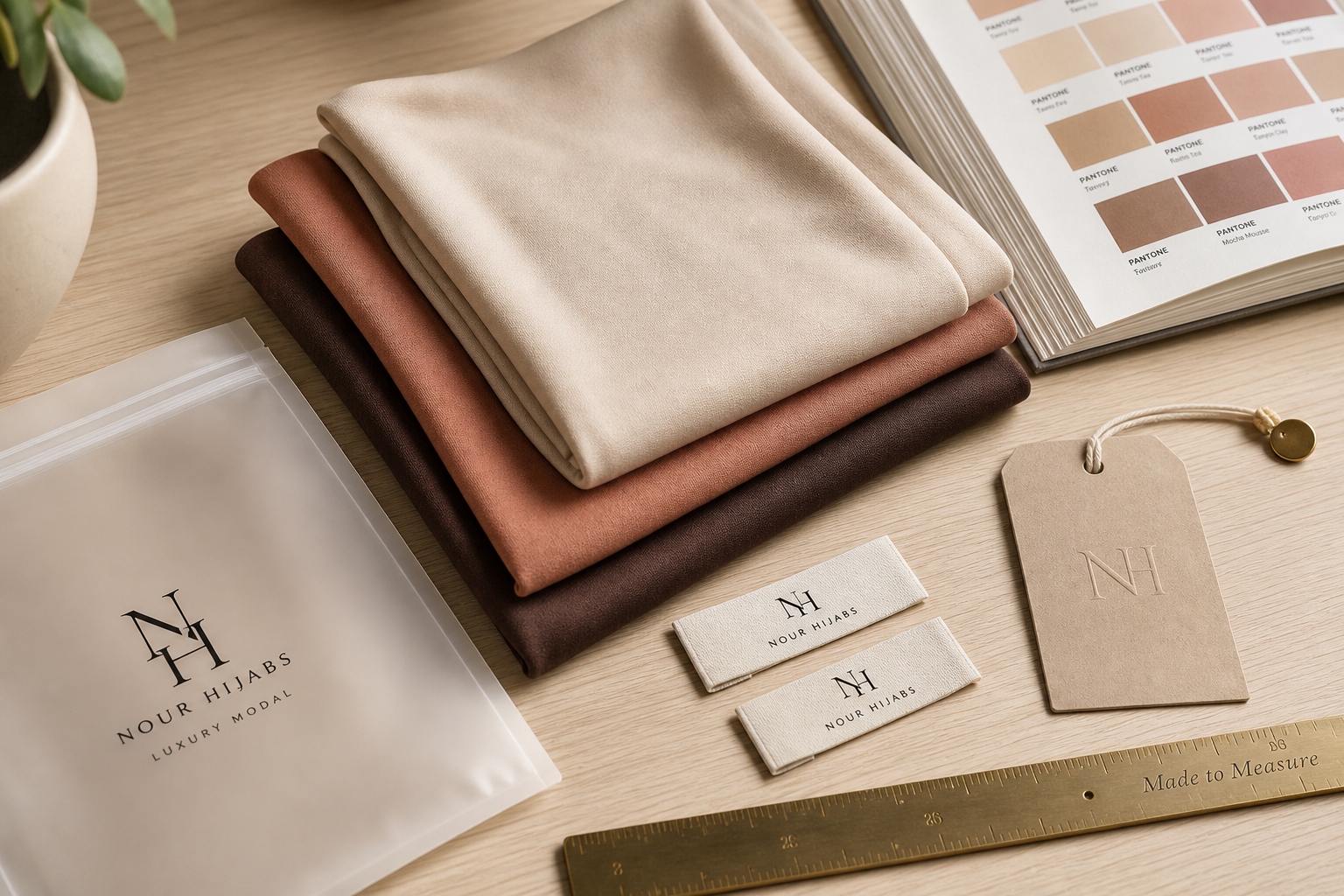
Conversely, consider the emotional resonance of a true luxury unboxing experience. The exterior mailer opens to reveal a bespoke frosted matte zip-lock pouch bearing your minimalist brand insignia in crisp charcoal foil. Sliding open the zipper releases the subtle, clean scent of fresh beechwood cellulosic fiber. As she lifts the scarf, her fingers touch an ultra-soft, micro-woven damask label that rests weightlessly against the skin, accompanied by an embossed matte cardboard hang tag explaining the ethical sourcing of the yarn and custom Pantone palette. Before she has even draped the scarf around her shoulders, the purchase is validated, trust is cemented, and an Instagram unboxing video is already being recorded.
This transformative transition -- from selling anonymous scarves to commanding luxury retail premiums of $38 to $65 USD -- is the essence of working with a true private label hijab manufacturer. At our manufacturing facility, our mission extends far beyond operating digital printing presses and sewing tables; our production experience allows brands to build cohesive, retail-ready brand identities that cultivate fierce customer loyalty from their very first collection drop.
Part 1: The Buyer Problem -- The Unboxing Disconnect, Scratchy Tags, and Margin Erosion
Many passionate boutique founders and modest fashion creators begin their entrepreneurial journey with a flawed supply chain approach. They source unbranded blank scarves from one general wholesale marketplace, purchase cheap paper hang tags from a local quick-print shop, order plastic mailers from another vendor, and spend exhausting late-night hours hand-tagging and folding scarves on their living room floors. This fragmented workflow invariably creates three critical operational failure modes.
The first failure mode is tactile dissonance caused by substandard labeling trims. When founders buy generic woven labels from non-apparel suppliers, they typically receive coarse, rigid 150-denier polyester tags with hard, heat-sealed edges. When stitched onto delicate 80-count micro-modal or featherlight bamboo jersey, these stiff label corners poke through the fabric, causing skin irritation around the neck and creating an unsightly lump under smooth wraps. In frustration, customers frequently take scissors to cut off the itchy label, unintentionally snipping the perimeter hem threads and permanently severing the brand’s visual identity from the garment.
The second failure mode is packaging degradation and shipping damage. Cheap Oriented Polypropylene (OPP) clear bags with peel-off adhesive strips offer virtually zero structural integrity. During international courier transit or warehouse handling, the adhesive gathers dust and lint, the seams burst open under pressure, and static electricity attracts cardboard dust directly onto dark-colored modal scarves. When the customer opens the delivery box, she is greeted by a wrinkled, dusty garment that looks like old warehouse surplus rather than a premium lifestyle purchase.
The third and most devastating consequence is margin erosion and scaling paralysis. When a brand founder acts as her own assembly and packaging line, packaging costs skyrocket due to small-batch domestic sourcing, shipping expenses multiply across separate vendor deliveries, and labor time is squandered on manual packing rather than marketing, community building, and customer acquisition. When order volume surges from 50 to 500 units per week, the homemade fulfillment system collapses under its own weight.
Part 2: Industry Trend -- The Rise of the D2C Modest Boutique and the Power of Unboxing
To understand why professional private labeling is essential today, one must analyze the commercial dynamics of Direct-to-Consumer (D2C) modest fashion across North America, Western Europe, and Australasia. The global modest fashion market has matured beyond basic functional apparel into a sophisticated design sector characterized by curated capsule drops, viral social commerce, and high repeat-purchase velocity.
Modern modest wear consumers on TikTok and Instagram are discerning aesthetic curators. For this demographic, the unboxing ritual is an integral component of the product experience. Organic user-generated content (UGC) -- unboxing hauls, styling tutorials, and "get ready with me" (GRWM) reels -- represents the single most cost-effective marketing engine for scaling apparel labels. A thoughtfully branded frosted packaging pouch or custom debossed gift box provides a visual focal point in social video feeds, effectively transforming every customer into an authentic brand ambassador.
Furthermore, retail buyers and luxury department store stockists evaluate a supplier’s packaging and labeling standards just as rigorously as the fabric hand feel. Whether pitching your collection to an upscale modest boutique in Birmingham or an international luxury platform in Dubai, retail buyers demand barcode-compliant SKU stickers, standardized polybag suffocation warnings, standardized carton labeling, and premium hanger-ready presentation. Brands that partner with an integrated private label manufacturer arrive at buyer meetings with fully realized retail packaging that commands immediate professional respect.
Part 3: Technical Knowledge -- Materials Science of Premium Labels and Packaging
Specifying luxury private label trims requires an understanding of the materials science that separates commercial apparel accessories from commodity stationery.
First, examine label weaving construction. Standard commercial clothing tags use coarse 100-denier to 150-denier polyester yarns woven on high-speed rapier looms. For luxury modal and jersey hijabs, our factory specifies high-density 50-denier or 75-denier damask weave technology on micro-electronic jacquard looms. By utilizing ultra-fine yarn filaments, we pack over 100 picks per centimeter, allowing razor-sharp reproduction of fine serif typography, delicate brand emblems, and miniature wash symbols. The resulting damask surface is silky smooth, lightweight, and completely non-abrasive against sensitive facial skin.
Second, evaluate edge finishing chemistry. Traditional woven labels are separated on large rolls using thermal hot-wire cutting, which melts the synthetic polyester into rigid, abrasive plastic beads along the cut margins. Our private label lines utilize ultrasonic sound-wave cutting. High-frequency acoustic vibrations generate localized molecular friction that severs the yarns while simultaneously annealing the microscopic fiber ends into a velvety, micro-soft border. When combined with end-fold or center-loop sewing techniques, the label integrates seamlessly into the perimeter hem of the hijab without causing stiffness or fabric puckering.
Third, consider the polymers used in outer packaging. Conventional clear polybags are extruded from low-density polyethylene (LDPE) or polypropylene (PP), which produce a glossy, reflective surface prone to static cling and wrinkling. For premium modest fashion packaging, we recommend high-grade Ethylene Vinyl Acetate (EVA) film finished with a silky frosted matte texture. EVA is an elastomeric copolymer that provides exceptional puncture resistance, superior low-temperature flexibility, and a soft, tactile rubber-like hand feel. It is non-toxic, odorless, and completely free of harmful plasticizers, ensuring that delicate modal headscarves absorb zero unpleasant chemical odors during transit.
Part 4: Our Factory Capability -- The Integrated 7-Stage Private Label Production Chain
Unlike trading brokers who outsource labeling to third-party workshops and sew tags on domestic sewing machines, our manufacturing facility operates an integrated, seven-stage private label production chain under one centralized roof.
Stage 1 begins with Brand Asset Ingestion and Technical Pack Creation. Our in-house branding specialists review your vector artwork, Pantone color codes, and packaging requirements, generating comprehensive manufacturing tech packs that specify exact label millimeter dimensions, seam stitch placement, hang tag cord lengths, and pouch thickness.
Stage 2 encompasses Dedicated Trim Manufacturing. We produce your bespoke 50-denier damask woven brand labels, satin care labels, foil-stamped hang tags, and frosted EVA zip pouches in coordinated production runs, synchronizing lead times so all accessories are ready before the fabric rolls exit the post-wash finishing ranges.
Stage 3 is Precision Textile Milling and Printing. Your custom modal, jersey, or blended headscarves are knitted, pre-treated, digitally printed with reactive inks, and fixed through saturated 102°C steam chambers under tension-controlled blanket feeds.
Stage 4 is Automated Precision Cutting and Perimeter Sewing. Fabric rolls are cut to precise millimeter tolerances using automated CNC tensionless cutting tables. Skilled sewing artisans fold and stitch delicate 1.2-millimeter pin hems, seamlessly incorporating your custom woven brand label into the corner or center-back hem fold with color-matched mercerized thread at 14 to 16 stitches per inch.
Stage 5 is Industrial Steam Pressing and De-Creasing. Every individual hijab passes through professional vacuum steam tables to relax the cellulosic fibers, establish crisp linear edges, and impart a smooth, showroom-ready surface finish.
Stage 6 is Retail-Ready Folding, Tagging, and Pouching. Trained packaging staff attach your custom embossed hang tags using wax cotton cords or safety-pin fasteners, fold each scarf around protective acid-free tissue inserts according to your dimensional requirements, and seal the finished garment inside your branded frosted EVA zip pouch.
Stage 7 is Barcoding, Carton Packing, and Global Logistics. We affix scannable barcode SKU stickers to the exterior pouch, pack the products into five-ply heavy-duty double-wall corrugated shipping cartons lined with waterproof poly-liners, and coordinate door-to-door express air freight or consolidated sea container delivery directly to your regional fulfillment hub.
Part 5: Quality Control -- Inline Golden Sample Audits and Color Matching Standards
Maintaining strict aesthetic consistency across both fabric and packaging is the hallmark of professional private label manufacturing. A slight color mismatch between your scarf’s custom Pantone shade and your printed brand hang tag instantly erodes brand authority. Our factory enforces rigorous inline quality control checkpoints to guarantee flawless execution.
The cornerstone of our private label quality system is the Golden Sample Master Swatch Protocol. Before mass production begins, our team produces a complete physical master prototype -- including the printed fabric, stitched label, attached hang tag, and custom outer pouch. Once reviewed and signed off by the brand founder, this Golden Sample is cataloged in our quality control laboratory under climate-controlled conditions. All subsequent production stages are benchmarked directly against this physical standard.
During label and packaging manufacturing, our technicians conduct colorimetric evaluations inside multi-illuminant light boxes calibrated to ISO 3664 standards. We inspect brand trims under D65 daylight (simulating natural outdoor light), Point of Sale (TL84 fluorescent boutique lighting), and Incandescent Home (Illuminant A) conditions. This multi-light verification prevents metamerism -- a common visual flaw where a label and fabric appear to match perfectly under factory lighting but shift into contrasting mismatched tones under retail shop or sunlight conditions.
On the final packaging line, 100 percent of sealed pouches undergo barcode readability verification using high-speed optical laser scanners to prevent fulfillment errors at Amazon FBA or third-party logistics (3PL) warehouses. Furthermore, random samples from each packing carton are inspected to ensure that hang tag cords are firmly secured, zipper pulls glide smoothly without snagging, and folding geometry remains uniform throughout the entire production run.
Part 6: Brand Development Advice -- Tiered Packaging Strategies That Protect Your Profit Margins
When planning your private label product launch, strategic packaging allocation ensures that your collection looks exceptionally luxurious without unnecessarily inflating your per-unit cost base. Based on our experience supporting emerging fashion labels, our team recommends adopting a tiered packaging framework.
For Core Everyday Hijabs and Solid Essentials, focus your investment on tactile, reusable essentials. A high-density 50-denier damask woven label paired with a custom printed frosted EVA zip-lock pouch delivers maximum visual impact and functional longevity at a very modest per-unit cost. Because customers reuse the frosted pouches in their gym bags, carry-on luggage, and wardrobes, your brand footprint remains active in their daily lives long after delivery.
For High-Ticket Signature Drops, Wedding Hijabs, and Eid Capsule Collections, elevate the presentation with sensory packaging accents. Consider incorporating custom debossed gold-foil hang tags on heavy 450 GSM textured cotton cardstock, wrapped in branded semi-translucent glassine paper with an embossed foil seal, and presented inside a rigid matte presentation gift box. This gift-ready architecture justifies retail price points above $60 USD and creates a truly unforgettable unboxing moment that drives viral social sharing.
Most importantly, take advantage of split-batch manufacturing. You do not need to produce thousands of scarves to achieve custom branding. By ordering your custom woven labels and printed packaging in bulk lots of 1,000 to 2,000 units while producing your scarves in agile small batches of 100 to 150 pieces per style, you achieve low packaging unit costs while keeping your fabric inventory lean, responsive, and trend-focused.
For boutique owners, e-commerce founders, and modest wear startups seeking an experienced private label hijab manufacturer in China, our team is equipped to support you at every milestone of your journey. From initial logo digitizing, label weaving, and custom packaging mockups to precision textile printing and door-to-door global logistics, we provide comprehensive, turnkey manufacturing solutions that transform your creative sketches into an internationally recognized modest fashion brand. Contact our technical team today to initiate your brand consultation.
Frequently Asked Questions
What is the difference between OEM and private label hijab manufacturing?+
Original Equipment Manufacturing (OEM) typically refers to producing headscarves according to a client’s exact technical specifications, such as custom dimensions, fabric blend ratios, and bespoke digital print patterns. Private label manufacturing takes this a step further by providing complete retail-ready brand identity integration. In addition to custom textile production, a private label manufacturer designs, sources, and attaches your custom damask woven labels, branded hang tags, care instruction labels, barcode SKU stickers, and bespoke outer packaging (such as frosted zip-lock pouches or gift boxes), delivering a finished product ready for immediate warehouse fulfillment or boutique display.
What type of woven label is best suited for delicate modal and jersey hijabs?+
We strongly recommend high-density 50-denier or 75-denier damask woven labels with ultrasonic soft-cut edges or center-folded end-folds. Delicate fabrics like 80-count micro-modal and fluid bamboo jersey drape directly against the neck, hair, and jawline. Traditional coarse polyester woven labels or hot-knife sealed edges create rigid, scratchy corners that irritate the skin and damage fine fabric weaves. Ultrasonic cutting melts the microscopic yarn edges with high-frequency acoustic vibrations, creating a velvety, soft perimeter that feels weightless and comfortable during all-day wear.
What is the minimum order quantity (MOQ) for custom branded packaging and labels?+
To accommodate boutique fashion startups and fast-growing social media brands, our factory offers a strategic split-MOQ workflow. While custom woven labels and printed frosted EVA pouches are produced in cost-effective batches of 1,000 to 2,000 pieces (which cost only a few cents each and are stored safely in our climate-controlled warehouse), we allow your physical hijab production runs to begin at an agile 100 to 150 pieces per style or colorway. As you release new seasonal drops, we pull from your pre-stocked branding trims, allowing you to launch fully customized collections without heavy inventory risk.
Why are frosted EVA zip-lock bags preferred over clear OPP adhesive polybags?+
Clear Oriented Polypropylene (OPP) bags with peel-and-stick adhesive strips look cheap, tear easily, crinkle noisily, and leave sticky residue on delicate fabrics when opened. Once unsealed, they are immediately discarded by the consumer. In contrast, frosted Ethylene Vinyl Acetate (EVA) zip-lock pouches offer a luxurious matte, soft-touch texture that is water-resistant, odorless, and durable. More importantly, customers keep and reuse frosted zip pouches to organize their hijab collections while traveling or storing scarves in wardrobes. This keeps your brand logo and aesthetic visible in your customer’s daily life long after the initial purchase.
Can a private label manufacturer handle barcode SKU labeling and Amazon FBA preparation?+
Yes. Our factory provides complete end-to-end packing services. We can print and adhere scannable EAN/UPC barcode labels, SKU identification stickers, fabric composition disclosures, country-of-origin tags, and required polybag suffocation warnings according to US, UK, EU, and Amazon FBA fulfillment center compliance standards. Every carton is packed with moisture-absorbing desiccant packs and robust double-wall corrugated outer cartons ready for international air or sea freight.
How long does the private label prototyping and sampling process take?+
For first-time brand launches, custom woven label weaving and packaging mockups typically require 5 to 7 business days following digital vector artwork approval. Fabric lab dips and digital print strike-offs on modal or jersey take 4 to 6 days. We assemble the complete retail-ready prototype -- finished scarf, sewn label, attached hang tag, and custom packaging -- and dispatch it via express courier (3 to 5 days transit) for your physical evaluation before launching commercial bulk production.
Need a quote for your next order?
Free samples available. MOQ from 100 pieces. Ships to 50+ countries.
Request a Quote