Quick Summary
A private label hijab programme succeeds when the brand controls the specification and the manufacturer controls the process that delivers it. The production sequence -- fabric preparation, print, fixation, finishing, labelling and packing -- determines where brand identity can be protected or lost. Inline colour approval, using a first-article check under a controlled light box, is the checkpoint that keeps a private label collection visually consistent from the first piece to the last. Brands that start with a small test batch, record what the test teaches them, and reuse the same approved standards when they reorder can scale volume without rebuilding quality from zero.
Introduction: Why Private Label Is a Process Decision, Not Only a Branding Decision
Most modest fashion founders approach private label as a branding question. They think about the label artwork, the packaging colour, the brand name stitched into the corner of the scarf and the unboxing moment that will appear on Instagram or TikTok. Those details matter, but they sit on top of something less visible: the production process that turns a design file into hundreds of identical, correctly labelled hijabs. When a private label collection disappoints customers, the cause is rarely the logo. It is usually a colour that drifted between pieces, a label sewn in the wrong position, or a reorder that does not quite match the first delivery.
This guide is written for brand owners who are working with, or evaluating, a private label hijab manufacturer. It explains how the production sequence works from fabric to finished branded product, where inline colour approval fits into that sequence, and how a small test batch can become the foundation for scaling rather than a one-off experiment. Our team focuses on custom printed modal and jersey hijabs for Instagram fashion brands, TikTok sellers, boutique owners and modest fashion startups, and the advice here reflects the questions those brands bring to us most often.
Part 1: Buyer Problem -- When the Brand Owns the Name but Not the Standard
The core problem in many private label relationships is a gap between ownership and control. The brand owns the name, the designs and the customer relationship. The manufacturer owns the machines, the fabric and the daily production decisions. If the standards that define the product are not written down and agreed, the manufacturer fills the gaps with its own defaults, and the brand discovers those defaults only when the goods arrive.
In hijab production this gap shows up in predictable places. The first is colour. A brand approves a sample that looks right on a phone screen or under office lighting, but the bulk run is printed on a different fabric lot, fixed at slightly different conditions and judged by a different person. The result can be a dusty rose that arrives warmer, or a sage that reads grey in daylight. The second is label placement and content. Fibre composition, care symbols and country of origin need to be correct for the markets you sell into, and they need to be attached in the same position on every piece. The third is reorder drift. A collection that sells well is reordered, and the second batch is close but not identical, which creates mismatched stock and confused customer reviews.
Part 2: Industry Trend -- Smaller Collections, Faster Cycles, Higher Visual Scrutiny
The modest fashion market served by social-first brands has moved towards smaller, more frequent drops. Instead of a single large seasonal collection, many brands release a few new prints or colourways every few weeks and use customer response to decide what to reorder. This model lowers inventory risk, but it raises the importance of consistency, because each drop is photographed, filmed and compared with the last one in public.
At the same time, customers are looking more closely. Short-form video shows fabric drape, print sharpness and colour in natural light, and comment sections quickly point out when a reorder looks different from the original. For a private label brand, visual consistency is now part of the brand promise. A manufacturer that can hold colour and finish steady across small, repeated runs is more valuable to this kind of brand than one that can only deliver large volumes at a low unit price.
Regulatory attention on labelling has also increased in key markets, including requirements for accurate fibre composition and care information. Private label brands carry responsibility for what appears on their labels, so they need a manufacturer that treats label content as a controlled part of the specification rather than an accessory added at the end.
Part 3: Technical Knowledge -- What Shapes Colour and Finish in Printed Modal and Jersey
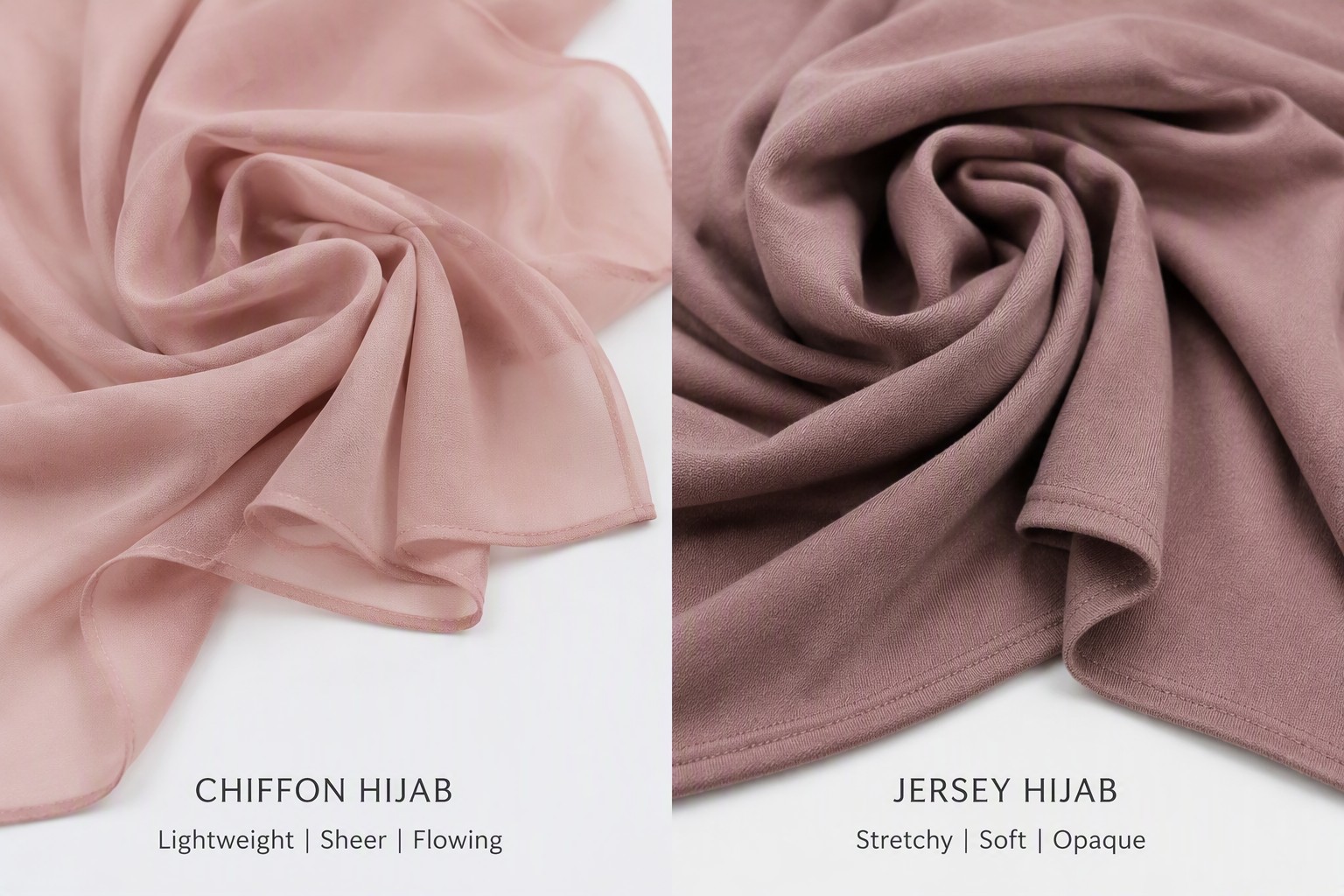
Understanding a few technical basics helps a brand ask better questions. Modal is a regenerated cellulose fibre with a smooth surface and high moisture absorbency. It takes reactive print colour well and produces soft, saturated tones, but it is sensitive to moisture content and fixation conditions, which affect how deep the final colour appears. Jersey hijabs are knitted, usually from cotton, viscose or blends with elastane, and they stretch. Stretch fabric must be fed through the printer with controlled tension, otherwise the print can distort or the colour density can vary across the width.
After printing, the colour must be fixed, typically through steaming, and then washed to remove unfixed dye. The fixation stage has a strong influence on final shade and on wash-fastness. Finishing follows: softening, drying, cutting and edge treatment such as rolled hems or overlocking. Each step can shift the appearance slightly, which is why a colour standard approved on a strike-off must be checked again on actual bulk production.
Colour judgement also depends on light. A shade can look different under warm indoor light, cool office light and daylight. Professional colour checking uses a light box with standard light sources so that the factory and the brand compare colour under the same conditions.
Part 4: Factory Capability -- The Private Label Production Sequence from Fabric to Branded Pack
Our private label hijab production runs as a defined sequence, and each stage hands a checked result to the next. Stage one is fabric allocation. Once your specification is confirmed, our team reserves modal or jersey fabric for your order and records the fabric lot. Keeping the lot record matters because fabric from different lots can take colour differently, and the lot reference is what allows us to trace a later question back to its source.
Stage two is colour development and strike-off. Our print team develops your colourways on the actual substrate and prepares strike-offs for your approval. Because we have optimised our own print equipment for hijab widths and for the behaviour of modal and jersey, our team can adjust colour profiles and feed settings for your fabric rather than forcing your design into a generic setting.
Stage three is bulk printing and fixation. The approved colour profile and fixation parameters are applied to the bulk run, and the first article is checked before the run continues, as described in the next section. Stage four is finishing: washing, softening, drying, cutting and edge finishing to the agreed hem type and dimensions.
Stage five is where private label becomes visible. Brand labels, care labels and any hang tags are attached in the agreed position, and the content of each label is checked against the approved artwork, including fibre composition and care symbols. Stage six is folding and packing to your packaging specification, whether that is a simple polybag with a branded sticker or a custom box with tissue wrap. Each stage has an owner on our team, and the order does not move forward until that owner signs off. This is how our OEM and ODM capability works in practice: a sequence with clear handovers rather than a single promise at the end.
Part 5: Quality Control -- Inline Colour Approval with First Articles and Light Box Comparison
Our quality control follows three stages: incoming fabric inspection, inline production checks and pre-shipment inspection. For private label collections, the inline stage carries particular weight, because it is the point at which a colour problem can still be corrected cheaply. Once a full run has been printed, fixed and finished, a colour deviation means remaking the goods. During the run, it means adjusting the settings and continuing.
The inline process starts with a first article. After the printer is set up with your approved colour profile, the first pieces are printed on the bulk fabric, fixed under production conditions and compared with the approved strike-off in a controlled light box. Our QC staff check the comparison under the agreed reference light source and under a secondary source, because a match under one light and a visible difference under another is an early sign of a colour that will look inconsistent in customer photos.
If the first article matches, the run is released. If it does not, the print team adjusts the colour profile or fixation settings and a new first article is produced. Only an approved first article allows the run to continue. During the run, further pieces are pulled at set intervals and compared with both the strike-off and the approved first article, so that gradual drift caused by ink, tension or fabric changes is caught while it is small.
For brands that want direct involvement, we can share photographs or video of the first article beside the strike-off in the light box before the run is released. The approved first article is then retained as a physical reference, alongside the strike-off, for future reorders.
Part 6: Brand Development Advice -- Treat Your Test Batch as the First Chapter of Scaling
Small MOQ support exists so that brands can test before they commit. The mistake many brands make is treating that test batch as disposable: they launch it, see how it sells and then start again with a new specification when they reorder. A better approach is to treat the test batch as the first chapter of your production history and to collect everything it can teach you.
Start by defining what the test is meant to prove. It might be customer response to a new print, the hand-feel of modal compared with jersey, or how your label and packaging photograph in natural light. Write these goals down before production, so you know what to observe when the goods arrive.
Next, keep the standards that worked. If the colour, hem finish, label position and packaging were right, ask your manufacturer to record them as the standard for future orders. If something needs to change, record the change clearly so the next run is a controlled improvement rather than a new guess.
Then plan the scale-up steps. A reasonable path is test batch, first reorder at a moderate quantity using the same approved standards, and then larger runs once demand is proven. Each step should reuse the approved strike-off, first-article reference and label artwork. This is how brands grow volume without losing the consistency that made the first drop successful. Finally, keep your private label assets organised: label artwork with version dates, approved colour references, packaging specifications and the inline QC photographs from each order. Together these become your brand's production record, which protects you if you ever need to compare batches or brief a new team member.
If you are planning a private label hijab collection and want to start with a small test batch that can later scale into larger runs without rebuilding your standards, our team can map out that path with you. Tell us which designs or colourways you want to test first, the fabric you are considering and the quantity you expect to reorder if the test performs well, and we will propose a test batch structure and a scale-up sequence that keeps every later run tied to the colour and label standards approved in the first one.
Frequently Asked Questions
What does a private label hijab manufacturer actually provide beyond the hijab itself?+
A private label hijab manufacturer produces the finished product under your brand name. In our case that covers fabric sourcing, print colour development, printing and fixation, edge finishing, attaching your woven or printed brand labels and care labels, and packing in your specified packaging. The brand supplies the design direction, label artwork and packaging specification; our team converts those into production standards and runs them through each stage.
What is inline colour approval and why does it matter for a private label brand?+
Inline colour approval is a check carried out during the print run, not after it. Our team prints a first article from the bulk fabric, compares it with the approved strike-off under a controlled light box, and only releases the run once the colour matches. Further checks are made at intervals through the run. For a private label brand this matters because customers see the collection side by side on your product pages and in their own wardrobes, so a colour shift between pieces is read as a brand quality problem.
How small can a first private label hijab test batch be?+
Our small MOQ structure is designed so brands can test a design or colourway before committing to volume. The exact minimum depends on fabric type, print method and the number of colourways, so we confirm it per project. The purpose of a test batch is to validate customer response, fabric hand-feel, print appearance and label presentation using real production rather than samples alone.
Can you reproduce the same colour when we reorder months later?+
Reorder consistency depends on keeping the approved standard and the production parameters on record. We retain the approved strike-off, the light box comparison reference and the print and fixation settings used for your order. When you reorder, the new run is checked against the same physical and recorded standard, which is how our production experience allows brands to repeat a bestselling colourway without starting colour development again.
Do you work with both modal and jersey for private label collections?+
Yes. Our team focuses on modal and jersey hijab production, and many private label brands carry both: modal for a soft, drapey premium line and jersey for an everyday stretch line. The two substrates behave differently in print and finishing, so each has its own colour standard and its own inline check, even when the design artwork is identical.
What should we prepare before contacting a private label hijab manufacturer?+
Prepare your design files or references, preferred fabric type, target colourways, label artwork including fibre composition and care symbols, a packaging concept, an estimated test quantity and a rough reorder plan. With these details our team can propose a production sequence, identify any print or fabric risks early and suggest a test batch structure that matches your launch timeline.
Need a quote for your next order?
Free samples available. MOQ from 100 pieces. Ships to 50+ countries.
Request a Quote