Quick Summary
A reliable printed hijab supplier combines specialised print equipment, calibrated colour management, and structured final inspection to deliver consistent results across every order. This guide explains what to look for in supplier equipment — from tension control on knit fabric to cure-temperature verification — and how a disciplined AQL outgoing inspection protects your brand before goods leave the factory. Brands sourcing printed modal and jersey hijabs should evaluate production data, not only samples, when selecting a manufacturing partner. Yiling Hijab supports small pilot quantities with the same equipment and QC process used for full production runs.
Introduction: The Sample Approval Is Only the Beginning
Most brand buyers focus their attention on sample approval — the moment a reference piece arrives, the fabric feels right, and the print colours match the brief. That is a necessary step, but it is not the same as confirming that a supplier can reproduce the result reliably across dozens of repeat orders.
A printed hijab is a technically demanding product. The fabric is a lightweight knit that moves during printing. The design requires accurate colour reproduction across two fabric substrates — modal and jersey behave differently under the same ink system. The finished product is inspected against a size tolerance and a colour standard before it reaches your customer.
This guide focuses on what distinguishes a printed hijab supplier that can support a growing brand from one that produces acceptable samples but struggles with consistent volume. The evaluation framework covers equipment, colour management, and final inspection — the three pillars that connect your design file to a shipment your customers will trust.
Part 1: Buyer Problem — The Gap Between Sample and Production
The most common sourcing complaint in the printed hijab category is not about defects visible in samples. It is about results that drift between the approved reference and the production shipment — or between the first bulk order and the second.
Colour shift is the most frequent issue. A terracotta that photographs accurately in the sample arrives slightly orange or brown in volume production. This is almost always a curing or profiling problem, not a deliberate change by the supplier. The sample was produced carefully under observation. The production run moved faster, the cure temperature was not monitored at the same frequency, or the substrate changed slightly between fabric rolls.
Print placement drift is the second common problem. On a geometric or repeat-pattern design, even a 3 mm shift from the hem edge looks uneven when pieces are folded together in retail packaging. This happens when the fabric tension during printing is not held constant — knit fabrics relax differently depending on how they have been stored, and a printer that lacks a dedicated tension system will produce variable placement results.
The buyer cannot easily detect these risks from a sample alone. What they can evaluate is the supplier's process documentation — whether cure temperatures are recorded per job, whether colour references are filed per order, and whether the equipment is maintained to a production-grade standard.
Part 2: Industry Trend — Branded Prints as Signature Assets
The fastest-growing segment of the B2B hijab market in 2025 and 2026 is signature branded prints — designs created by the brand, manufactured exclusively by one supplier, and used as a consistent brand identifier across multiple seasons.
Instagram and TikTok fashion brands have driven this trend. A brand that builds a recognisable print library can use print as a storytelling tool — seasonal colourways of the same geometric pattern, exclusive collaborations with illustrators, or archive reprints of bestselling designs. The business model depends on a supplier who can reprint the same design with the same colour reference across multiple production runs, sometimes separated by six to twelve months.
This is a different requirement from one-time print sourcing. It requires a supplier who archives colour profiles, maintains equipment calibration records, and treats each repeat order as a continuation of a live asset rather than a new job. Brands that recognise this distinction source more strategically — they are not looking for the cheapest price per unit but for a supplier who can protect the consistency of their visual identity.
The market context also matters. Buyers sourcing printed hijabs for boutique retail or direct-to-consumer channels face customers who notice colour variation. A loyal customer who reorders a favourite print expects it to look the same. Colour drift is a customer-retention problem as much as it is a quality problem.
Part 3: Technical Knowledge — Print Equipment and Fabric Behaviour
Understanding a few key technical parameters helps buyers ask better questions during supplier evaluation and interpret what they see during a factory visit or video review.
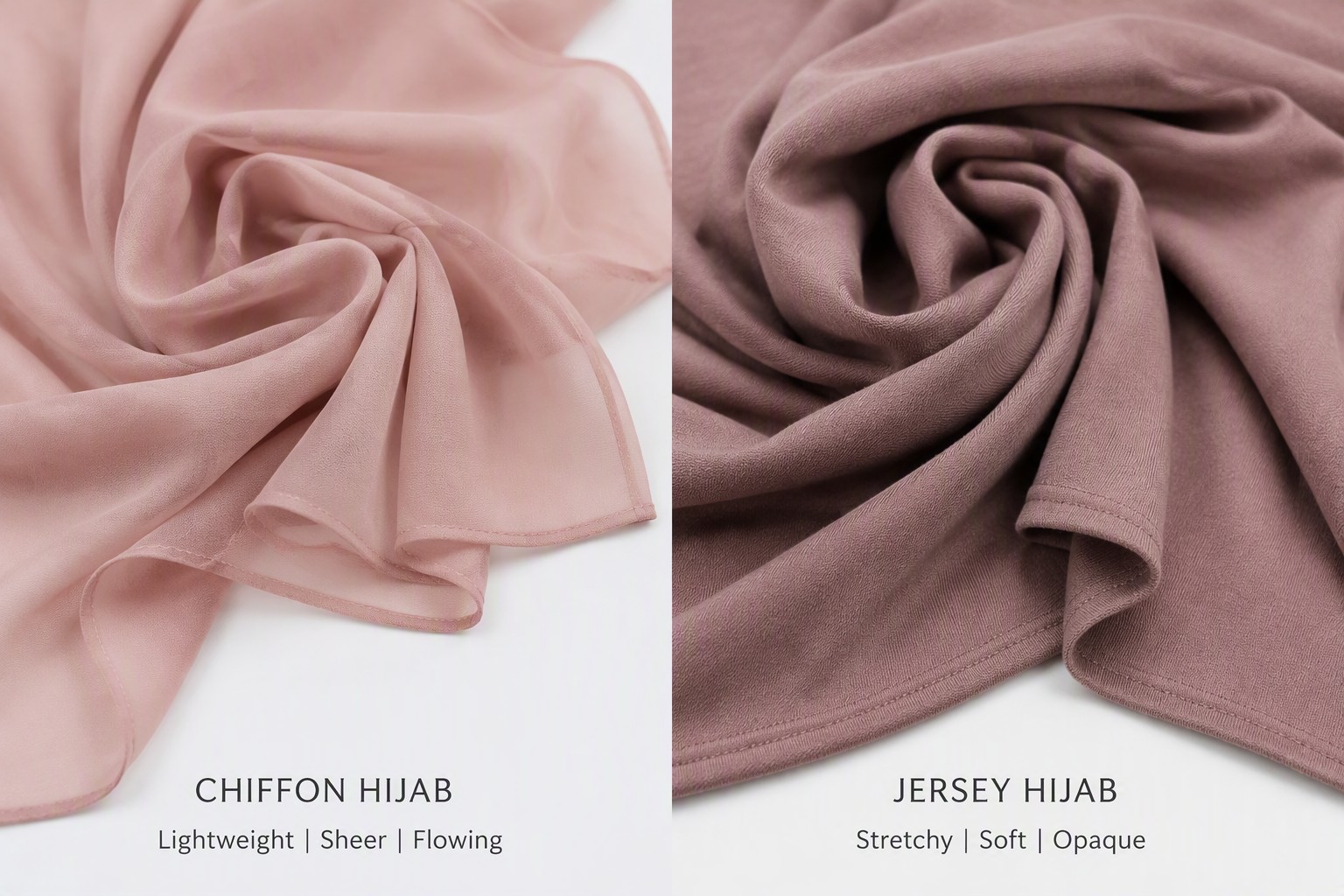
Digital textile printing on hijab fabrics uses two main ink systems: reactive inks for natural-fibre modal (which bonds chemically with cellulose fibres for strong wash fastness) and pigment inks for polyester-modal blends or jersey fabrics that do not take reactive dyes effectively. Each system requires different pre-treatment chemistry and different cure conditions.
Cure temperature is critical for colour development and wash fastness. For reactive printing, the fabric typically passes through a steamer or heat-fixation unit at 100–102°C for 8–12 minutes. For pigment printing, a curing oven at 160–180°C for 2–4 minutes bonds the binder to the fibre surface. Deviation from these parameters — by even 5–10°C — changes colour density and reduces fastness performance.
Fabric tension during printing matters because knit hijab fabrics are not dimensionally stable under the stress of a print run. A fabric that enters the printer under too much tension will relax after printing and the design will appear compressed. Too little tension produces print placement variation. A production-grade digital printer for knit fabrics should have a dedicated tension system — a series of rollers and a fabric-feed regulator that holds the substrate at a consistent tension throughout each job.
Colour management begins with ICC profiling — a calibration file that maps how a specific printer, ink set, and substrate combination reproduces colour. A supplier with properly maintained ICC profiles can reproduce a colour reference more reliably than one relying on operator visual judgment. When evaluating a supplier, ask whether they maintain substrate-specific ICC profiles and how frequently they recalibrate.
Part 4: Our Factory Capability — Equipment Built for Printed Knit Fabrics
Our production experience with modal and jersey hijab printing has led us to invest in and continuously optimise our print equipment for knit-fabric specific requirements, rather than using standard textile printers configured for woven fabrics.
The tension control system on our primary print lines uses a multi-zone roller feed with individual tension monitoring per zone. This holds the fabric at ±5% of the target tension throughout the print run, which is sufficient to maintain placement accuracy on our standard print patterns to within ±1.5 mm from the design reference. For geometric patterns with hard edges, this level of control is the difference between a clean production result and a shipment with visible placement inconsistency.
Cure temperature is monitored using inline temperature verification at entry and exit of the fixation unit, with readings logged per production batch. Our team focuses on validating that the cure profile — temperature, dwell time, and ramp rate — matches the specification for each ink-substrate combination. This data is available to buyers on request as part of the production record for their order.
For reactive printing on modal, our standard fixation protocol targets 101°C for 10 minutes under controlled humidity, monitored by a calibrated thermocouple rather than relying on the equipment's own display. For pigment printing on jersey blends, we run a cure oven at 170°C with a 3-minute dwell, verified by heat-transfer tape on the first fabric piece of each production session.
Colour management is maintained through substrate-specific ICC profiles that are rebuilt when we introduce a new fabric batch, when the printer undergoes maintenance, or when seasonal checks indicate colour drift beyond our internal tolerance of ΔE 1.5 from the reference card. Each order's colour reference card is filed and retained, so repeat orders can be matched against the original approval standard rather than the last production run.
Part 5: Quality Control — AQL Outgoing Inspection Before Shipment
Our three-stage QC process concludes with a structured outgoing inspection before every shipment, applied to finished and packed goods using an AQL 2.5 sampling plan.
The AQL 2.5 standard defines the number of pieces to inspect from each shipment lot and the maximum number of defects permitted before a lot is placed on hold for re-inspection or rework. For a typical order of 500 pieces, the AQL 2.5 plan requires a sample of 50 pieces, with a maximum of 3 major defects accepted. If 4 or more major defects are found in the sample, the entire lot is re-inspected piece by piece before release.
Defect categories for printed hijabs in our outgoing inspection are: colour deviation greater than ΔE 2.0 from the approved reference card (major); print placement outside ±1.5 cm from the design specification (major); visible streak, banding, or ink drop artefact on the print surface (major); hem width outside ±2 mm tolerance (minor); loose thread longer than 3 cm at a seam (minor). The inspection team uses a calibrated lightbox at D65 illuminant for colour comparison to eliminate the effect of ambient light variation.
Dimension checks are carried out on 10% of the inspection sample using a calibrated measuring board. Length and width are recorded against the order specification and any piece outside ±1.5 cm on either dimension is classified as a dimension non-conformance. Buyers who require tighter tolerances for specific retail packaging requirements can discuss ±1.0 cm as an upgraded specification at the order stage.
The outgoing inspection report — recording sample size, defect findings by category, and the final accept/reject decision — is issued per shipment lot and shared with the buyer as part of the shipping documentation. This gives buyers an objective quality record for each shipment that can be referenced if any quality questions arise after delivery.
Part 6: Brand Development Advice — Build a Print Library, Not Just a Catalogue
Brands that succeed with printed hijabs over multiple seasons treat their print designs as assets rather than one-time orders. This requires a different approach to supplier selection and order management.
First, document your colour approvals. When a sample is approved, keep the physical piece and note the substrate batch, the print date, and the supplier's colour reference code. This becomes your master reference for every repeat order. A supplier who maintains their own colour records cannot correct for drift if you have no reference to compare against.
Second, design for repeatability from the start. Designs with complex gradients, precise photographic details, or very fine line work are harder to reproduce consistently than geometric patterns or botanical motifs with clear colour separation. If repeat-order consistency is a priority, discuss your design with the supplier before finalising artwork to identify any elements that will create production risk.
Third, use pilot orders to establish your baseline. A pilot of 100–200 pieces on a new design gives you a production approval reference under actual production conditions — not just sample-room conditions. The approved pilot piece should be signed, labelled with the production date, and retained as the standard for all subsequent repeat orders.
Fourth, ask for production data with your orders. A supplier who can share cure temperature logs, colour deviation records, and AQL inspection reports is giving you visibility into the process behind the product. This transparency is a reliable indicator of production maturity and a supplier who will protect your quality programme as your order volumes grow.
A Practical Print Supplier Evaluation Checklist
When evaluating a printed hijab supplier, ask these questions: Does the printer have a dedicated tension control system for knit fabrics? What ICC profiles do they maintain and how frequently are they updated? Can they provide cure temperature logs from a recent production run? What is their internal colour tolerance, and how is it measured? What AQL level do they apply at outgoing inspection, and can they share a recent inspection report format? How are colour reference cards stored and indexed for repeat orders?
A supplier who can answer these questions with documented evidence rather than verbal assurances is demonstrating that their quality results come from a controlled process, not from careful sample-room work that does not carry over into production.
Conclusion: Equipment and Process Define the Supplier, Not the Sample
The right printed hijab supplier for a growing brand is one whose equipment, colour management system, and inspection process make consistent results the normal outcome rather than the exception. Samples show what a supplier is capable of on a good day. Production data and process documentation show what they deliver on every day.
Our team focuses on equipment-driven consistency — maintained ICC profiles, monitored cure parameters, and a documented AQL outgoing inspection — so that brands who build their identity around signature prints can count on the same result from order one to order fifty.
If you have a print design brief — artwork files, colour references, and a quantity requirement — send it to us and we will provide a technical assessment of the design alongside a production quotation. We will identify any production risk points in the artwork before sampling begins, so your approval process is more efficient and the production result is closer to your reference from the first run.
Frequently Asked Questions
What print technology is best suited for modal and jersey hijabs?+
Digital reactive printing delivers the sharpest results on natural-fibre modal, while pigment printing suits jersey blends that resist reactive dyes. The key differentiator is not the ink type but the printer tension system — knit fabrics must be held under controlled tension throughout the print run or pattern placement shifts between pieces.
How do suppliers maintain colour consistency across multiple orders?+
Consistent colour requires a calibrated ICC profile for each substrate, a controlled cure temperature validated by a heat-transfer tape or thermocouple, and a reference colour card filed per order. Without these controls, the same design can shift by more than ΔE 3.0 between runs — visible to a trained eye at retail.
What is AQL and how does it apply to printed hijabs?+
AQL (Acceptable Quality Level) is a statistical sampling standard that defines how many pieces to inspect and how many defects are permitted before a shipment is rejected. For printed hijabs, AQL 2.5 is a common B2B benchmark, covering print alignment, colour uniformity, hem quality, and dimensions. A documented AQL inspection report gives buyers an objective quality record for each shipment.
Can I order a small quantity to test a new print design before scaling up?+
Yes. Our production experience allows brands to place pilot quantities from 100 pieces per design to validate colour approval, fabric handle, and label placement before committing to a full run. The pilot uses the same equipment, ink, and process as volume production, so the approval result transfers directly.
What dimension tolerances should I expect for cut-and-hem hijabs?+
Industry-standard tolerance for finished hijab dimensions is ±1.5 cm on each edge for square and rectangular styles. Tighter tolerances of ±1.0 cm are achievable with a dedicated cutting programme and fixed fabric-feed tension. Discuss your tolerance requirement before sampling so it is built into the production instruction.
How should I submit a print design file to avoid production problems?+
Submit artwork as a high-resolution PDF or TIFF at 150–300 dpi at production scale, with colour values specified in CMYK or Pantone references where critical. Include a physical or calibrated-screen colour reference. Avoid submitting compressed JPEGs or RGB-only files, as the colour conversion to print profiles can introduce unexpected hue shifts.
Need a quote for your next order?
Free samples available. MOQ from 100 pieces. Ships to 50+ countries.
Request a Quote