Quick Summary
Choose a placement print when one composed layout must appear in a controlled position on every hijab. Choose an all-over repeat when a tile can be cut at different points while keeping the overall surface coherent. The decision affects motif scale, border width, corner handling, and how the design appears when the rectangular hijab is wrapped. Confirm the finished size, base fabric, and hem finish before approving the first sample.
The choice between a placement print and an all-over repeat is a design decision, not a technical label to leave for the printer. It determines whether every hijab carries one controlled composition or whether each cut piece receives a different section of a repeating surface. It also changes how you plan borders, corners, motif scale, and the parts of the design that remain visible when the rectangle is worn.
For a brand founder, designer, or boutique buyer developing a custom printed hijab, the right format is the one that protects the visual idea through cutting, hemming, and styling. This guide focuses on that decision. It does not assume that one format is always better, and it does not treat the base fabric as interchangeable: the same artwork may need separate sample approval on modal and jersey because the fabric surfaces are different.
What the Two Print Formats Mean
A placement print is one composition designed for the finished hijab. A border may run along one long edge, a large motif may sit near a corner, or a gradient may travel from one end to the other. The intended position of the artwork relative to the hijab edges is part of the design brief, so every piece should be checked against that layout.
An all-over repeat is a tile that continues across the printable area. The tile may be geometric, floral, abstract, or built from a smaller motif. Each hijab is cut from the printed length, so the exact position of a motif can vary from piece to piece while the surface still reads as one consistent pattern. The tile edges must join cleanly, or the repeat will show a visible break.
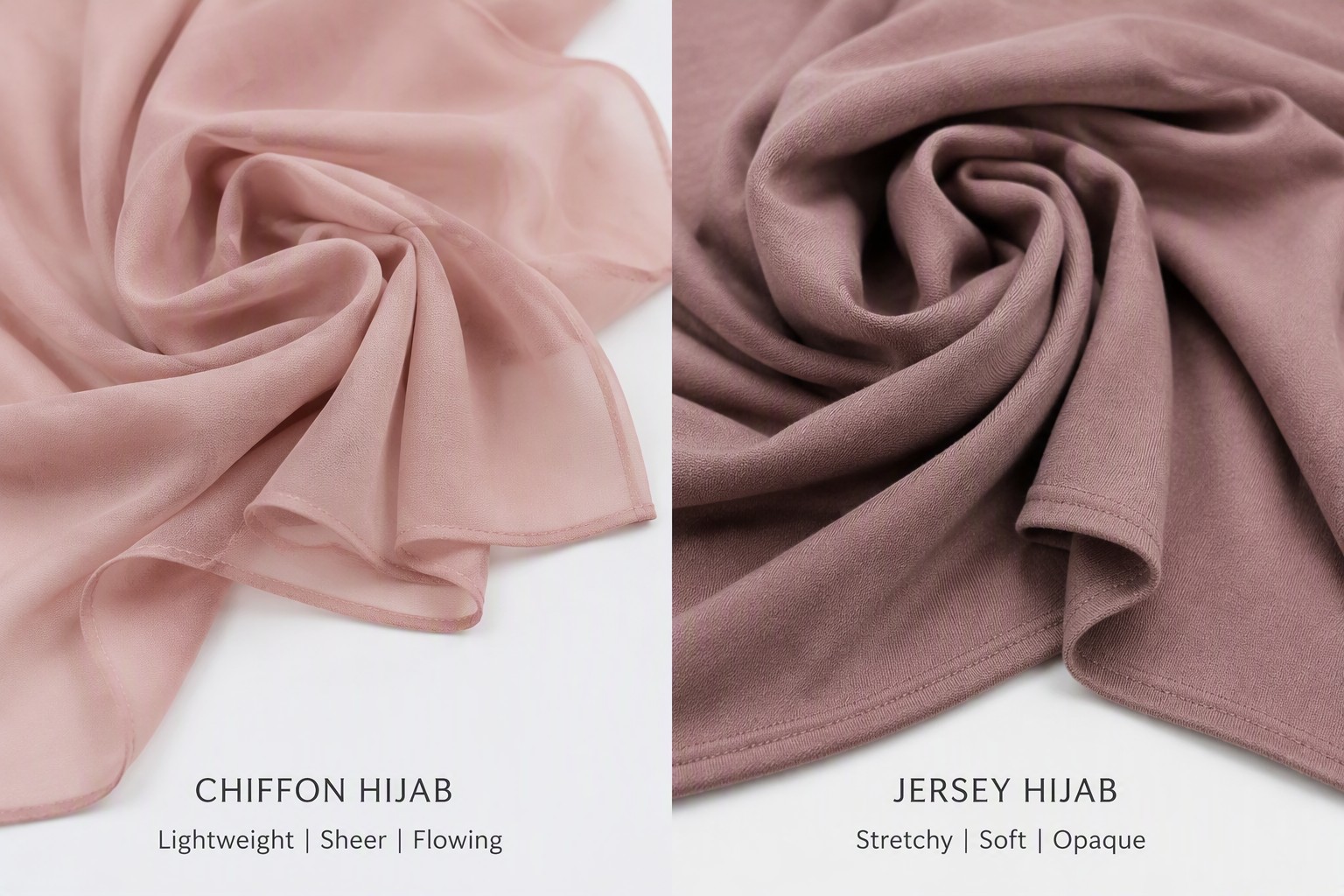
Neither format describes the fibre or the fabric structure. Modal identifies a fibre category, while jersey identifies a weft-knit construction. A jersey modal hijab can therefore carry either a placement print or a repeat; the print format and the material description answer different questions.
When a Placement Print Is the Better Starting Point
Choose placement when the artwork tells one visual story across the rectangle. A framed border, a large botanical composition, a logo-led corner, or a deliberate end-to-end colour movement benefits from controlled coordinates. The design is judged by whether the key elements land where the wearer and camera will see them.
Placement also suits a collection whose identity depends on a recognisable hero image. If a particular flower, emblem, or colour field must appear near the front edge on every piece, an all-over repeat gives the cutter too much freedom. Write the orientation into the brief and show which end is intended to be the front or feature end.
The trade-off is that placement is less forgiving. A border that is too close to the edge, a motif that is too large for the finished rectangle, or a design that does not allow for cutting tolerance can lose its balance. Review the layout at the actual hijab size, not only as a square social-media mock-up.
When an All-Over Repeat Gives the Collection More Flexibility
Choose an all-over repeat when the design should feel continuous rather than tied to one focal point. Small florals, abstract marks, evenly spaced geometry, and textures that can be worn in several directions are natural candidates. A repeat makes it easier to cut multiple pieces from a printed length without requiring every motif to land at one exact coordinate.
The key design task is to define the tile before the file is released. State the tile width and height in centimetres, test the join on all four sides, and inspect the pattern at full size. A tile that looks seamless at thumbnail scale may reveal a line, gap, or sudden change in rhythm when it is printed across a long fabric panel.
Repeat does not mean random. The motif scale, spacing, direction, and density still control how the hijab looks around the face and shoulders. Make a simple full-rectangle mock-up and mark several possible fold positions. If the pattern becomes too busy when doubled over, reduce the motif scale or open the spacing before sampling.
Plan the Rectangle Around How the Hijab Is Worn
A hijab is not viewed flat for most of its life. Long edges may frame the face, short ends may fall over the chest, and folds can hide part of a motif. Start by marking the main viewing zones on the finished rectangle: the face-framing areas, the shoulder fall, and the ends that may be displayed or tucked.
For placement artwork, keep the most important motif in a zone that remains visible after the expected fold. For a repeat, check whether the motif scale stays legible when the fabric is gathered or layered. This is a design review, not a promise about how every customer will style the hijab; the goal is to avoid placing all the visual interest in a zone that commonly disappears.
Use the actual finished dimensions supplied for the style. Yiling lists custom printed modal hijabs at 180 x 75 cm, while listed jersey modal styles use other dimensions. Do not carry the canvas from one base or product into another without confirming the cut size first.
Borders, Corners, and the Hem
Borders need more planning than a simple line around the artwork. Decide whether the border runs on one edge, two edges, or all four. Then check how the design turns at the corners. A corner that meets perfectly in a flat file may look heavy after folding, while a border that stops abruptly may look unfinished when the hijab is draped.
Keep logos, faces, fine lines, and other non-negotiable details inside the edge. Edge finishing takes up fabric: a rolled edge folds a narrow strip under, an overlocked finish wraps thread over the edge, and other finishes may trim or turn the fabric. Let background colour or pattern reach the edge so a narrow unprinted line does not appear after finishing.
The hem finish is part of the design approval. Yiling supports rolled edge, overlocked, and other hemming options, but the exact finish should be confirmed for the style. Ask for the relevant allowance before locking a border width, and review the border on the finished sample rather than relying on the screen file.
Motif Scale and Colour References
Motif scale should be judged at the finished print size. Very small details can lose visual separation when the fabric is folded, while an oversized motif can become unrecognisable when part of it falls outside the camera frame or is hidden in a wrap. Prepare one full-size mock-up and one close view of the smallest important detail.
For colours that are central to the brand, provide a Pantone reference or physical swatch rather than relying on a screen value. Screens vary in brightness and colour settings, while fabric reflects light and different fabric surfaces can make the same artwork appear different. If the same placement or repeat is planned on modal and jersey, approve the colour on each base separately.
Do not use a cover image or digital mock-up as evidence of the final fabric colour. A visual reference can explain the concept, but the first sample is where the brand should review the actual printed surface, layout, and hem interaction.
A Brief That Prevents Ambiguity
A useful brief names the base fabric and finished size, identifies placement or repeat, states the tile dimensions when relevant, marks the intended orientation, and shows the hem finish to be reviewed. Add a full-rectangle preview with safe zones, a close-up of important detail, and a short note explaining which colours are brand-critical.
Yiling accepts AI, EPS, PDF, PSD, and TIFF files. Supply artwork at the required resolution for the final print size, and include a clear JPG preview so the receiving team can confirm that the working file matches your intent. Name each file by design and colourway, and keep version numbers consistent when you send revisions.
If a low-resolution reference needs to be redrawn, treat that redraw as a design step that requires approval. Do not assume that enlarging a small image creates usable detail. The purpose of the first sample is to test the approved design on the chosen fabric, not to discover which version of an unclear file was printed.
The First-Sample Review
Review a placement sample against the full-rectangle layout first. Check orientation, key motif position, border width, corner behaviour, and the distance between important details and the edge. Then review it in a few realistic folds so you can see which parts remain visible.
Review a repeat sample for tile continuity, motif scale, spacing, and the way the pattern reads when folded. Look for visible seams in the repeat, unexpected cropping of key marks, or a density that feels different from the approved mock-up. Record one change at a time so the next sample answers a specific question.
Also compare the printed sample with the agreed colour reference under consistent lighting. Screen approval is not a substitute for physical review, and the sample should not be described as a test result for fastness, shrinkage, or sun protection unless separate reliable evidence has been provided.
Decision Checklist
Choose placement when the composition, border, or hero motif must land in a controlled position on every hijab. Choose an all-over repeat when the surface should remain coherent while pieces are cut at different points. In either case, confirm the actual finished size, base fabric, orientation, motif scale, edge safe zone, hem finish, colour references, and the approval questions you want the first sample to answer.
When the brief is ready, use the Request a Quote button below this article to share the design direction and ask about the appropriate custom printed modal or jersey modal development path. A clear decision between placement and repeat gives the design team something precise to review before the first sample is made.
Frequently Asked Questions
What is a placement print on a hijab?+
A placement print is one composition designed for the finished hijab, with motif and border positions controlled relative to the edges. Every piece is intended to follow the same layout.
What is an all-over repeat hijab print?+
An all-over repeat uses a tile that continues across the printable area. The exact motif position can vary from piece to piece, but the tile should join cleanly so the surface reads as one pattern.
Which is better for a border hijab design?+
Placement is usually the clearer starting point when a border must sit at a particular edge or turn consistently at the corners. The border still needs a safe zone for the chosen hem finish and approval on the finished sample.
Does repeat or placement describe the fabric?+
No. Placement and repeat describe the artwork layout. Modal describes a fibre category, while jersey describes a weft-knit fabric structure. A jersey modal hijab can use either print format.
How do I choose motif scale for a custom hijab print?+
Judge the motif at the finished hijab size and in a few realistic folds. Make sure the smallest important detail remains legible and that the design does not become too dense when layered.
What should I send with a placement or repeat artwork file?+
Send the finished size, base fabric, orientation, print format, tile size if it is a repeat, hem direction, safe-zone preview, colour references, and a clear full-rectangle mock-up. Yiling accepts AI, EPS, PDF, PSD, and TIFF files.
Need a quote for your next order?
Free samples available. MOQ from 100 pieces. Ships to 50+ countries.
Request a Quote