Quick Summary
Sourcing private label and custom printed headscarves from an OEM hijab factory in China offers significant cost and scale advantages, but success depends on verifiable manufacturing systems rather than superficial vendor claims. A dependable OEM partner provides transparent remote auditing, strict incoming fabric quality control, and reproducible digital reactive printing standards. Our production facility specializes in custom printed modal and high-elastic jersey hijabs, operating under documented incoming inspection protocols and supporting overseas buyers with live video line tours. We help emerging fashion founders transition smoothly from low-MOQ pilot batches of 100 pieces to reliable multi-thousand-unit seasonal drops.
Navigating the Global Supply Chain: Why Factory Selection Defines Brand Equity
For modest fashion entrepreneurs in North America, the United Kingdom, and the European Union, the decision to partner with an OEM hijab factory in China represents a pivotal growth milestone. The Chinese textile ecosystem offers an unmatched combination of digital reactive printing precision, high-grade cellulosic fiber processing, and cost-efficient specialized hemming labor. When executed properly, an OEM partnership unlocks gross product margins that allow independent labels to compete aggressively against established fashion houses while funding continuous social media marketing campaigns.
However, navigating overseas manufacturing carries inherent operational risks when buyers rely on superficial platform listings rather than verifiable production standards. The modest fashion landscape is crowded with commercial middlemen presenting themselves as direct factories while brokering production across fragmented workshops. A brand that partners with an unvetted supplier frequently suffers from unpredictable delivery delays, shifting fabric hands between batches, and color variances that ruin product photography. Transforming an overseas supply chain into a competitive advantage requires understanding the technical verification checkpoints that distinguish an engineering-focused OEM manufacturer from an ordinary reseller.
Part 1: The Buyer Problem -- The Vulnerabilities of Unvetted Overseas Sourcing
The most common nightmare for emerging modest fashion boutique owners begins with a flawless sample followed by a disastrous bulk delivery. A founder orders a prototype scarf from a commercial intermediary; the sample arrives with silky modal drape, vibrant color saturation, and razor-sharp baby hemming. Reassured by the initial piece, the founder commits thousands of dollars to a bulk production run of 1,000 units for an upcoming seasonal collection.
When the shipping cartons finally clear customs and arrive at the fulfillment center, the discrepancies emerge. The bulk fabric feels noticeably thinner and coarser than the sample piece. Colors that appeared rich and warm in the initial prototype exhibit a chalky cast or show visible banding lines across the fabric face. Worse, the perimeter hems curl and pucker along the bias, making the scarves look cheap on display and triggering an immediate wave of customer returns upon launch.
This failure happens because the commercial intermediary did not own a manufacturing facility. The initial sample was custom-crafted in a boutique studio to win the contract, but the bulk production order was farmed out to the lowest-bidding subcontracting mill. Because the broker lacked technical oversight and raw material control, the mill substituted inferior lower-GSM polyester blends and skipped essential steam fixation cycles to cut processing expenses. Independent brands can avoid this trap entirely by demanding direct operational transparency and partnering exclusively with verified manufacturing plants.
Part 2: Industry Trend -- The Shift Toward Verified Manufacturing Transparency
The global fashion market is undergoing a profound regulatory and cultural shift toward supply chain traceability. European Union regulations on textile sustainability and supply chain due diligence are mandating that fashion brands trace garment components back to raw fiber sources. Simultaneously, digital-native consumers on Instagram, TikTok, and YouTube actively demand proof that garments are produced ethically and without harmful chemical residues.
For modest wear brands, this trend represents a major commercial opportunity. Labels that can show authentic factory floor footage, publish OEKO-TEX Standard 100 chemical safety test results, and detail their environmental water purification processes build powerful consumer loyalty. Savvy brand founders are no longer asking suppliers merely for their lowest unit price; they are evaluating supplier documentation systems, environmental effluent compliance, and labor standards.
Consequently, progressive OEM hijab factories in China have modernized their operating models. They have transitioned from opaque, low-cost commodity producers into technical manufacturing partners that offer open remote auditing, rigorous documentation archiving, and direct engineering consultations. Sourcing has evolved from a game of blind trust into a structured partnership based on shared data, standardized testing, and mutual commercial growth.
Part 3: Technical Knowledge -- Fabric Grading, Dye Bonding, and Dimensional Tolerances
Conducting technical conversations with an OEM hijab factory requires fluency in the engineering principles of headscarf manufacturing. Three technical variables govern ninety percent of physical product quality: greige fabric yarn grading, reactive dye chemical fixation, and mechanical hemming geometry.
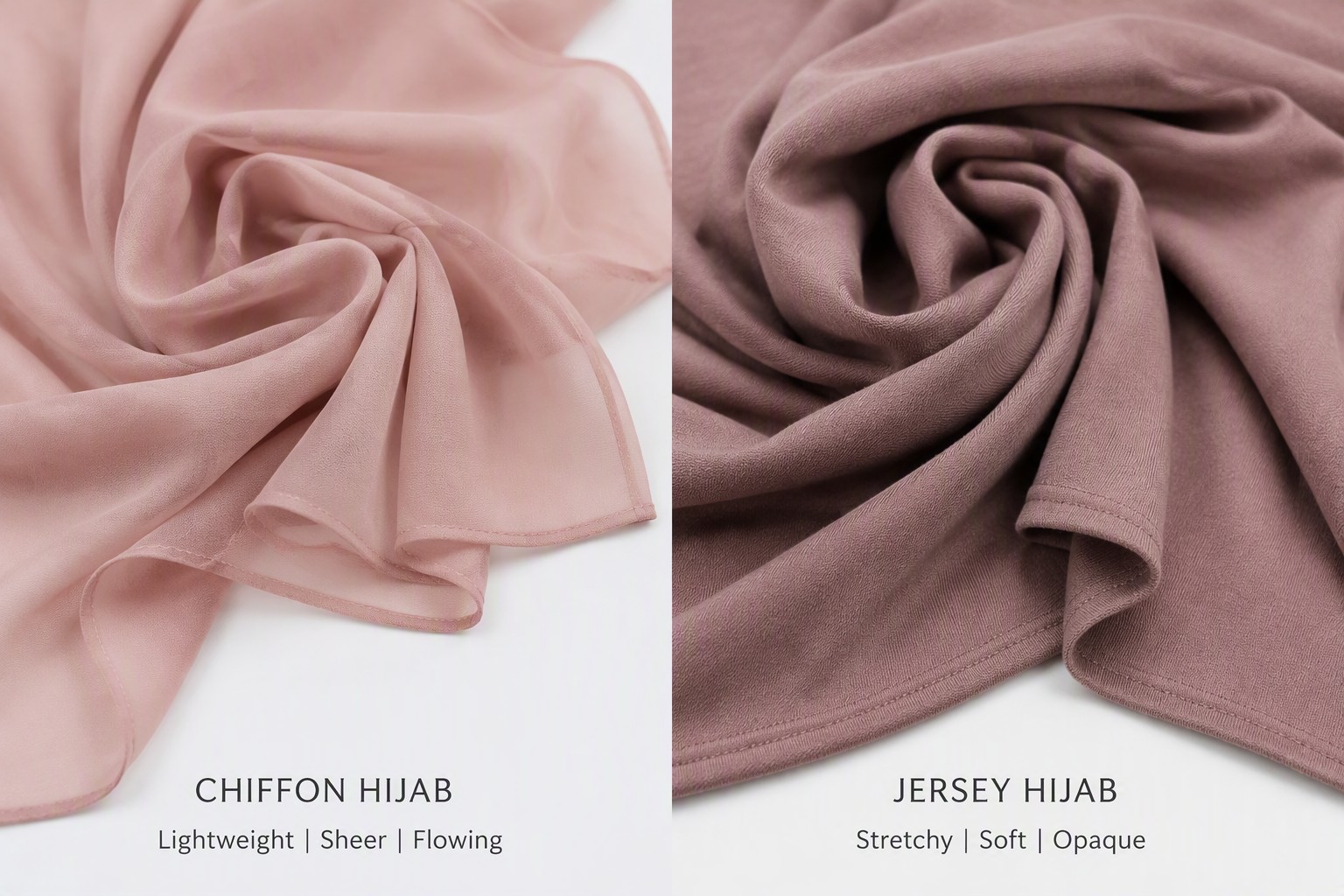
The foundation of any luxury hijab is the greige yarn specification. For custom printed modal, the industry benchmark is an 80s or 100s combed micro-modal weave yielding a finished weight of 85 to 95 grams per square meter (GSM). Coarser 40s or 60s yarns feel heavy, trap heat around the neck, and lack the fluid, liquid-like drape that customers associate with premium modest wear. For stretch jersey hijabs, the preferred construction is a single-knit jersey utilizing 50s modal or bamboo yarn blended with 5% to 7% elastane, calibrated at 180 to 210 GSM. This specific blend ratio provides excellent four-way stretch recovery without sagging over repeated daily wear.
The second critical factor is the chemical dye system. Direct pigment printing coats ink binders on top of the fabric surface, creating a stiff film that cracks after washing and impedes natural fiber breathability. In contrast, true digital reactive printing employs water-soluble reactive dyes that chemically bond with the hydroxyl groups of the cellulose fiber under high-temperature saturated steam (102°C to 105°C). This molecular bond ensures that the fabric maintains its buttery hand feel while achieving commercial Grade 4 wash fastness under ISO 105-C06 international standards.
Finally, dimensional tolerances must be strictly controlled. Standard rectangular hijabs (such as 180 x 70 cm or 200 x 70 cm) require precision automated rotary cutting with alignment guides. If a factory cuts fabric manually with dull shears, the weave skews off-grain, creating a parallelogram distortion that prevents the scarf from folding cleanly along its centerline. Professional OEM facilities maintain cutting tolerances within ±1.5 cm and ensure edge hem widths remain strictly between 1.0 mm and 1.5 mm.
Part 4: Our Factory Verification -- Transparent Remote Auditing and Operational Access
Our team believes that long-distance manufacturing relationships thrive on complete operational transparency. For overseas buyers who cannot travel to our facility in China due to scheduling or budget constraints, we have built a structured remote verification workflow that provides full visibility into our production operations.
We provide scheduled, real-time video audits conducted via high-definition mobile streaming equipment. During these live sessions, a bilingual technical manager walks the buyer through our raw material warehouse to view incoming fabric lots and OEKO-TEX storage certifications, demonstrates our digital printing rooms to view print head calibration and nozzle test patterns, walks through our steam fixation chambers and tensionless washing ranges, and visits the finished hemming lines. Buyers can request unscripted close-up views of any machine, inspect fabric edges directly, and ask technical questions directly to workshop supervisors.
Furthermore, our facility routinely hosts third-party inspection agencies commissioned by international clients, including SGS, Bureau Veritas, and Intertek. We maintain standardized documentation dossiers covering worker safety protocols, chemical storage standards, environmental water treatment systems, and calibrated instrument maintenance logs. By making our factory floor completely transparent, we eliminate the uncertainty of remote overseas sourcing and give brand founders total confidence in their manufacturing backbone.
Part 5: Quality Control -- The Rigorous Protocol of Incoming Fabric Inspection
At our manufacturing plant, quality control begins long before digital printers deposit the first drop of reactive ink. Raw fabric variations represent the single largest contributor to finished garment defects. To eliminate quality drift at the root, our dedicated quality control department enforces a mandatory four-point incoming fabric inspection protocol on every delivery of greige rolls.
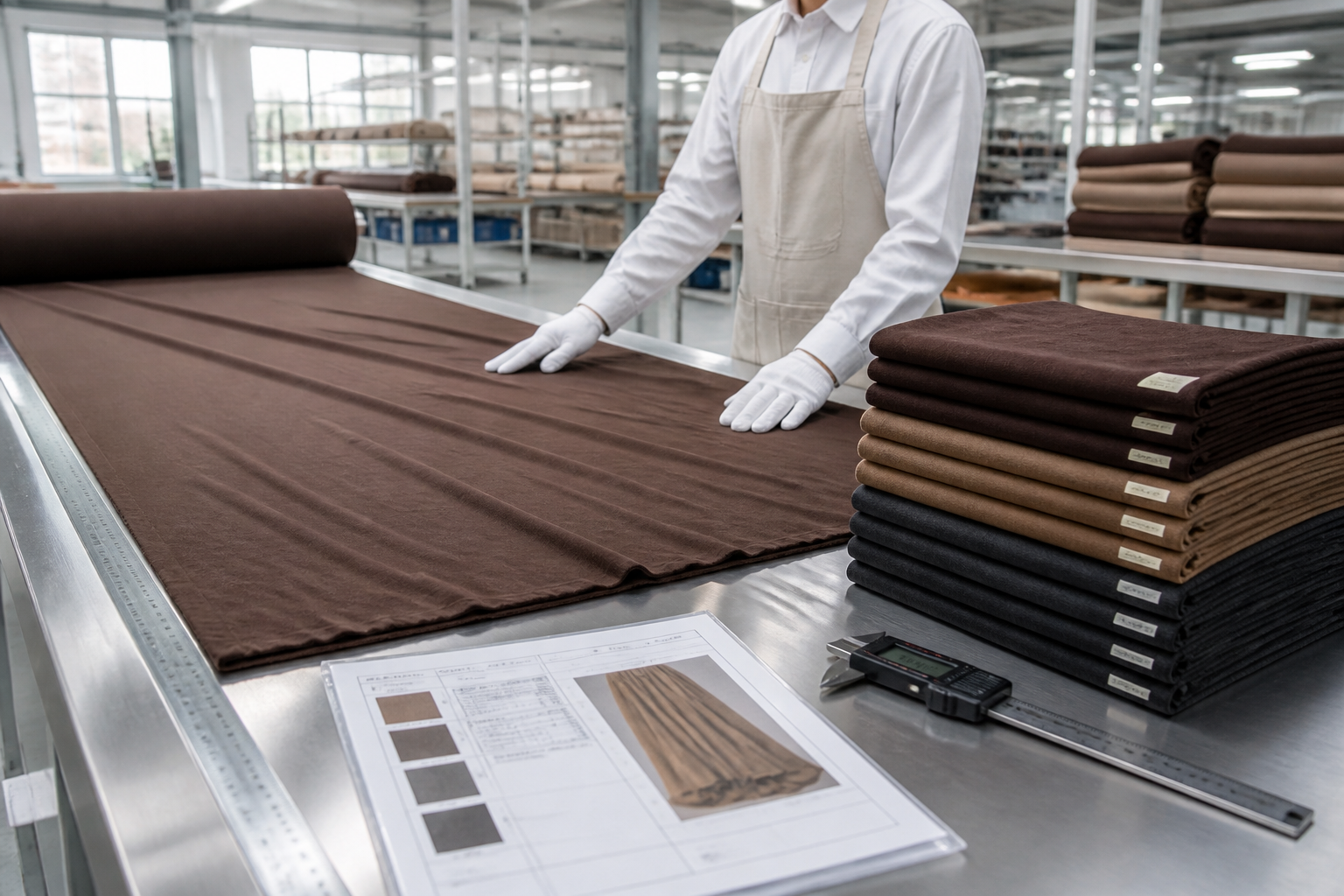
Upon arrival at our warehouse, every fabric lot is quarantined until our laboratory technicians complete initial compliance testing. We draw specimen swatches across the beginning, middle, and end of selected rolls to perform circular disc cutter GSM testing. The measured weight must match the approved technical specification within a tight tolerance of ±3%. Fabric rolls falling outside this weight threshold are immediately flagged and rejected to ensure seasonal thickness continuity across production runs.
Next, fabric rolls pass through automated, variable-speed fabric inspection machines equipped with top and bottom optical lighting banks. Specially trained fabric auditors inspect rolls at a controlled speed of 15 meters per minute, scoring defects according to the international ASTM D5430 Four-Point System. Every yarn knot, slub, oil spot, weft skew, and weaving hole is measured and recorded. Any lot exceeding 1.5 penalty points per hundred square yards is disqualified. Finally, we measure base fabric whiteness index and surface pH using precision spectrophotometers to guarantee that incoming fabric will react consistently with our established dye formulas.
Part 6: Brand Development Advice -- The Scalable Path From Pilot Run to Mass Volume
The most common strategic error made by modest fashion startups is jumping prematurely into massive wholesale purchase orders before testing customer response and establishing manufacturing baselines. Conversely, some brands remain trapped in tiny 20-piece boutique purchases that erode profit margins and prevent them from branding their products with custom woven tags and custom packaging.
We advocate for a disciplined, tiered scaling model. Begin your brand journey with an agile pilot production run of 100 to 150 pieces per colorway across three to four core aesthetic neutral shades. This initial run allows your creative team to produce campaign lookbooks, seed social media influencers, and collect real customer fit feedback with minimal capital risk. More importantly, this pilot batch establishes your approved physical strike-off references, digital ICC color profiles, and packaging design specs inside our production database.
Once your product drop proves commercial traction and your sales data identifies top-selling colorways, scaling up to 500 or 1,000 pieces per shade becomes a seamless operational reorder rather than an anxious gamble. Because all technical parameters -- fabric lot formulas, steaming temperatures, and hemming stitch densities -- were locked and archived during your pilot run, bulk expansion delivers identical hand feel and color fidelity at substantially lower per-unit production costs.
If you are seeking a reliable OEM hijab factory in China to manufacture your brand’s upcoming collection, our engineering team is ready to assist. We invite you to schedule an initial technical consultation and live video factory walkthrough to review your product specifications, examine our fabric swatches, and map out a structured pilot production plan tailored to your launch calendar.
Frequently Asked Questions
What is the primary difference between a trading company and a direct OEM hijab factory in China?+
A direct OEM hijab factory owns and operates dedicated printing lines, fixation steamers, and post-wash finishing facilities, giving technical engineers direct control over ink recipes, steam dwell times, and sewing tension. A trading company acts as an intermediary, outsourcing production to third-party contract mills. Working directly with a genuine OEM factory eliminates middleman markups, cuts communication latency by half, allows direct technical adjustments during sampling, and ensures that approved fabric specifications remain identical across repeat bulk orders.
How does an OEM hijab factory verify the authenticity of sustainable modal fibers?+
Authentic sustainable modal requires documented chain-of-custody verification. A legitimate OEM manufacturer sources raw greige goods from spinning mills certified under OEKO-TEX Standard 100 and utilizing authentic Lenzing Modal or verified eco-harvested beechwood viscose fibers. Brands should demand mill test certificates showing chemical safety compliance, fiber purity percentages, and absence of restricted substances such as formaldehyde, azo dyes, or heavy metal mordants before bulk cutting begins.
Can overseas buyers conduct a factory audit without traveling physically to China?+
Yes. Modern OEM hijab factories provide comprehensive remote auditing options. Through scheduled high-definition live video walkthroughs, overseas buyers can inspect greige fabric storage racks, examine digital inkjet print heads during active runs, witness post-print washing and stentering lines, and observe QC personnel performing light box color inspections in real time. Reputable factories also welcome third-party inspection agencies such as SGS, Intertek, or QIMA for on-site social and quality audits.
What parameters should be tested on incoming greige fabric before printing begins?+
Incoming fabric rolls must undergo standardized testing: actual fabric weight (GSM measurement using precision circular cutters across three points of the roll width), warp and weft yarn density, dimensional skew or weft bow (must be under 2.5%), whiteness index, and baseline pH value. Testing these parameters ensures the fabric absorbs reactive dyes evenly and prevents skewing during downstream rotary finishing.
What are typical production lead times for custom OEM hijab manufacturing in China?+
For an initial OEM order with custom strike-offs and bespoke branded packaging (woven labels, hang tags, and frosted slider bags), pre-production sampling and lab dips take 5 to 7 working days. Once strike-offs are approved, bulk manufacturing of 300 to 1,000 units requires 15 to 22 working days, encompassing printing, steaming, washing, precision hemming, and AQL 1.5 final inspection. Repeat reorders utilizing archived color profiles typically ship within 12 to 16 days.
How should a modest fashion startup structure its initial order with an OEM factory?+
We strongly advise founders to begin with a structured pilot run of 100 to 150 pieces per colorway across three to four core neutral shades. This test batch verifies the factory’s physical execution, communication speed, and packaging accuracy under commercial conditions with manageable capital outlay. Once the pilot run sells through and confirms customer demand, the brand can confidently scale up to 500 or 1,000 units per colorway using the exact technical parameters archived from the pilot run.
Need a quote for your next order?
Free samples available. MOQ from 100 pieces. Ships to 50+ countries.
Request a Quote