Quick Summary
Selecting an OEM hijab factory in China requires more than comparing price and MOQ -- it requires evaluating the factory's transparency systems: its willingness to show you the production floor, share process documentation, and maintain a traceable record for every order. This guide explains how to conduct a productive remote factory assessment, what documentation a professional OEM factory should provide, and how production records protect your brand when quality questions arise. Yiling Hijab supports remote video line tours and provides structured production documentation with every OEM order.
Introduction: Transparency Is the Missing Criterion in OEM Factory Selection
When brands begin sourcing from an OEM hijab factory in China, the evaluation criteria are usually price, MOQ, sample quality, and lead time. These are necessary criteria, but they are not sufficient.
The criterion most often overlooked in early-stage OEM sourcing is transparency -- the factory's willingness to show you its production environment, share its process records, and maintain documentation that traces your order from raw material to finished shipment.
A factory that produces an excellent sample under careful conditions but operates without structured documentation will not deliver consistent results at volume. The sample was made carefully. The production run will be made at speed. What connects the two is the factory's process discipline -- and transparency is both the evidence of that discipline and the mechanism by which you can hold the factory accountable.
This guide covers three topics: how to assess an OEM hijab factory's transparency before placing an order, what documentation a professional factory should provide with every shipment, and why production records protect your brand investment over the long term.
Part 1: Buyer Problem -- What You Cannot See From a Quotation
A price quotation from an OEM hijab factory tells you very little about how the factory actually operates. Two factories can quote an identical price for the same hijab specification and produce results that differ significantly in consistency, responsiveness, and problem-solving ability.
The information gap is most dangerous for brands placing their first OEM order. Without a production visit and without documentation from a previous order cycle, the buyer has no evidence base from which to evaluate the factory's process maturity. They are making a commitment based on sample quality, which is the result of a short, carefully managed production run, not of a typical 500-piece bulk order.
Common problems that emerge after the first bulk shipment include colour deviation between the sample reference and the production lot, construction differences in hem width or label position, and packaging that does not match the specification. These are almost never intentional deception by the factory -- they typically result from a handover breakdown between the sampling team and the production floor, combined with the absence of a documented production specification that travels with the order.
The buyer's problem is that they approved a sample, not a production process. Without visibility into the process -- either through a factory visit or through documented process checkpoints -- the gap between sample and production is filled by assumption rather than verification.
Part 2: Industry Trend -- Remote Assessment Has Become Standard Practice
Since 2020, remote factory assessment has moved from a temporary compromise to a standard practice in international OEM sourcing. Brands that previously required in-person factory audits have developed structured remote protocols that deliver comparable insight without the cost and time of international travel.
The most effective remote assessment tool is the structured video line tour -- a live or recorded walkthrough of the production floor conducted by a factory representative, covering key production areas and answering buyer questions in real time. This is different from a marketing video. A structured tour is unscripted, covers the entire production sequence from material storage through to finished goods, and allows the buyer to ask to see specific equipment or processes.
The factories that adapted quickly to remote assessment requirements have generally become stronger OEM partners across other dimensions too. A factory that invests in clear communication systems, prepares documentation for buyer review, and can articulate its production process on camera has typically built the same habits internally. Transparency is both a capability and a signal.
For brands sourcing OEM hijabs from China, the ability to conduct a thorough remote assessment is no longer a nice-to-have -- it is a baseline requirement for managing supply chain risk at a distance. Factories that cannot or will not support a structured remote assessment should be treated as higher-risk partners.
Part 3: Technical Knowledge -- What a Production Documentation System Looks Like
A professional OEM hijab factory maintains production documentation at three stages: before production begins, during the production run, and at the point of shipment. Each stage serves a different function.
Pre-production documentation confirms that the factory has received, reviewed, and accepted the buyer's specifications before any fabric is cut. A pre-production specification sheet should include the approved material details (fabric composition, GSM, supplier reference), the construction specification (hem type, stitch density, label placement with measurements), the colour approval reference, the packaging specification, and the agreed quantity and delivery date. This document is signed off by both the factory production manager and the buyer before production begins.
In-line documentation captures checkpoints during the production run. The most important is the first-article inspection record -- a documented check of the first completed piece from the production run against the approved sample and specification sheet. If a deviation is found at first article, production stops for a correction before the full run proceeds. The first-article record confirms that the production floor has received and applied the pre-production specification correctly.
Outgoing documentation covers the final inspection before shipment. This includes the AQL inspection record (sample size, defect findings by category, accept/reject decision), the dimension check results, and a packing list cross-referenced against the order specification. The outgoing inspection record is the buyer's primary quality evidence for each shipment -- it is the document that answers the question "what did the factory actually check before this left the building?"
Together, these three document sets create a traceable record from the buyer's approved specification to the finished shipment. When a quality question arises after delivery, this record identifies at which stage a deviation occurred and whether it was detected or missed by the factory's own checks.
Part 4: Our Factory Capability -- Open to Remote and In-Person Assessment
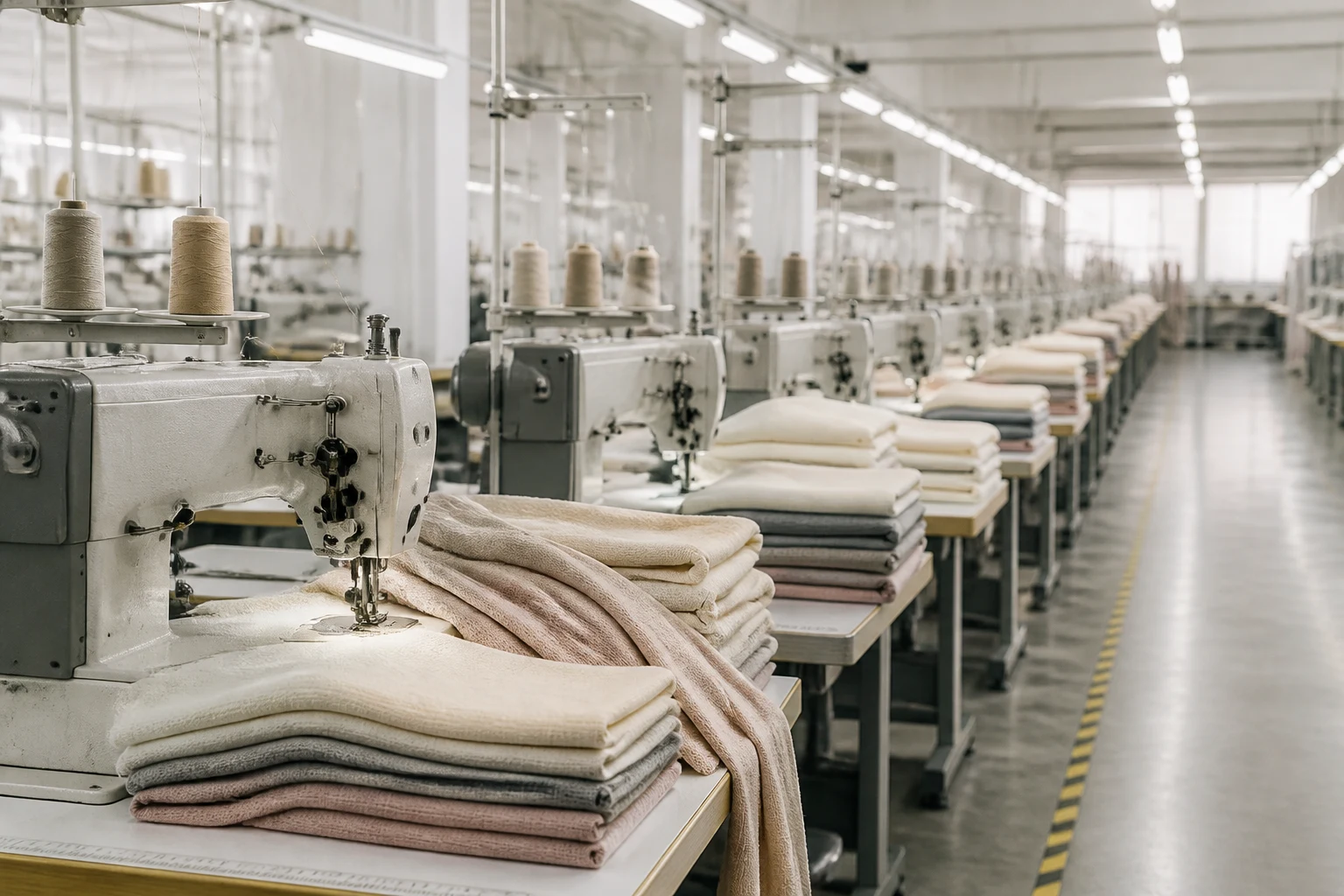
Our team focuses on providing international brand buyers with the visibility they need to make sourcing decisions confidently. For buyers who cannot visit in person, we offer a structured video line tour that covers each area of our production facility in sequence: the fabric and material storage area, the cutting room, the printing section (including our ink-management setup and fixation equipment), the sewing floor, the trimming and finishing area, and the final inspection station.
The tour is conducted as a live video call so that buyers can ask to see specific processes in more detail, request to see fabric construction up close, or ask questions directly to the production manager rather than only a sales representative. We do not pre-edit or selectively film our facility -- the purpose is to give you an accurate picture of where and how your product will be made.
For buyers who prefer a recorded walkthrough before scheduling a live session, we can prepare a narrated video of each production area with reference to the specific fabric types and processes relevant to their order. This is typically delivered within three to five working days of an inquiry.
We welcome in-person visits for buyers who travel to China or who are working with sourcing agents based in Guangdong or Zhejiang. Our production experience allows brands to time their visit around the production of their own order, so that they see their materials and construction in process rather than a general production run.
For buyers evaluating multiple factories remotely, we are also happy to provide documentation samples from previous orders (with buyer information removed) so that you can review the format and completeness of our pre-production sheets, first-article records, and outgoing inspection reports before placing an order.
Part 5: Quality Control -- Documentation as the Third QC Stage
Our three-stage QC process at Yiling Hijab includes incoming material inspection, in-line production checks, and outgoing final inspection. Each stage generates a written record that is filed against the order reference and retained for a minimum of two years.
The incoming material inspection record documents the fabric batch details (composition, GSM measured against specification, lot number, supplier reference), the colour verification result against the buyer's reference, and any defects or deviations found in the raw material. If a fabric batch fails the incoming check, it is quarantined and replaced before cutting begins. The record includes the quarantine decision and the replacement batch reference, so there is a clear trail if a buyer ever asks why their order used a different fabric lot than the one quoted.
The first-article record from in-line inspection documents the measurements and construction details of the first completed piece, the colour comparison result under D65 lighting, and the inspector's sign-off confirming that production may proceed. Any first-article deviation and the corrective action taken are also documented, so that a buyer reviewing the record can see not only that a check was performed but what was found and what was done about it.
The outgoing inspection report is issued per shipment lot and includes the AQL sampling plan applied, the sample size drawn, defect findings categorised by type and severity, the final accept/reject decision, and the inspector's identification number. This report is shared with the buyer as part of the standard shipping documentation for every order.
The documentation system as a whole gives buyers a complete quality trail for each order. When brands build a multi-season supply relationship with us, this documentation archive becomes a reference library for their product standards -- a record of what was approved, how it was made, and what was verified at each stage, order by order.
Part 6: Brand Development Advice -- Use Documentation to Build Supplier Accountability
For brands developing an OEM programme with a China factory, production documentation is not just a quality tool -- it is a relationship management tool. The act of requesting and reviewing documentation signals to the factory that you are an informed, process-oriented buyer, and informed buyers typically receive more consistent treatment than buyers who only inspect the finished goods.
Before placing your first OEM order, ask the factory to share an example of their pre-production specification sheet template. Review it against your own specification to confirm that all the details you care about -- fabric GSM, hem type, label position, colour reference -- have a corresponding field in the document. If the template is missing important fields, ask for it to be updated before production begins.
During your first order, review each documentation package as it is issued rather than waiting until after delivery. If the first-article record shows a minor deviation that was corrected, that is actually a positive signal -- it means the factory found a problem before it was replicated across the full run. A first-article record with no deviations ever is either a sign of very consistent production or a sign that the check is not being performed carefully.
Over time, build a documentation archive for your OEM programme. Keep each pre-production sheet, first-article record, and outgoing inspection report indexed by order number. This archive serves three functions: it is your evidence base if a quality dispute arises; it is your reference for calibrating your own quality expectations across orders; and it is the input for any quality review conversation with the factory at the end of each season.
Brands that treat documentation as a genuine part of their supplier relationship -- rather than a compliance checkbox -- typically achieve more consistent production results and faster problem resolution when issues do occur. A factory that knows its documentation will be reviewed is more likely to perform the underlying checks carefully.
An OEM Factory Assessment Checklist for Remote Buyers
When evaluating an OEM hijab factory in China remotely, work through these questions: Will the factory conduct a structured live video line tour covering all production areas? Can they introduce you to the production manager during the tour, not only the sales contact? Can they provide an example pre-production specification sheet, first-article inspection record, and outgoing inspection report format before you place an order? What is the minimum order quantity for a pilot run on your specific fabric type? How do they handle a first-article deviation -- do they stop production, document the finding, and confirm the correction before proceeding? Is their production facility at the same registered address as their business licence?
A factory that can answer each of these questions with documentation and evidence rather than verbal assurances is demonstrating the process maturity that produces consistent results at volume.
Conclusion: Transparency Is the Foundation of a Reliable OEM Partnership
The factories that build durable OEM relationships with international brands are not always the ones with the lowest price -- they are the ones that give buyers genuine visibility into their process and maintain the documentation systems that make quality results traceable and repeatable.
Our production experience allows brands to evaluate us thoroughly before committing to an order, and to hold us accountable to a documented standard across every order that follows. That accountability is not a burden -- it is how we build production systems that serve brand programmes over multiple seasons.
If you would like to schedule a video line tour of our facility, or review example documentation from a previous OEM order, contact us with your preferred time and we will arrange both within three working days. Walk through the factory with us before you decide -- it is the most efficient way to evaluate whether our process can support your brand.
Frequently Asked Questions
How can I visit an OEM hijab factory in China without travelling?+
A structured video line tour is the most practical remote assessment tool. Ask the factory to walk you through the cutting room, printing section, sewing floor, and final inspection area via a live video call or a recorded walkthrough. A factory that declines or provides only a brief highlight reel is signalling limited transparency. A professional OEM partner will prepare for the tour and answer technical questions during the walkthrough.
What production documents should an OEM hijab factory provide with each order?+
A professional OEM factory should provide: a pre-production specification sheet confirming your approved materials, colours, and construction details; an in-line inspection record noting the first-article check result; a final outgoing inspection report with defect findings and AQL decision; and a packing list with carton-level detail. These documents create a traceable record that connects your approved sample to the shipment that arrives at your warehouse.
What is the typical OEM MOQ for custom hijabs from a China factory?+
MOQ for OEM custom hijabs in China typically starts at 100 pieces per style per colour for printed modal and jersey styles. Some factories require higher minimums for custom woven labels or specialty packaging. A factory willing to work at lower pilot quantities for first orders is usually more focused on building a long-term brand relationship than maximising short-term volume.
How do I verify that an OEM factory in China is the actual manufacturer and not a trading company?+
Ask for a video of the production floor with the factory's machinery running on your fabric type, and request the business licence registered address to cross-check with the production location. A genuine manufacturer will have both cutting and sewing operations at the same site and will be able to introduce you to the production manager, not only a sales representative. Trading companies typically cannot produce this evidence on request.
What should I include in an OEM brief to a hijab factory in China?+
An effective OEM brief should include: fabric specification (composition, GSM, weave or knit type), finished dimensions and size tolerance, construction details (hem type, stitch count, label placement), colour reference (Pantone code, physical swatch, or calibrated image), required certifications (OEKO-TEX, SGS if applicable), target quantity and delivery window, and packaging specification. The more complete the brief, the more accurately the factory can quote and the less rework occurs during sampling.
How does production documentation protect my brand if a quality dispute arises?+
Production records create a chain of evidence linking your approved sample to the finished shipment. If a colour deviation or construction issue is found after delivery, a factory with complete documentation can identify at which stage the deviation occurred -- incoming fabric, in-line production, or finishing. Without this documentation, resolving disputes depends entirely on goodwill rather than evidence, and your leverage as a buyer is significantly weaker.
Need a quote for your next order?
Free samples available. MOQ from 100 pieces. Ships to 50+ countries.
Request a Quote