Quick Summary
Operational transparency in OEM hijab factory China production is built on four specific production documents -- pre-production colour approval, incoming material verification, inline production records, and pre-shipment inspection reports -- that together create a continuous and traceable record from material receipt to shipment release. Brands that specify documentation requirements as contractual terms, rather than informal expectations, substantially reduce their risk of late quality discovery and improve their ability to resolve quality disputes with evidence rather than assertion. Our OEM production process provides brand partners with three scheduled live video access sessions during each production run, conducted by the responsible production team member rather than sales staff, giving remote visibility at the stages where corrective action is still possible. We retain complete production dossiers for 24 months and share redacted examples from completed orders during factory evaluation, so brands can assess our documentation practices before committing to an OEM programme.
Introduction: What OEM Hijab Factory Transparency Actually Looks Like in Practice
OEM hijab factory China relationships work best when both parties can see the production process clearly. The brand needs to verify that the factory is producing to the approved specification. The factory needs the brand to understand what the production process involves so that feedback and approvals are grounded in production reality rather than expectation. Transparency is the mechanism that makes this mutual understanding possible, and it is more operational than it sounds -- it consists of specific documentation practices, specific communication protocols, and specific access arrangements that either exist in a factory or do not.
This OEM guide examines factory transparency from the brand perspective: what documents a transparent OEM hijab factory in China provides at each stage of production, what remote access looks like in practical terms, and how the documentation system supports both quality control during production and brand protection across the supplier relationship. We also explain what questions to ask a factory during the evaluation stage to distinguish operational transparency from claimed transparency.
Part 1: Buyer Problem -- Why OEM Hijab Brands Lose Visibility During Production
The most common point of failure in OEM hijab factory China relationships is the period between sample approval and shipment receipt. The brand approves a sample, places an order, and then has no reliable visibility into what is happening during production until the shipment arrives. If the shipment meets the approved standard, the opacity of the production period is inconvenient but manageable. If the shipment does not meet the approved standard, the brand has no information about where in the production process the deviation occurred, which makes it difficult to determine whether the failure was a one-time event or a systemic problem that will recur.
The loss of visibility during production creates three specific risks for OEM hijab brands. The first is late discovery of quality deviations: a colour shift or construction variation that could have been corrected at the inline inspection stage is instead discovered at shipment receipt, when correction requires either accepting a non-conforming batch or initiating a return and remanufacture process. The second is limited leverage in quality disputes: without production documentation, the brand cannot demonstrate where the deviation occurred or establish whether it resulted from a process failure at the factory or a specification ambiguity in the original brief. The third is inability to evaluate factory improvement: without visibility into production data over time, the brand cannot tell whether a factory is improving its quality consistency or maintaining a stable baseline, which limits the brand's ability to make evidence-based sourcing decisions.
All three risks are reduced by factory transparency systems. A factory that documents its production process at each stage and shares that documentation with the brand creates a shared record that both parties can reference. This shared record does not eliminate quality variation -- production processes have inherent variability -- but it converts quality variation from a disputed event into a diagnosed and traceable event, which is a substantially different situation for both parties.
Part 2: Industry Trend -- Brands Are Building Documentation Requirements Into OEM Contracts
A growing segment of OEM hijab brands has begun including documentation requirements as contractual terms rather than as informal expectations. Rather than assuming that the factory will provide production records if asked, these brands specify in their purchase agreements the documents they require at each production stage, the format in which those documents must be provided, and the timeline within which they must be delivered. This shift reflects accumulated experience with factories whose documentation practices were inconsistent or whose records were produced after the fact rather than during production.
The documentation requirements that appear most frequently in OEM hijab contracts are: pre-production colour approval records (the specific measurement result that approved the strike-off for production), inline inspection records (the colour and dimension measurements taken during production, not only at completion), and pre-shipment inspection records (the AQL sampling result and the specific units inspected). Contracts that include these three categories of documentation requirement create a production record that covers the full manufacturing period, rather than only the endpoints.
For brands that have not yet formalised their documentation requirements, the practical equivalent is to ask factories to share examples of the production records they generated for a recent comparable order. A factory that can produce clear, dated, order-specific records for a recent production run has an operational documentation system. A factory that produces generic quality certificates without order-specific measurement data does not have the operational documentation system that supports transparent production management.
Part 3: Technical Knowledge -- The Four Production Documents That Create Factory Transparency
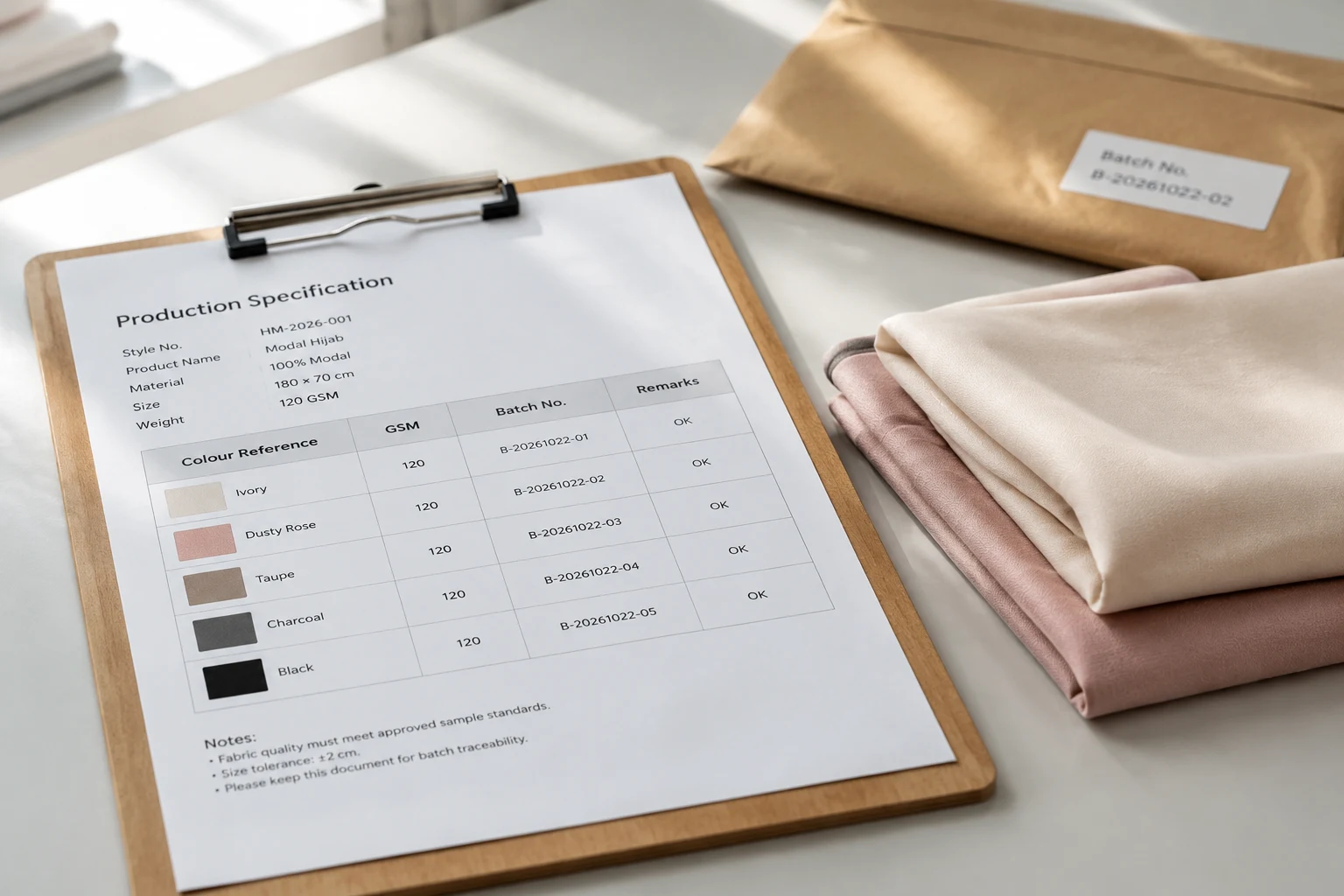
Operational transparency in OEM hijab factory China production is built on four specific documents: the pre-production approval record, the incoming material verification record, the inline production record, and the pre-shipment inspection report. Each document covers a specific stage of the production process, and together they create a continuous record from material receipt to shipment release.
The pre-production approval record documents the specific measurement results that approved the production strike-off. For custom printed hijab production, this record includes: the colour measurement of the approved strike-off (delta-E value against the colour standard, illuminant, and measurement geometry), the fabric GSM of the production material, and the ink delivery parameters used to produce the approved strike-off. This record is the reference against which all subsequent production measurements are compared, and its existence is the operational basis for the claim that production was approved to a specific standard.
The incoming material verification record documents the measurements taken on the production material when it arrives at the factory. For OEM hijab production, this record typically includes: fabric GSM at three measurement points across the roll width, colour affinity assessment using a test swatch from the production roll, and surface defect rate from a visual inspection of the roll. This record establishes the baseline condition of the production material before processing begins, which is necessary for diagnosing quality issues that originate in the material rather than the production process.
The inline production record documents the measurements taken during production rather than only at completion. For printed hijab production, this record includes colour measurements taken at defined intervals during the print run -- typically at the start of the run, at the midpoint, and at the end -- and any corrective actions taken when measurements fell outside the accepted range. The inline record is the document that provides evidence of process control during production, as distinct from a pre-shipment inspection that only verifies the condition of the finished product.
The pre-shipment inspection report documents the AQL sampling result on the finished batch before release. This report includes: the sampling plan applied, the specific units inspected, the measurements taken on each inspected unit, the number of units found non-conforming, and the accept/reject decision. The pre-shipment report is the document most commonly requested by brands during receiving inspection, but it has the most value when read alongside the three upstream documents, because it shows the end condition of a production process whose inputs and intermediate states are also documented.
Part 4: Our Factory Capability -- Remote Visibility Into Our OEM Production Process
Our OEM hijab production process is designed to be visible to brand partners without requiring physical presence at the factory. We provide brand partners with scheduled video access to their production runs at three defined points: the pre-production colour approval session, the inline inspection session at the midpoint of the print run, and the pre-shipment inspection session before batch release. Each session is conducted by the production team member responsible for the order, not by a sales or account management representative, which means the brand partner is receiving information directly from the person responsible for the production decisions.
The pre-production colour approval session is a live video review of the production strike-off, conducted before bulk printing begins. During this session, we show the brand partner the physical strike-off alongside the colour standard reference, we share the spectrophotometric measurement of the strike-off, and we explain the print parameters used. The brand partner approves or requests adjustment during the session, which means the approval record is created in real time rather than retrospectively. We retain the video recording of this session as part of the order file.
The inline inspection session is a live video review conducted at the midpoint of the print run. During this session, we show the brand partner the inline colour measurements from the first half of the run, we show the physical fabric as it comes off the printer, and we explain any adjustments that were made during the run. This session gives the brand partner visibility into the production process at the point when corrective action is still possible, rather than only at the point of completion. We provide the inline measurement data to the brand partner in writing within 24 hours of the session.
The pre-shipment inspection session is a live video review of the finished batch before packing and release. During this session, we show the brand partner the AQL sampling in progress, we measure colour on selected finished units under standard illuminant, and we confirm the dimensional measurements on sampled units. The brand partner receives the pre-shipment inspection report within 48 hours of the session, including the specific measurement data collected during the review.
Part 5: Quality Control -- Production Documentation as the Foundation of Quality Accountability
Our quality control approach for OEM hijab factory China production is built on the principle that quality accountability requires a continuous production record. A pre-shipment inspection that passes is useful evidence that the finished product meets the specification at the time of inspection, but it does not provide evidence of what happened during production. Our documentation system provides that evidence by creating a record at each production stage that can be reviewed independently and in sequence.
Each order file contains four categories of production documentation: the pre-production approval record with spectrophotometric data, the incoming material verification record with GSM and affinity test results, the inline production record with interval colour measurements and any corrective actions, and the pre-shipment inspection report with AQL sampling results and unit-level measurements. These records are retained in the order file for a minimum of 24 months and are provided to the brand partner at order completion as a complete production dossier.
The production dossier serves three practical functions for the brand. First, it provides the measurement basis for evaluating whether any quality variation in the received batch is within the accepted range or represents a genuine deviation. Second, it provides the documentation basis for any quality dispute, because the records show exactly what was measured at each stage and who made each approval decision. Third, it provides the historical data basis for evaluating production consistency across repeat orders, because each order dossier contains comparable measurements that can be tracked over time to show whether quality consistency is improving, stable, or deteriorating.
We share this documentation approach with brand partners before entering into an OEM relationship because we believe that a brand should understand the quality accountability system they are entering before they commit to a production programme. A factory that is unwilling to commit to specific documentation practices before an order is placed is unlikely to produce those documents reliably during production. We invite brand partners to review our documentation from a completed comparable order during the evaluation stage, so they can assess the quality and completeness of our records before committing.
Part 6: Brand Development Advice -- Use Documentation Requirements to Filter OEM Factory Candidates
The most effective way to filter OEM hijab factory China candidates at the evaluation stage is to ask each factory to provide the production documentation from a recent comparable order. Specifically, ask for the inline production record showing interval measurements during the print run, not only the pre-shipment inspection report. Most factories that have robust quality systems will be able to provide this documentation readily, because they generate it as a matter of operational practice. Factories that cannot produce it, or that produce it in a form that appears to have been created retrospectively, are likely to have quality control systems that depend on end-of-process inspection rather than process-stage documentation.
The distinction matters because end-of-process inspection is a quality filter, not a quality control system. A factory that inspects at shipment and rejects non-conforming units is preventing those units from reaching the brand, but it is not controlling the production process that produced them. A factory that measures at inline stages and takes corrective action during production is controlling the process, which means fewer non-conforming units are produced rather than fewer being shipped. For a brand running repeat orders, the difference accumulates into a substantially different quality consistency track record over time.
If you are evaluating OEM hijab factories and would like to use our production documentation as a reference standard for your evaluation, we are willing to share a redacted example dossier from a completed order. If you would like to discuss whether your specific product requirements can be met by our current production configuration, we invite you to send a sample of your current production and your current specification, and we will provide an assessment of where our process would deliver an improvement and where your current standard is already being met. That conversation is the starting point for an OEM relationship based on documented evidence rather than general capability claims.
Frequently Asked Questions
What production documents do you provide for OEM hijab orders?+
We provide four categories of production documentation for each OEM order: a pre-production colour approval record with spectrophotometric measurement of the approved strike-off, an incoming material verification record with GSM and dye affinity test data, an inline production record with interval colour measurements taken during the print run, and a pre-shipment inspection report with AQL sampling results and unit-level measurements. These are provided as a complete production dossier at order completion and retained in the order file for 24 months.
Can we observe production remotely without visiting the factory in China?+
Yes. We offer three scheduled live video sessions for each OEM production run: a pre-production colour approval session before bulk printing begins, an inline inspection session at the midpoint of the print run, and a pre-shipment inspection session before batch release. Each session is conducted by the production team member responsible for the order, and written measurement data is provided to the brand partner within 24 to 48 hours of each session.
How long do you retain production records for completed orders?+
We retain production records for each completed order for a minimum of 24 months. The retained file includes the pre-production approval record, incoming material verification record, inline production record, pre-shipment inspection report, and the video recordings of the three production review sessions. Records are available to the brand partner on request during the retention period.
Can we see documentation from a comparable completed order before committing to an OEM programme?+
Yes. We are willing to share a redacted production dossier from a completed comparable order during the evaluation stage, so brand partners can assess the quality and completeness of our documentation before committing. We believe that a brand should understand the quality accountability system they are entering before placing an order, and reviewing completed documentation is the most reliable way to assess whether our documentation practices meet your requirements.
What is your minimum order quantity for OEM hijab production?+
Our minimum order quantity for OEM hijab production depends on the fabric type and design complexity. For established designs on our standard modal and jersey fabrics, the minimum is typically 150 to 300 pieces per colourway. For new designs requiring a full colour development round and pre-production approval session, the minimum may be higher to accommodate the development investment. We recommend discussing your specific design and volume requirements during an initial conversation so we can confirm the applicable minimum and production timeline.
How do you handle quality deviations discovered during the inline production session?+
If the inline production measurement at the midpoint of the print run falls outside the accepted tolerance, we pause the run and take corrective action before resuming. Corrective actions depend on the nature of the deviation and may include adjusting ink delivery parameters, re-calibrating the fixation system, or replacing the fabric roll if the deviation originates in the incoming material. We document the corrective action in the inline production record and share the updated record with the brand partner. If the corrective action cannot bring the production within specification, we communicate this to the brand partner before completing the run and agree on a resolution before proceeding.
Need a quote for your next order?
Free samples available. MOQ from 100 pieces. Ships to 50+ countries.
Request a Quote