Quick Summary
A modal hijab supplier with genuine material expertise applies incoming fabric verification, reactive ink calibration, and modal-specific fixation processes that distinguish consistent multi-season production from variable single-order results. This sourcing guide explains the technical requirements specific to modal fabric -- GSM verification, reactive printing, side-to-centre shading inspection, and hem tension calibration -- and describes how to evaluate a supplier against these requirements before placing a production order. Our team focuses on modal and jersey hijab production as the primary technical domain, with fabric verification and print calibration built into the standard process rather than reserved for premium accounts. Brands starting with a 150 to 300 piece pilot order can establish the specification and production documentation that makes every subsequent reorder predictable and scalable.
Introduction: What to Look for When Evaluating a Modal Hijab Supplier
Modal hijab sourcing decisions look straightforward from the outside -- find a supplier, request a sample, approve the fabric, place an order. In practice, the decisions that determine whether a modal hijab programme succeeds are made much earlier and go much deeper than the sample stage. The fabric composition, the print behaviour, the supplier team knowledge, and the incoming material standards all determine whether a brand gets consistent results across multiple orders or spends each season renegotiating what the product is supposed to be.
A modal hijab supplier with genuine expertise in the material does not simply offer modal fabric as one option in a broad catalogue. They understand the specific behaviour of modal in printing, in washing, in wear, and in retail return scenarios. They have made production decisions -- equipment calibration, ink selection, fixation temperature control -- based on modal-specific requirements rather than generic textile manufacturing defaults.
This sourcing guide explains how to evaluate a modal hijab supplier at the level that produces consistent results: the incoming material verification stage, the technical team knowledge, and the production experience that translates into a repeatable product across seasons.
Part 1: Buyer Problem -- Why Modal Hijab Sourcing Fails Across Orders
Modal hijab sourcing fails at the reorder stage more often than at the initial sample stage. The first order is typically produced with careful attention because the supplier is establishing the relationship. The second and third orders are produced under normal production conditions -- standard team, standard line speed, standard incoming material acceptance. If the supplier has not documented and institutionalised the specific requirements for modal hijab production, the results drift.
The most common drift points are fabric weight and colour consistency. Modal fabric is sourced in batches, and batch-to-batch GSM variation of 8 to 12 grams per square metre is common among suppliers who do not apply tight incoming inspection standards. A hijab produced from 145 GSM modal feels and drapes differently from a hijab produced from 155 GSM modal, even if the composition is identical. Brands that do not specify a GSM range in their product specification have no contractual basis for rejecting the heavier or lighter batch.
Colour consistency is the second major failure point. Modal fabric has strong dye absorption characteristics, which is one of its advantages as a print substrate. This same characteristic means that small variations in ink concentration, fixation temperature, or fabric batch origin produce visible colour differences on the finished hijab. A supplier who has not calibrated their print process specifically for modal -- using modal-optimised reactive inks and a documented fixation profile -- will produce colour results that vary across batches even when using the same print file.
Both of these failure points trace back to the same root cause: a supplier treating modal as a generic fabric rather than as a material with specific production requirements. Identifying this distinction before placing the first production order is the most important sourcing decision a modal hijab brand can make.
Part 2: Industry Trend -- Modal Is Becoming the Premium Standard for Printed Hijabs
Modal fabric has moved from a premium niche to the expected standard for printed hijabs in the mid-to-upper price segment of the modest fashion market over the past three years. Brands selling printed hijabs above 25 USD retail are increasingly specifying modal as the default fabric, not as a premium option. Brands selling below this price point are facing competitive pressure to upgrade from polyester chiffon or jersey blends to modal in order to remain relevant in markets where the modal drape and hand-feel have become a baseline expectation.
This shift has two implications for sourcing. First, modal hijab supplier capacity is more contested than it was four years ago. Suppliers with genuine modal expertise and consistent quality standards are servicing more brands, and brands without established supplier relationships are finding that the most reliable suppliers have limited availability for new accounts at small minimum quantities. Second, the quality bar for modal hijab production has been raised by brands that have invested in their product specifications and have educated their customers about what good modal looks like, feels like, and washes like.
For brands entering the modal hijab market now, this means that supplier evaluation needs to be more rigorous, not less. A supplier who was acceptable for a jersey hijab programme may not have the specific modal expertise required for a printed modal hijab programme. The technical requirements are different, and the quality expectations in the market are higher.
Part 3: Technical Knowledge -- What Modal Requires That Other Fabrics Do Not
Modal is a cellulose-based regenerated fibre produced from beech wood pulp. Its performance characteristics in hijab production differ from polyester and from cotton in ways that require supplier-side technical adjustments to achieve consistent results.
In printing, modal fabric requires reactive inks rather than the disperse inks used for polyester. Reactive inks form a covalent bond with the cellulose fibre during the fixation stage, which is why reactive-printed modal produces colours with a depth and intensity that disperse-printed polyester cannot match. The fixation stage requires precise temperature and humidity control -- typically 102 to 105 degrees Celsius in a steam fixation process -- because under-fixation produces washable colour loss and over-fixation produces colour shift toward the red end of the spectrum. Suppliers who have calibrated their fixation equipment specifically for reactive-printed modal can hold colour accuracy to within a delta-E of 1.0 to 1.5 against the reference. Suppliers who have not will produce less predictable results.
In washing, modal fabric has a higher tendency to pill at friction points than polyester, and a higher tendency to elongate under tension than woven fabrics. A hijab hemmed with excessive tension will distort in the first wash cycle. These characteristics require that the supplier uses hem equipment calibrated for knit modal fabric and that their QC team knows what post-wash distortion looks like and how to identify hem tension settings that will cause it.
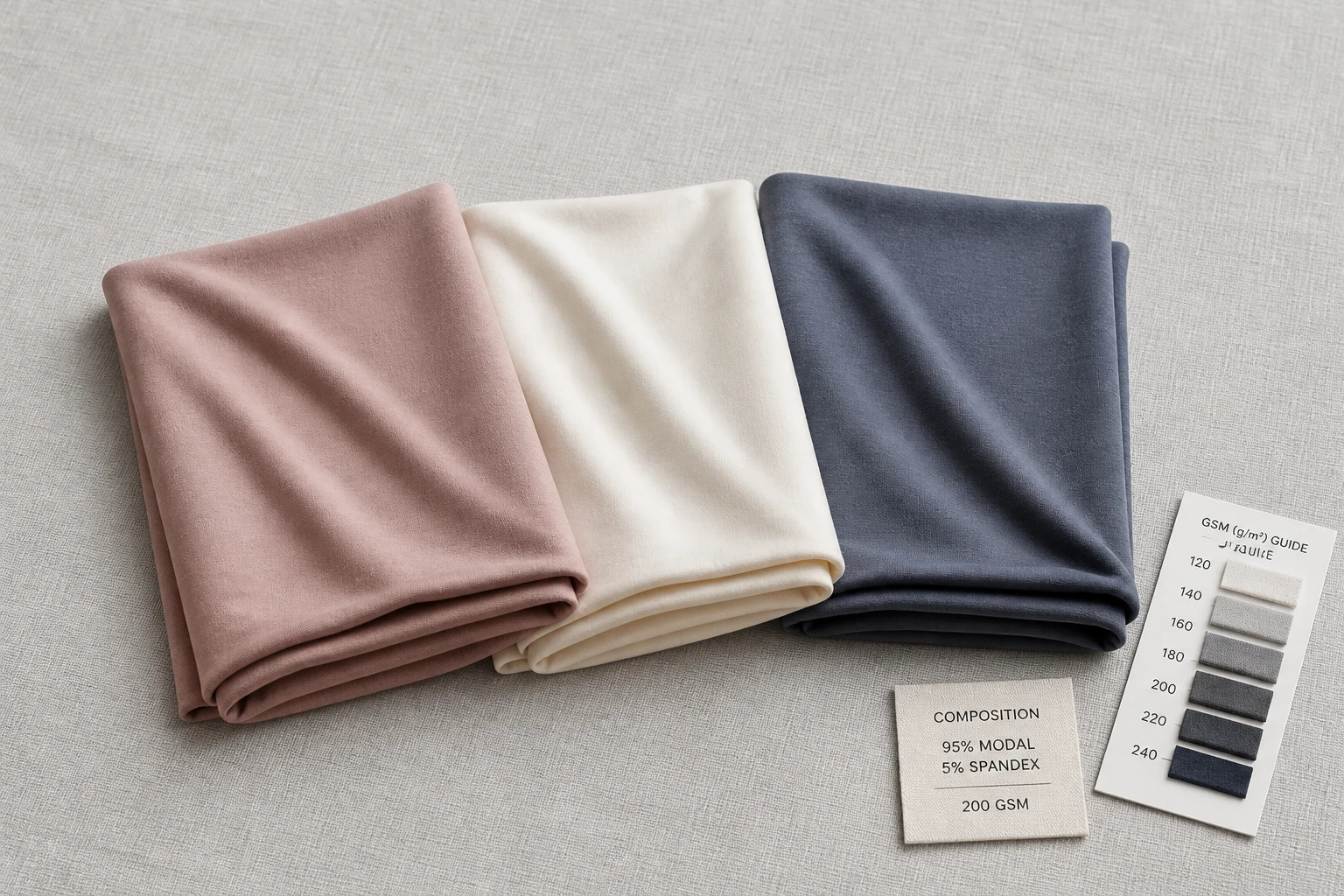
In fabric sourcing, modal is available in a wide GSM range from under 100 grams per square metre (suitable for lightweight summer hijabs) to above 180 grams per square metre (suitable for cooler climates and structured styles). The GSM appropriate for a standard printed hijab intended for year-round moderate climate use is typically 140 to 160 grams per square metre. Fabrics outside this range behave differently in cutting, sewing, and wearing, and a supplier that does not specify and verify GSM at incoming inspection is not controlling one of the most significant quality variables in the product.
Part 4: Our Factory Capability -- The Team Behind Modal Hijab Production
Our production team for modal hijab orders is structured around specialists who have worked specifically with modal fabric and reactive printing over multiple seasons. This is a deliberate staffing decision, not a coincidental outcome. Our print technicians understand reactive ink behaviour on modal and have calibrated our print and fixation equipment to the specific requirements of modal cellulose rather than to a generic textile average.
The production decisions that matter most for modal quality consistency -- ink concentration adjustment across fabric batches, fixation temperature management through seasonal humidity changes, hem tension settings for different GSM ranges -- are made by team members who have encountered and resolved these issues across multiple production runs. This accumulated experience is not documented in a manual; it lives in the judgment of people who have seen what happens when a fixation temperature drifts 3 degrees Celsius during a summer production run and know how to correct it before the batch is lost.
Our print technician team reviews incoming fabric batches for GSM and surface consistency before releasing fabric to the print stage. When a batch falls outside the specified GSM range, the lead technician assesses whether the print and hem parameters need adjustment before production proceeds. This decision is made at the technician level, not escalated to a production manager, because the technician has the specific knowledge required to make it accurately and quickly.
For brands ordering printed modal hijabs for the first time, we provide a fabric sample for approval before bulk printing begins, along with a print strike-off on the specific fabric batch sourced for their order. This allows the brand to approve the actual colour result on the actual fabric, not a colour result on a reference fabric that may differ from the production batch.
Part 5: Quality Control -- Incoming Material Verification for Modal Fabric
Incoming material verification is the QC stage that determines the ceiling of quality achievable in production. If the fabric entering the production line does not meet the specification, no amount of care at the print, cut, or sew stage can recover the product. For modal hijab production, the three incoming verification checks that matter most are GSM measurement, colour consistency across the roll width, and surface defect inspection.
GSM measurement is performed on samples taken from each fabric roll at three points -- the outer edge, the centre, and the inner edge -- using a calibrated GSM disc cutter and precision scale. The three readings are averaged and compared against the specified range. Rolls that fall outside the tolerance are quarantined and either returned to the fabric supplier or assessed for use in a lower-specification style where the GSM variance is acceptable. We do not mix rolls of significantly different GSM within the same production batch because the visible and tactile difference in the finished product is detectable by an attentive end customer.
Colour consistency check is performed using a lightbox and a standard grey card to assess the base fabric tone across the roll width. Modal fabric from some suppliers shows a visible tone shift from selvedge to selvedge due to uneven dye penetration in the base fabric. This variation, known as side-to-centre shading, will be visible in the finished printed hijab as a colour gradient that is not part of the print design. Identifying and quarantining affected rolls before printing begins prevents the most visually objectionable quality failure in modal hijab production.
Surface defect inspection is performed by running each roll through a fabric inspection frame under even LED lighting. Inspectors mark needle holes, yarn slubs, broken threads, and surface contamination on a defect map for each roll. Rolls with a defect rate above our internal acceptance threshold (typically above 2 defects per 100 linear metres for the specified defect types) are returned or quarantined. This inspection stage adds time to the production schedule but eliminates the situation where a printed and cut hijab has a visible defect that originated in the base fabric.
Part 6: Brand Development Advice -- Build Your Modal Hijab Programme Around Fabric Consistency
The single most effective investment a brand can make in their modal hijab programme is establishing a clear, verified fabric specification and requiring their supplier to document incoming fabric verification against that specification. This is not a complex technical requirement -- it is a documentation discipline. But it is the discipline that separates brands that have consistent product results across seasons from brands that are constantly managing quality variability.
When defining your fabric specification, do not rely on composition alone. Specify the GSM range (for example, 145 to 158 grams per square metre), the fabric construction (single jersey or interlock), and if relevant, the surface finish (brushed or unbrushed). Ask your supplier to provide a physical fabric swatch alongside any sample hijab, and retain that swatch as the reference for future orders. When a reorder arrives, compare the production fabric swatch against the reference swatch before approving bulk production.
For print colour consistency, ask your supplier how they document the colour standard for your specific design on your specific fabric. If the answer is a JPEG file or a screen-based colour reference, that is not a reproducible standard. A reproducible standard is a printed strike-off on the production fabric, retained at both the factory and the brand, with the delta-E measurement against the approved colour documented for the specific fabric batch used. This documentation takes one extra production day but makes every subsequent reorder reproducible.
Finally, when evaluating a modal hijab supplier, ask specifically about their experience with reactive printing on modal. A supplier who works exclusively or primarily with modal and jersey fabrics has made equipment and staffing decisions specific to those materials. A supplier who works across a broad range of fabrics may treat modal as one of many substrates rather than as a material that requires specific technical calibration. The distinction is visible in the consistency of the results across orders.
Conclusion: Modal Hijab Sourcing Success Starts with the Right Supplier Foundation
A modal hijab supplier that understands the material, verifies incoming fabric against a documented standard, and has calibrated their print and fixation process to modal-specific requirements provides the foundation for a product programme that can scale cleanly across seasons. A supplier that does not have this foundation will produce variable results that become harder to manage as order volumes grow.
Our team focuses on modal and jersey hijab production as our primary technical domain. The fabric verification, print calibration, and hem tension knowledge that supports consistent modal hijab production is built into our standard process, not reserved for premium accounts.
If you are building a modal hijab programme and want to test the consistency of our production before committing to a volume order, we encourage you to start with a small batch of 150 to 300 pieces using your approved design and fabric specification. That first batch establishes the colour standard, the fabric reference, and the production documentation that make every subsequent order a predictable, scalable operation rather than a fresh negotiation.
Frequently Asked Questions
What is the standard GSM for a printed modal hijab?+
The most common GSM range for a standard printed modal hijab intended for year-round moderate climate use is 140 to 160 grams per square metre. Fabrics below 130 GSM feel lightweight and semi-sheer, which some end customers prefer for warm climates or summer wear. Fabrics above 170 GSM provide a more structured drape suited to cooler climates. The appropriate GSM for a specific product should be specified in the product specification document and verified at incoming inspection.
Why does modal require reactive ink rather than disperse ink for printing?+
Modal is a cellulose-based fibre, and disperse inks are formulated to bond with synthetic polyester fibres through a heat-transfer process that is not compatible with cellulose. Reactive inks form a covalent chemical bond with cellulose during steam fixation, which produces colours with greater depth, intensity, and wash fastness than any surface-application ink system. Using reactive inks on modal requires a steam fixation stage at controlled temperature and humidity, which is why modal printing requires different equipment calibration than polyester printing.
How do you verify GSM consistency across different fabric batches?+
We measure GSM from samples taken at three positions across the width of each incoming fabric roll -- outer edge, centre, and inner edge -- using a calibrated disc cutter and precision scale. The three readings are averaged and compared against the specified range. Rolls that fall outside the tolerance are quarantined. We do not mix rolls with significantly different GSM within the same production batch, because the visible and tactile difference in the finished product is detectable.
What is side-to-centre shading and how do you prevent it from affecting the finished hijab?+
Side-to-centre shading is a fabric defect where the base fabric shows a visible tone difference from the selvedge edge to the centre of the roll, caused by uneven dye penetration during fabric production. When this fabric is printed, the shading shows as a colour gradient on the finished hijab that is not part of the intended design. We check for shading during incoming fabric inspection using a lightbox and a standard grey reference card. Rolls with visible side-to-centre shading are quarantined before printing begins.
What is the minimum order quantity for a modal hijab sourcing test?+
Our standard minimum for a modal hijab pilot order with a new print design and new fabric specification is 150 pieces. This quantity is sufficient to run a complete production cycle -- fabric incoming inspection, print strike-off approval, cut and sew, and outgoing inspection -- and generate a documented production record that serves as the reference for subsequent reorders. Brands placing a pilot order can scale to larger quantities on reorders once the specification and production standard are established.
How long does it take to develop and produce a first modal hijab order?+
A first modal hijab order with a new print design typically takes 28 to 38 working days from inquiry to shipped goods. This includes fabric sourcing and incoming inspection (3 to 5 days), print strike-off development and approval (4 to 7 days), cut and sew production (8 to 14 days), and outgoing inspection and packing (2 to 3 days). Repeat orders with an approved design and an existing fabric reference run faster, typically 20 to 28 working days.
Need a quote for your next order?
Free samples available. MOQ from 100 pieces. Ships to 50+ countries.
Request a Quote