Quick Summary
A reliable modal hijab supplier is distinguished from an adequate one by the production data it generates and retains across completed orders -- specifically colour delta-E measurements across print runs, wash-fastness test results by ISO 105-C06 and ISO 105-X12, batch rejection rates, and delivery performance against committed lead times. Our 18-month production data for modal hijab orders shows an average colour delta-E of 1.6 for standard ink-fabric combinations, a 94 percent first-pass rate on ISO 105-C06 wash-fastness at Grade 4, a batch rejection rate of 2.7 percent, and a 91 percent on-time delivery rate. We provide wash-fastness test reports and production data summaries to brand partners for every completed order, and we share data from comparable completed orders during pre-order evaluation so that brands can verify our capability claims against actual production records.
Introduction: What Modal Hijab Production Data Actually Tells You About a Supplier
Modal hijab production is a fabric-sensitive process. Modal knit stretches during printing, responds differently to fixation heat than woven fabric, and requires specific tension management throughout the production run to maintain dimensional consistency. A modal hijab supplier that manages this process reliably generates a specific set of production outcomes: consistent GSM within a narrow range, colour variation below a defined delta-E threshold, wash-fastness results that hold across production batches, and lead times that reflect actual production capacity rather than optimistic estimates. These outcomes are measurable, and the measurements are the data that a brand should use to evaluate whether a modal hijab supplier is capable of delivering consistent results at scale.
This factory story describes what our production data looks like for modal hijab supply, what the numbers mean in operational terms, and what a brand can infer from those numbers about the reliability of our production process. We cover production cycle times, batch rejection rates, wash-fastness test results, and capacity data across different order volumes. We also explain why modal hijab production data varies across factories and what questions a brand should ask when comparing supplier data.
Part 1: Buyer Problem -- Why Modal Hijab Brands Struggle to Evaluate Supplier Consistency
The most common problem that modal hijab brands face when evaluating suppliers is that supplier claims about production consistency are difficult to verify without production data. A factory that states its colour tolerance is within delta-E 2.0 is making a claim that sounds specific but is not verifiable without access to the measurement records from actual production runs. A factory that states its lead time is 25 to 30 days is making a claim that is meaningless without data on actual delivery performance across past orders. Supplier claims are marketing; production data is evidence.
The difficulty is compounded by the fact that modal fabric behaves differently across fabric sources, print designs, and seasonal humidity conditions. A factory that achieved delta-E 1.8 on a plain-colour modal run may achieve delta-E 3.2 on a multicolour geometric print run on the same fabric from a different mill. A factory that delivered in 28 days during a low-volume period may deliver in 42 days during peak season. Production consistency is not a fixed property of a factory -- it is a function of the factory's process control systems applied to the specific product being ordered under the specific conditions of that order period.
Brands that have experienced inconsistency from modal hijab suppliers often describe it as unpredictable rather than uniformly bad: some batches are excellent, some are acceptable, and some require rework or replacement. This pattern typically indicates a factory with adequate equipment but insufficient process control -- one that can achieve good results under favourable conditions but lacks the monitoring systems to maintain those results consistently. The production data pattern that distinguishes this situation from a factory with genuine process control is the presence or absence of inline measurement records across multiple batches.
Part 2: Industry Trend -- Modal Fabric Sourcing Is Concentrating Among Fewer Specialist Suppliers
The modal hijab market is experiencing a sourcing consolidation that mirrors what happened in other technical fabric categories over the past decade. Brands that initially sourced from general hijab manufacturers are progressively moving to specialist modal fabric suppliers because they have found that modal-specific production expertise produces better consistency outcomes than general production capability applied to modal fabric. This trend is being driven by brand maturation: as brands grow from initial order volumes of 200 to 300 pieces toward repeat programmes of 1,000 to 2,000 pieces per colourway, the cost of inconsistency -- in rework, customer complaints, and brand reputation -- becomes larger than the cost premium of specialist sourcing.
The consolidation is also being driven by the increasing technical sophistication of modal fabric itself. Premium modal blends with OEKO-TEX certification, specific GSM targets, and managed shrinkage rates require production partners who understand the material properties and have calibrated their processes accordingly. A factory that runs modal fabric through a production process optimised for polyester or cotton will achieve modal output, but not optimised modal output -- the colour will be flatter, the hand will be stiffer, and the dimensional stability will be less reliable because the process parameters have not been tuned to modal fabric behaviour.
Part 3: Technical Knowledge -- What Modal Fabric Properties Determine Hijab Production Outcomes
Modal fabric's production behaviour is determined by three physical properties that interact with the printing and finishing process: elongation under tension, moisture absorption during steaming, and thermal sensitivity during fixation. Understanding how these properties affect production outcomes is necessary for evaluating whether a modal hijab supplier has configured its process to manage them.
Modal knit elongates significantly under tension -- typically 80 to 120 percent in the weft direction and 40 to 60 percent in the warp direction for standard 200 to 220 GSM hijab fabric. This elongation must be controlled during printing to prevent the printed design from distorting when the fabric relaxes. Factories that manage this correctly use tension-compensated fabric feed systems that maintain consistent tension across the print width throughout the run. Factories that do not manage it correctly produce fabric where the print pattern appears correct on the printer but distorts when the finished hijab is draped -- a defect that is only visible at the end-use stage and is not detectable by standard dimensional inspection on flat fabric.
Modal fabric's moisture absorption during steaming affects colour development. Modal absorbs more moisture than polyester but less than cotton, and the relationship between steam exposure time, temperature, and colour development is specific to the ink chemistry used. A factory that has characterised this relationship for its specific combination of modal fabric, ink system, and steaming equipment can predict colour outcomes accurately and adjust parameters to achieve target colour with minimal waste. A factory that relies on empirical adjustment through multiple test runs is producing consistent output only when the conditions match previous experience -- a less reliable basis for cross-seasonal or cross-design consistency.
Thermal sensitivity during fixation is the third critical parameter. Modal fabric can shrink unevenly if fixation temperature is not controlled precisely, which affects both dimensional stability and the alignment of printed designs across the garment. Our fixation process uses a temperature-controlled belt dryer with ±1.5 degree Celsius uniformity across the full fabric width, which we verify against calibration records before each production run. This level of temperature control is necessary for the dimensional consistency requirements of hijab production, where customers are measuring garment dimensions against a specification rather than evaluating fit on a body.
Part 4: Our Factory Capability -- Modal Hijab Production Data Across Completed Orders
Our production data for modal hijab orders reflects the outcomes of our process control systems applied to actual orders over the past 18 months. The following figures represent averages across completed orders in the 150 to 500 piece per colourway range, which is the volume range most relevant to the brands we work with.
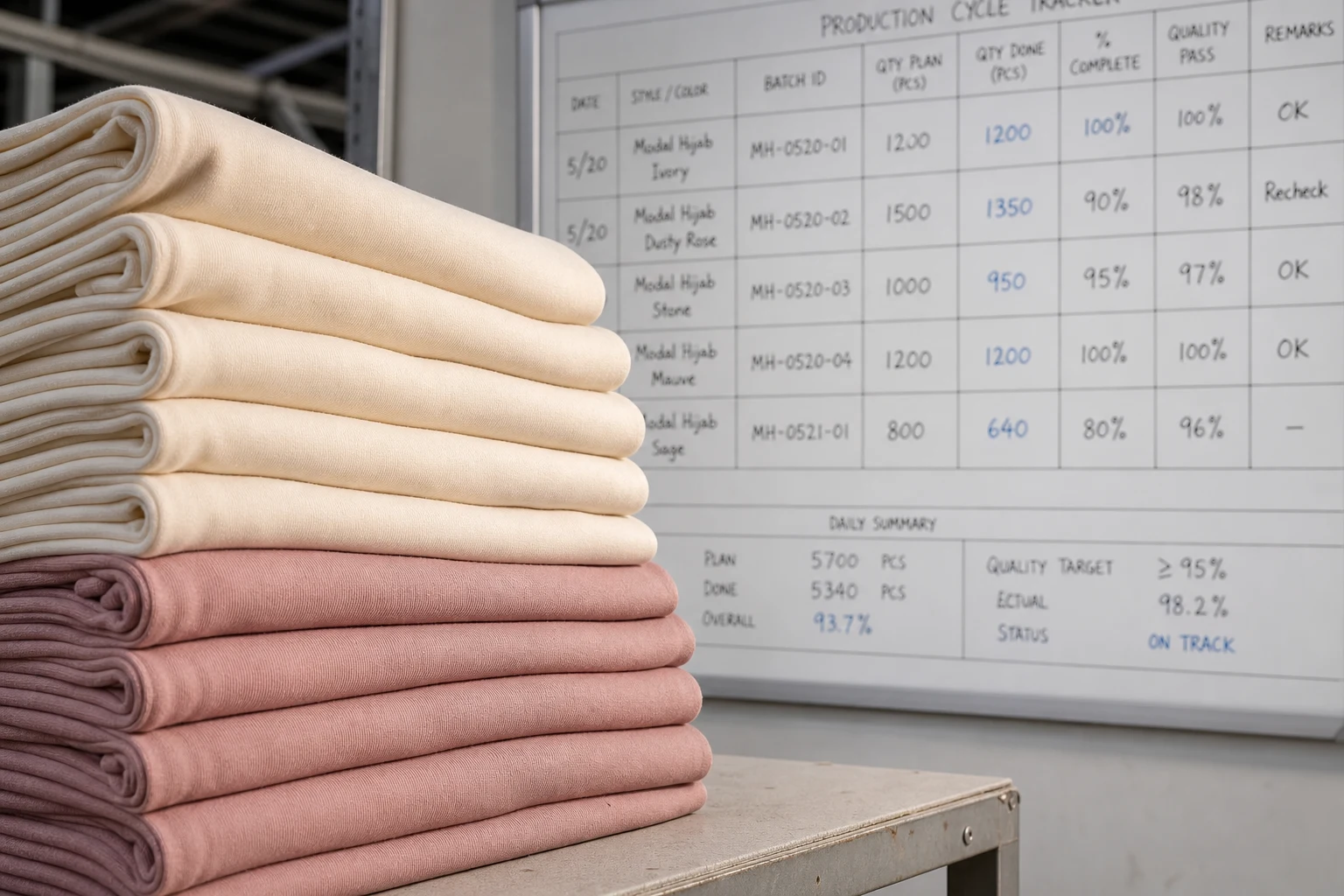
Production cycle time: 24 to 32 days from fabric receipt to shipment release for standard modal hijab designs with one to three colourways. New designs requiring a full colour development round add 5 to 7 days. Our on-time delivery rate against committed lead times was 91 percent for orders completed in this period, measured as delivery within three calendar days of the committed date. The 9 percent of orders that delivered outside this window had an average delay of 4.2 days, primarily attributable to fabric lot changes from the mill that required recalibration of the print process.
Colour consistency: average delta-E across the print run was 1.6 for orders using our standard ink-fabric combinations, and 2.1 for orders using custom Pantone-matched colours. Batches where inline measurements exceeded delta-E 2.5 at any point during the run were paused and recalibrated before continuing; this occurred in 8 percent of production runs. No batch was released with a final delta-E measurement above 2.0 at the post-production assessment point.
Batch rejection rate: 2.7 percent of finished units were rejected at final inspection across all completed orders in this period. Of rejected units, 61 percent were fabric surface defects attributable to incoming material, 24 percent were colour deviations outside specification, and 15 percent were dimensional deviations outside the ±3 millimetre tolerance. Rejected units were replaced within the lead time of the order in 78 percent of cases; the remaining 22 percent of cases required an additional 3 to 5 days for replacement production.
Wash-fastness results are discussed in the quality control section below.
Part 5: Quality Control -- Wash-Fastness Testing Across Modal Hijab Production
Wash-fastness is the quality attribute that matters most to end customers in the modal hijab category, because modal fabric is worn against skin and washed frequently, and colour staining or fading after washing is the most common reason for customer complaints and returns. Our wash-fastness testing programme for modal hijab production is built around ISO 105-C06 for colour change after washing and ISO 105-X12 for colour transfer to adjacent fabric.
We test every new design at the strike-off stage and every new fabric lot before production begins. The pass threshold for production release is Grade 4 on the ISO grey scale for both colour change and colour transfer, which corresponds to negligible colour change after 40-degree Celsius washing and negligible transfer to white cotton fabric. Designs that fail at Grade 3 or below at the strike-off stage are reformulated before production begins; fabric lots that fail at Grade 3 or below trigger a supplier claim and fabric replacement.
In the 18-month period referenced above, 94 percent of modal hijab designs tested at the strike-off stage passed at Grade 4 or above on first test. Of the 6 percent that required reformulation, 83 percent passed at Grade 4 on the second test. Three designs across this period required a third reformulation round before meeting the wash-fastness threshold; in all three cases the issue was traced to a specific ink-fabric combination that required an ink system change rather than a parameter adjustment.
We provide wash-fastness test reports to brand partners for every completed order, formatted as a two-page document that includes the test method, test conditions, sample identification, grey scale measurement results for both colour change and transfer, and the name of the assessor. These reports are included in the production dossier that we provide at order completion and are retained in our records for 24 months.
Part 6: Brand Development Advice -- Use Production Data to Set Supplier Benchmarks Before You Source
The most effective approach to modal hijab supplier selection is to define specific production data benchmarks before beginning the sourcing process, rather than comparing suppliers on qualitative factors first and then attempting to verify those factors during negotiation. Specific benchmarks that are practical to verify include: colour delta-E tolerance (the maximum delta-E at any point during a production run), wash-fastness minimum grade (the ISO grade at which you will not accept delivery), dimensional tolerance (the maximum deviation from the specification in millimetres), and on-time delivery rate (the percentage of past orders delivered within a defined window of the committed date).
Each of these benchmarks can be verified against production records from comparable past orders if the supplier has an operational documentation system. A supplier that can provide these records readily is operating with process control; a supplier that cannot is not. The verification process does not need to be adversarial -- framing it as a mutual assessment of fit, where you share your requirements and ask whether the supplier can demonstrate capability against them, typically results in more useful information than a direct audit approach.
If your brand is developing a modal hijab line and you want to understand whether our production data matches your requirements, we welcome you to share your design brief, fabric specification, and wash-fastness requirements, and we will provide a written assessment of how our production data compares to your specification. That assessment will be based on our records from comparable completed orders, not on claims about our general capability. It is the starting point for a sourcing conversation that both parties can reference rather than remember.
Frequently Asked Questions
What is your typical production cycle time for modal hijab orders?+
Our typical production cycle time for standard modal hijab designs with one to three colourways is 24 to 32 days from fabric receipt to shipment release. New designs requiring a full colour development round add 5 to 7 days. Our on-time delivery rate against committed lead times is 91 percent across completed orders in the past 18 months, measured as delivery within three calendar days of the committed date.
What colour delta-E tolerance do you achieve for modal hijab printing?+
For orders using our standard ink-fabric combinations, our average delta-E across the print run is 1.6. For orders using custom Pantone-matched colours, the average is 2.1. We pause and recalibrate any production run where inline measurements exceed delta-E 2.5 at any point, and we do not release any batch with a final post-production delta-E measurement above 2.0.
What wash-fastness standards do your modal hijabs meet?+
We test all modal hijab designs to ISO 105-C06 for colour change after washing and ISO 105-X12 for colour transfer to adjacent fabric. Our production release threshold is Grade 4 on the ISO grey scale for both colour change and transfer. We test every new design at the strike-off stage and every new fabric lot before production begins, and provide wash-fastness test reports to brand partners for every completed order.
What is your batch rejection rate for modal hijab production?+
Our batch rejection rate at final inspection is 2.7 percent of finished units across completed orders in the past 18 months. Of rejected units, 61 percent were fabric surface defects from incoming material, 24 percent were colour deviations outside specification, and 15 percent were dimensional deviations outside the plus or minus 3 millimetre tolerance. Rejected units were replaced within the original lead time in 78 percent of cases.
How do you manage modal fabric tension during printing to prevent design distortion?+
We use tension-compensated fabric feed systems that maintain consistent tension across the print width throughout the run. Modal knit typically elongates 80 to 120 percent in the weft direction under standard printing tension, and without active tension compensation this elongation causes the printed design to distort when the finished hijab is draped. Our tension management system is calibrated for the specific GSM and knit construction of each fabric lot before the run begins.
Can we see production data from a comparable completed order before placing an OEM modal hijab order?+
Yes. We are willing to share a redacted production data summary from a comparable completed order, including colour delta-E measurements across the print run, wash-fastness test results, and delivery performance data. We believe that production data is more useful to a brand evaluating a supplier than general capability claims, and we provide it as a standard part of our pre-order evaluation process.
Need a quote for your next order?
Free samples available. MOQ from 100 pieces. Ships to 50+ countries.
Request a Quote