Quick Summary
Evaluating a jersey hijab factory requires looking beyond sample quality to the production systems that determine whether quality holds at bulk scale. Key benchmarks include first-time-right rates, inline colour check frequency, and lead time consistency across order sizes. A factory that shares production data transparently -- cycle times, rework rates, capacity utilisation -- gives brands a more reliable basis for sourcing decisions than one that offers only a polished sample. Our team operates with documented production metrics and supports brand evaluation with data-backed factory profiles and a structured sample review process.
What a Jersey Hijab Factory Evaluation Actually Needs to Cover
Most brands approach jersey hijab factory evaluation the same way: they request a sample, check the colour and drape, and if it looks good, place the first order. This process works well enough for a one-time purchase, but it is not a reliable method for identifying a factory that will maintain quality across multiple seasons and growing order volumes. Samples are produced under close supervision. Bulk runs are not.
A thorough factory evaluation looks past the sample to the systems that determine whether that sample quality can be reproduced consistently at 200 pieces, 500 pieces, or 2000 pieces. The questions that reveal this are not about the sample -- they are about the production cycle, the rework rate, the colour management protocol, and the capacity planning approach. Factories that answer these questions with specific data are demonstrating operational maturity. Factories that deflect or generalise are telling you something important.
Part 1: The Buyer Problem -- Inconsistency Between Sample and Bulk
The most common sourcing complaint in the jersey hijab category is bulk that does not match the approved sample. The colour is close but slightly off. The fabric hand feel is different -- often stiffer or with less drape. The hemming quality varies across units. These are not random manufacturing failures. They are the predictable result of sourcing from a factory that optimises sample quality without having documented systems for replicating that quality at production scale.
Jersey fabric adds complexity to this challenge. Unlike woven fabrics, jersey knit has four-way stretch, which means it responds differently to tension at different points in the printing process. A factory that does not have controlled tension management on its printing line will produce colour variation across a single roll -- darker near the edges where the fabric stretches more, lighter in the centre. This variation can be invisible in a sample cut from the centre of a roll and highly visible in bulk production where fabric from across the full roll width is used.
The practical consequence for brands is a quality gap between seasons. The first collection launches well. The second order looks slightly different. By the third season, the brand has accumulated a range of pieces that do not photograph consistently together, which creates problems for Instagram content, product listings, and customer return rates. Addressing this at the sourcing stage -- by choosing a factory with documented colour management -- is significantly less costly than addressing it after the fact.
Part 2: Industry Trend -- Jersey Is the Fastest-Growing Hijab Category for Social Brands
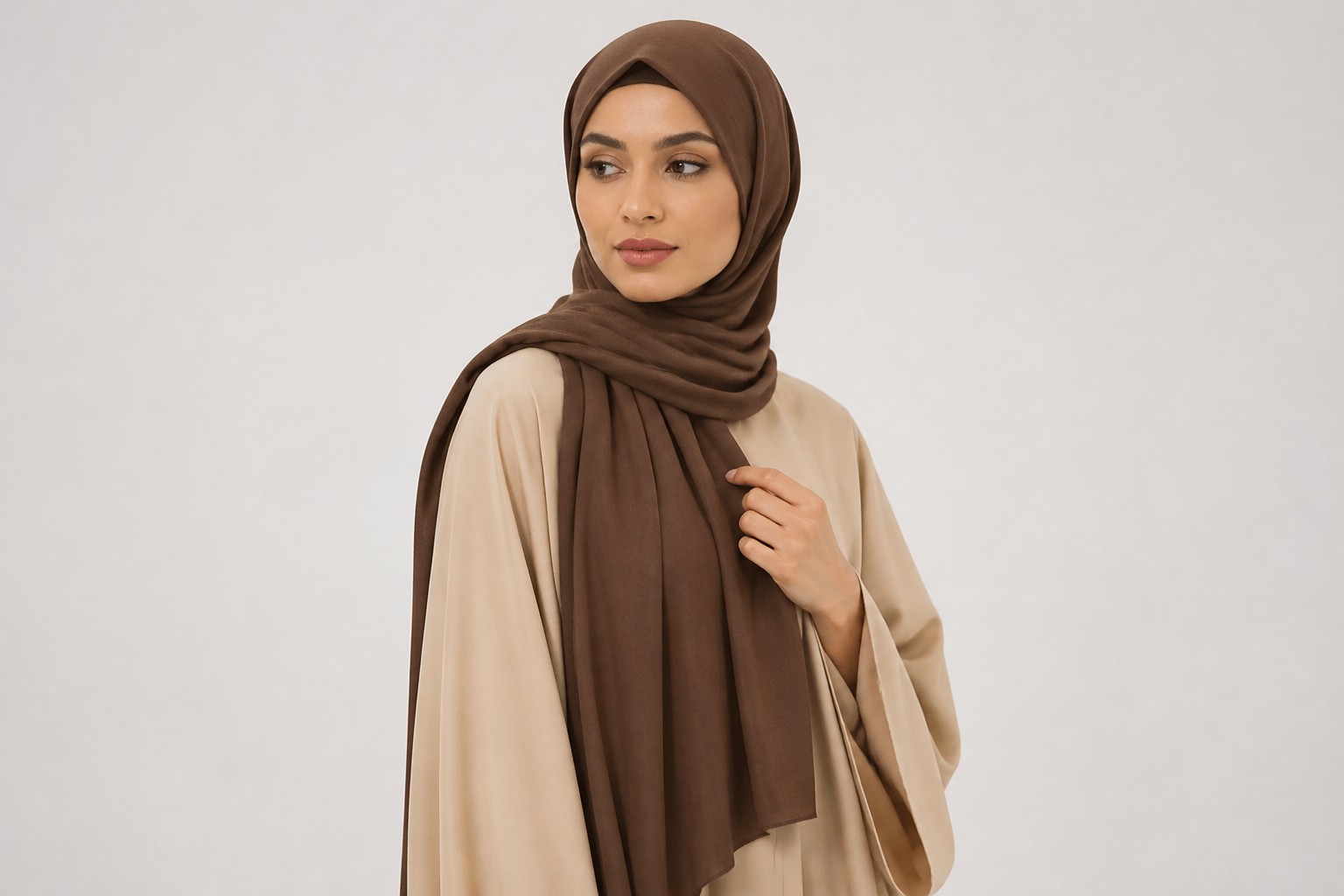
Jersey hijab has grown faster than any other category in the modest fashion market over the past three years, driven primarily by social commerce. The characteristics that make jersey attractive to wearers -- its stretch, its grip-without-pins draping behaviour, its comfortable weight for all-day wear -- are the same characteristics that make jersey hijab content highly watchable. A well-draped jersey hijab in a saturated colour photographs exceptionally well and is easy to demonstrate in short-form video.
TikTok and Instagram Reels have been the primary distribution channels for new jersey hijab brands. The format rewards brands that can release new colourways and print designs with high frequency because each new release is an occasion for fresh content. This drives a particular set of supply chain requirements: low minimum orders to test a new design before committing to volume, fast turnaround on repeat orders of proven colourways, and consistent quality that holds up under close-up video scrutiny.
The factories that serve this market well are not necessarily the largest. They are the ones with the flexibility to handle small orders efficiently and the discipline to maintain quality standards across a high volume of distinct colourways running concurrently. Finding this combination requires a different evaluation approach than sourcing a commodity product from the lowest-cost supplier.
Part 3: Technical Knowledge -- What Makes Jersey Hijab Production Different
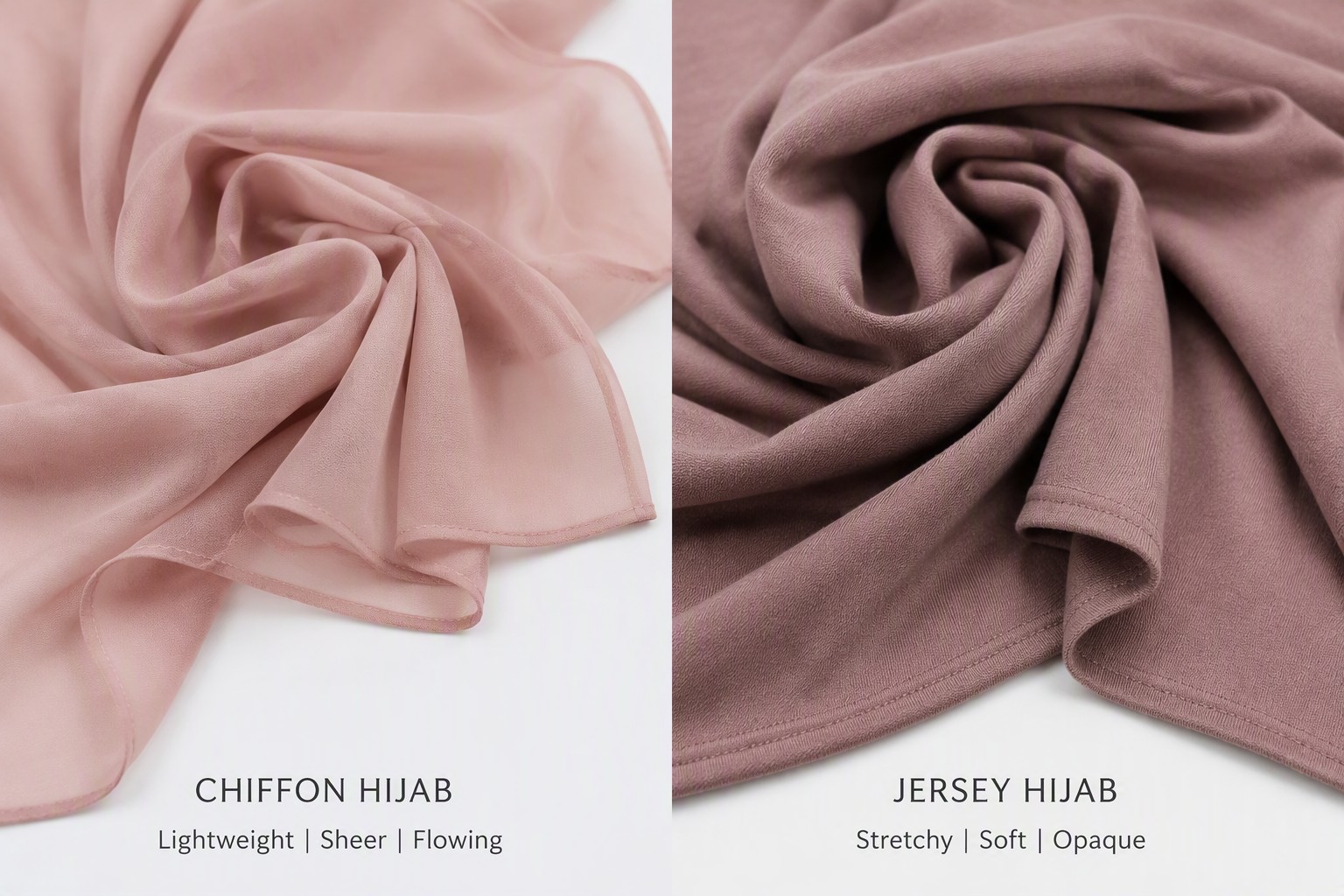
Jersey fabric used in hijabs is typically a modal-jersey or cotton-jersey blend. The modal-jersey variant -- which has become the dominant choice for printed designs -- combines the soft hand feel of modal with the stretch recovery of a knit structure. The blend ratio affects both the print behaviour and the wash fastness. A higher modal content gives more vibrant colour uptake but requires careful pre-treatment to ensure the dye bonds fully with the fibre structure.
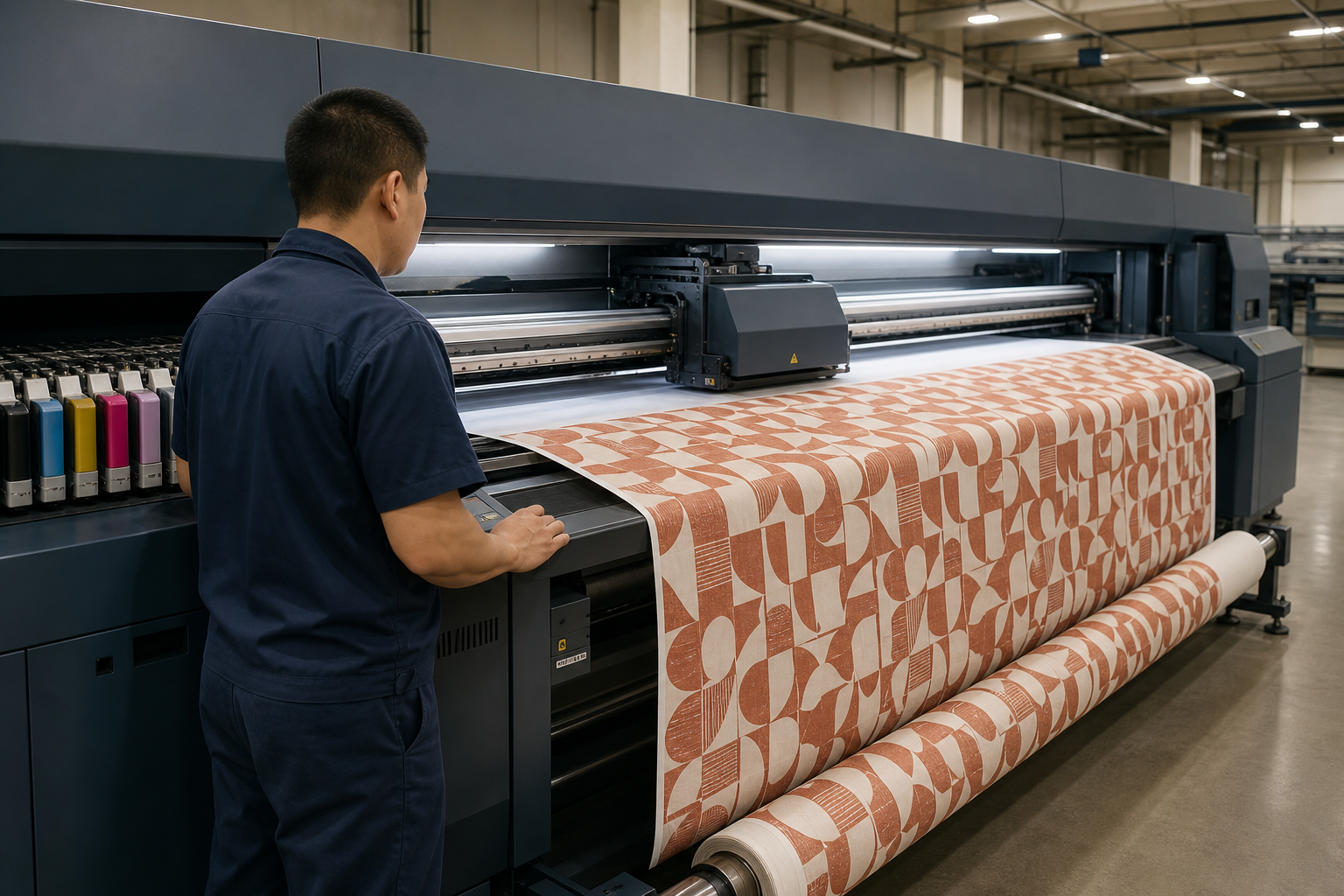
Digital reactive dye printing on jersey requires specific machine configurations that differ from woven fabric printing. The fabric must be fed under controlled tension to prevent stretch during printing, which would cause colour registration errors and distorted print geometry. A standard flatbed printer is not appropriate for jersey production. The factory needs a dedicated roll-to-roll system with tension feedback control, and the operators need experience calibrating that tension for different jersey weights and stretch ratios.
After printing, the dye is fixed through a steaming process. The steaming parameters -- temperature, humidity, and dwell time -- need to be calibrated for the specific dye and fabric combination. Under-steaming results in poor wash fastness: the colour looks correct before the first wash and shifts significantly after it. Over-steaming can cause colour bleeding between adjacent print zones, particularly on saturated or high-contrast designs. Factories with experience in modal-jersey printing have these parameters documented and consistent; factories new to the substrate are still experimenting.
Part 4: Factory Capability -- Production Metrics That Reveal Real Performance
Our team tracks production performance across four core metrics for every jersey hijab order: production cycle time, first-time-right rate, rework rate, and on-time delivery rate. We share these figures with brand partners on request because we believe sourcing decisions should be based on data, not on the quality of a showroom sample.
Our current benchmarks for jersey hijab orders: standard bulk orders complete in 18 to 28 days from fabric confirmation, with first orders running 25 to 32 days due to the colour matching and approval process. Our first-time-right rate -- orders that proceed from strike-off to bulk without a colour hold -- runs above 91% across all colourways. Our rework rate on finished units is consistently below 2.5%. Monthly production capacity across jersey and modal orders is 8,000 to 12,000 pieces, allowing us to handle multiple concurrent brand programmes without queue pressure on individual orders.
These figures are generated by a production tracking system that records cycle time by production stage, not just total order duration. This means we can identify which stage -- pre-treatment, printing, steaming, or finishing -- is the source of any delay, and we can communicate specifically about production status rather than offering generic progress updates. For brands running tight launch calendars, this level of operational transparency is a practical requirement, not a preference.
Our production capacity for jersey specifically is supported by roll-to-roll printing equipment configured for knit fabrics, with tension control calibrated to the modal-jersey blends we most commonly run. We have invested in equipment optimisation over several years of jersey and modal production, and the current configuration produces consistent colour registration and surface quality across different print designs and colourway densities.
Part 5: Quality Control -- Inline Colour Checks That Catch Problems Before They Scale
Our QC approach for jersey hijab production centres on two inline checks that happen during production rather than after it. The first is the strike-off approval: before bulk fabric is fed to the printer, a strike-off is produced on the actual production fabric lot and measured under D65 lighting against the approved colour standard. If the ΔE measurement is within the agreed tolerance, bulk proceeds. If it falls outside tolerance, the ink formulation is adjusted and a second strike-off is produced before any production fabric is committed.
The second check is the first-piece confirmation: once the production run begins, the first finished hijab coming off the line is pulled and evaluated before the run continues. This check covers not just colour but also print registration accuracy, hem quality, and dimensional consistency against the approved size specification. A discrepancy at this stage stops the run for correction before it affects the rest of the order.
Both checks are documented with spectrophotometer readings and photographs that become part of the production record for the order. This documentation serves two purposes: it gives the brand traceability for the specific production run, and it provides our team with the data to improve consistency across future orders of the same colourway. For brands running seasonal programmes, this record is the foundation of colour consistency from one order to the next.
Part 6: Brand Development Advice -- How to Use Factory Data in Your Sourcing Decision
The most useful thing a brand can do during jersey hijab factory evaluation is request the production data described above and compare it across the factories under consideration. A factory with a documented first-time-right rate above 90% and a rework rate below 3% is operating at a standard that can support a consistent seasonal programme. A factory that cannot provide these figures is either not tracking them or not willing to share them -- either is informative.
Beyond the data, the evaluation process itself reveals useful information. How quickly does the factory respond to technical questions? Do they ask detailed questions about your fabric specification and colour requirements, or do they move straight to pricing? Do they offer a structured sample review process with documented checkpoints, or do they send a sample and wait for feedback? A factory that engages with the technical details of your product at the evaluation stage will engage with those details in production.
For brands at the early stage, the most valuable evaluation tool is a physical sample order with the full production documentation package -- strike-off record, first-piece confirmation photo, production parameters, and wash fastness certificate. This tells you more about a factory than any sales conversation. If you would like to request a jersey hijab sample from our team with the complete documentation package, send us your print design and colourway reference and we will confirm the sample timeline and cost within 48 hours.
Frequently Asked Questions
What is the typical MOQ for a jersey hijab factory order?+
Most specialist jersey hijab factories accept orders from 100 to 200 pieces per colourway for first orders. Some will go lower for established brand relationships with stored colour standards. For repeat orders where the production parameters are already documented, minimum quantities can often be negotiated downward because the setup time is significantly reduced.
How long does production take at a jersey hijab factory?+
A well-organised jersey hijab factory typically completes bulk production in 18 to 28 days from fabric confirmation to finished goods ready for shipment. First orders run longer -- usually 25 to 35 days -- because they include the colour matching, strike-off approval, and first-piece confirmation steps that are shortened on repeat orders. Factories that cannot give a specific range based on your order volume are a reliability risk.
What print method is best suited for jersey hijab fabric?+
Digital reactive dye printing is the most appropriate method for jersey fabric used in hijabs. It bonds directly to the cellulose content of the jersey knit, delivers accurate colours including gradient and photographic prints, and produces wash-fast results with proper steaming and fixing. Screen printing can also be used for simple geometric or text designs at higher volumes, but digital printing gives brands more design flexibility at small-to-medium order quantities.
How do I check colour consistency across a jersey hijab order?+
The two checkpoints that matter most are the strike-off approval (a printed fabric sample from the actual production run, measured against the agreed colour standard under D65 lighting before bulk proceeds) and the inline first-piece check (the first finished hijab from the production line, measured and compared to the approved strike-off before the full run continues). A factory that performs both checkpoints and documents the results gives brands a traceable record of colour consistency for each order.
What production data should I request when evaluating a jersey hijab factory?+
The most informative data points are: average production cycle time by order size, first-time-right rate (the percentage of orders that reach bulk without a colour or quality hold), rework rate (the percentage of finished units requiring correction before shipment), and monthly production capacity. A factory that can provide these figures from recent production history is demonstrating operational transparency, not just commercial willingness.
Can I visit the factory before placing a jersey hijab order?+
Yes, and it is strongly recommended for first orders above 500 pieces. For smaller initial orders or brands outside China, a structured video walk-through covering the printing station, curing line, and QC area is a practical alternative. Our team can arrange a live video tour typically within 48 hours of request, and we can provide a production floor overview alongside the sample review process for new brand enquiries.
Need a quote for your next order?
Free samples available. MOQ from 100 pieces. Ships to 50+ countries.
Request a Quote