Quick Summary
A jersey hijab factory that produces consistent results has made deliberate decisions about print equipment, fixation temperature profiles, cutting relaxation protocols, and hemming tension calibration -- decisions that separate specialist jersey production from generic textile manufacturing. This product guide explains the three most common jersey hijab production failure modes (dimensional variation, colour inconsistency, and edge curl), the equipment and process decisions that prevent them, and the outgoing inspection standard that verifies results before shipment. Our team uses flatbed digital printing with jersey-specific vacuum hold-down, a documented steam fixation profile checked at each production run start, and a fabric relaxation cutting protocol to produce jersey hijabs that meet dimension and colour specifications consistently across orders. Brands developing a jersey hijab programme can start with a sample run to establish the fabric specification, colour reference, and dimension documentation that supports scalable reordering.
Introduction: What Makes a Jersey Hijab Factory Worth Working With
Jersey fabric is the most technically demanding substrate in hijab production. Its stretch behaviour, its sensitivity to heat during fixation, and the way it responds to tension at every stage of cutting and sewing mean that a factory producing jersey hijabs needs to have made deliberate equipment and process decisions to achieve consistent results. A jersey hijab factory that has not made those decisions produces inconsistent output -- hijabs that vary in dimension, colour, and drape across a production batch and between orders.
For brands building a jersey hijab programme, identifying a factory with genuine jersey expertise is more important than identifying one with a broad fabric range. The factories that produce the most consistent jersey hijab results are those that have invested in jersey-specific equipment calibration, trained their team to recognise jersey-specific quality issues, and built their production schedule around the slower, more controlled line speeds that jersey cutting and sewing require.
This product guide explains what to look for in a jersey hijab factory: the equipment decisions that support consistent results, the QC process that catches dimension and colour issues before shipment, and the brand development path that takes a jersey hijab programme from a single test order to a scalable seasonal product.
Part 1: Buyer Problem -- Why Jersey Hijab Production Fails Without Specialist Knowledge
Jersey hijab production failures share a common origin: treating jersey as a generic fabric rather than as a material that requires specific process adaptations. The most frequent failure modes are dimensional variation, colour inconsistency across a print run, and edge curl at the hemline.
Dimensional variation in jersey hijabs comes from tension applied during cutting. Jersey fabric stretches under tension, and a cutting operator who does not allow the fabric to relax before cutting will produce pieces that are shorter and narrower than the pattern specification. When the cut pieces are sewn, the tension releases and the finished hijab is smaller than intended. This is particularly visible in square hijabs where the diagonal measurement is the primary wearing dimension -- a hijab cut 5 mm short in each direction will produce a noticeably reduced spread on the head.
Colour inconsistency in jersey printing comes from the interaction between ink concentration, fixation temperature, and fabric stretch during the printing process. Jersey fabric stretches slightly as it passes through a flatbed or rotary print machine, and the stretch rate is not uniform across the fabric width. A fixation temperature calibrated for polyester jersey will under-fix reactive inks on modal jersey. A fixation temperature calibrated for thick jersey will over-fix and colour-shift thin jersey. Factories that have not characterised the specific fixation profile for each jersey weight they print produce colour results that vary across batches.
Edge curl at the hemline is caused by hem tension applied during sewing. Jersey fabric curls toward the technical face when tension is released, and a hem sewn with excessive tension will curl open in the first wearing. Factories that use hemming equipment calibrated for woven fabrics apply too much tension to jersey edges, resulting in hem curl that is visible in the finished product.
All three of these failure modes are preventable with the right equipment calibration, trained operators, and a QC process that checks for the specific failure modes of jersey production. They are not random quality variations -- they are predictable consequences of applying generic textile production settings to a material that requires specific process adaptations.
Part 2: Industry Trend -- Jersey Hijabs Are Expanding Beyond Modest Fashion Into Athleisure and Lifestyle
Jersey hijabs have moved beyond their original position as a practical everyday option in the modest fashion segment. In the past two years, jersey hijab styles have expanded into athleisure, casual lifestyle, and sport-adjacent categories that attract customers who are not primarily modest fashion shoppers. This expansion has brought new buyer profiles into the jersey hijab market -- fitness brand buyers, wellness brand buyers, and lifestyle apparel brands who want to add jersey hijabs as category extensions rather than as core modest fashion products.
For brands and sourcing managers, this trend has two practical implications. First, the technical requirements for jersey hijabs in these new categories are more demanding in some dimensions than traditional modest fashion requirements. Athleisure and sport-adjacent jersey hijabs need to perform under physical activity, which means the colour fastness under perspiration (ISO 105-E04) and the dimensional stability after repeated washing (ISO 6330) are more important than they are for occasional-wear modest fashion hijabs. A factory producing jersey hijabs for these categories needs to test and document these performance parameters, not just visual appearance.
Second, the customers buying jersey hijabs in these new categories have different aesthetic expectations. They expect colours that match the rest of their athleisure wardrobe -- clear, saturated, consistent -- and they expect hijabs that hold their shape and colour through regular wearing and washing cycles. The quality bar for colour consistency and wash fastness is higher in these customer segments than in the traditional modest fashion segment, which makes factory selection more consequential.
Part 3: Technical Knowledge -- Jersey Print Equipment and the Decisions That Determine Colour Consistency
Jersey hijab colour consistency depends on three equipment-level decisions that a factory makes before the first print run: ink system selection, flatbed versus rotary printing method, and fixation temperature profile.
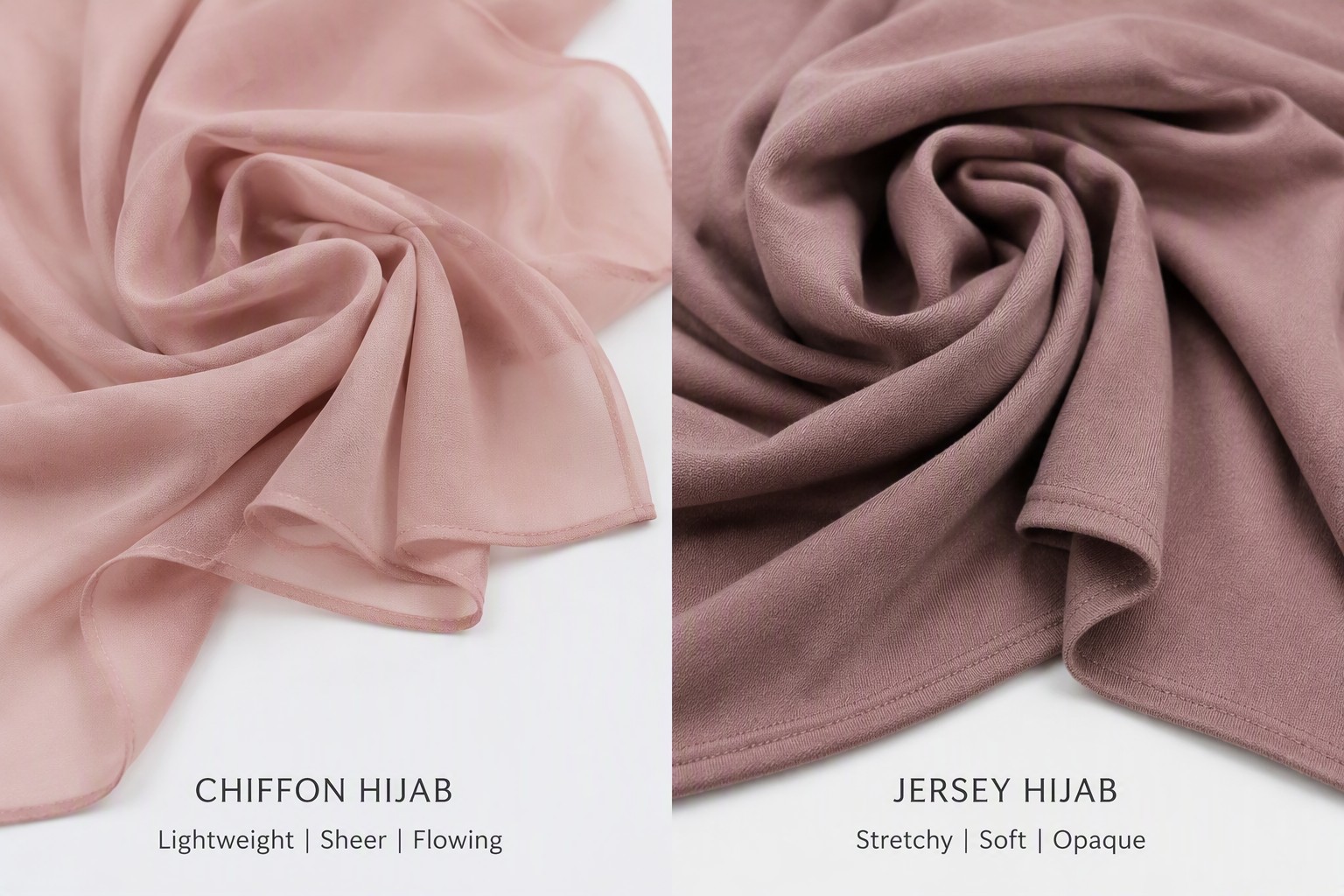
Ink system selection for jersey hijabs depends on the fibre composition of the jersey fabric. Polyester jersey uses disperse inks applied through a sublimation heat transfer process. Modal jersey and modal-polyester blend jersey use reactive inks applied through a direct print and steam fixation process. Cotton jersey also uses reactive inks but with different fixation parameters than modal. A factory that has calibrated their ink system for one jersey type will produce suboptimal results on other jersey types unless they recalibrate for each material. Factories that claim to print all jersey types on one machine with one ink system are making a quality compromise.
Flatbed printing is more appropriate for jersey hijab production than rotary printing for most order sizes, because flatbed printing applies zero tension to the fabric during printing. The fabric lies flat and stationary while the print head passes over it, so there is no stretch-induced colour distortion. Rotary printing is faster and more economical for very large runs but requires precise tension control to prevent stretch-induced colour inconsistency. For jersey hijab orders under 3000 pieces, flatbed printing is the recommended method.
Fixation temperature profile is the most significant variable in reactive-printed jersey colour accuracy. Steam fixation for reactive inks on modal jersey requires a temperature of 102 to 105 degrees Celsius at controlled humidity for 8 to 12 minutes, depending on the dye concentration. Under-fixation produces colour that washes out in the first laundry cycle. Over-fixation produces colour shift -- typically a warm shift toward red or orange -- that is not visible immediately but develops after washing. Factories that document their fixation profile for each fabric type and each ink concentration can reproduce the approved colour result on reorders. Factories that do not document this profile reproduce it only by chance.
Part 4: Our Factory Capability -- Equipment Calibrated for Jersey-Specific Production
Our jersey hijab production line uses flatbed digital printing equipment that has been calibrated specifically for jersey fabric behaviour. The calibration parameters -- print head height, ink droplet volume, pass speed, and vacuum hold-down pressure -- are set for jersey rather than for woven or paper substrates. The vacuum hold-down system prevents jersey stretch during printing without applying mechanical tension to the fabric edges, which is the primary cause of print registration error on stretch fabrics.
The fixation system is a continuous steam tunnel with documented temperature and humidity profiles for each fabric weight and ink concentration we use in production. The profile for 150 GSM modal jersey at standard reactive ink concentration is documented, tested, and checked at the start of each production run using a temperature data logger. When the steam tunnel temperature drifts more than 1.5 degrees Celsius from the target profile during a run, production pauses and the profile is rechecked before continuing.
The cutting stage uses a relaxation protocol for jersey fabric. Incoming jersey rolls are unrolled and left flat for a minimum of four hours before cutting begins, to allow any tension introduced during rolling to release. Cutting operators use weight-hold rather than pin-hold to keep fabric flat during cutting, which avoids introducing tension at the cut stage. The result is cut pieces that match the pattern specification rather than pieces that have been stretched before cutting.
Our hemming equipment for jersey hijabs uses a narrow rolled-hem foot calibrated for the tension requirements of jersey knit fabric. The tension setting is adjusted for each fabric weight to produce a hem that lies flat after the first wash rather than curling open. Our hemming team leads check the first 20 pieces of each production run for hem curl using a standardised wash-and-inspect protocol before releasing the run to full production speed.
Part 5: Quality Control -- Outgoing Inspection and Dimension Verification Before Shipment
Our outgoing inspection for jersey hijab orders combines AQL statistical sampling with dimension verification on every sampled piece. The AQL level applied is 2.5 for major defects (visible colour defects, dimension out of tolerance, hem defects) and 4.0 for minor defects (small surface marks, minor hem tension variation) on orders above 300 pieces. For orders below 300 pieces, we inspect 100 percent of the finished goods.
Dimension verification at the outgoing stage measures the finished hijab at four points: the two diagonal measurements (for square hijabs), the straight width, and the straight length. Measurements are taken after the hijab has been folded and unfolded once to release any packing tension, and compared against the specification tolerance. Our standard tolerance for a 110 by 110 cm jersey hijab is plus or minus 1 cm on each straight dimension and plus or minus 1.5 cm on each diagonal. Pieces outside this tolerance are separated from the shipment and assessed for rework or rejection.
Colour verification at the outgoing stage compares finished hijabs against the approved strike-off under a D65 light source using a calibrated lightbox. Inspectors assess colour match visually and flag pieces that show visible deviation from the reference. We use a delta-E 2.0 threshold as the pass-fail boundary: pieces with a measured colour difference above delta-E 2.0 against the approved reference are rejected from the shipment. This threshold is appropriate for retail jersey hijabs where colour consistency is a visible quality attribute.
The outgoing inspection report for each order documents the sample size, defects found by category, the pass or fail decision, and the disposition of any rejected pieces. This report is shared with the brand before shipment and retained in our production archive for the lifetime of the customer relationship. If a quality dispute arises after delivery, the outgoing inspection report provides the documented evidence of the production quality at the time of shipment.
Part 6: Brand Development Advice -- Building a Jersey Hijab Line That Scales Cleanly
A jersey hijab programme that scales cleanly is built on three documented foundations: an approved fabric specification, an approved colour reference, and an approved dimension specification. These three documents take one or two sample orders to establish, but once established, they make every subsequent production order a predictable, verifiable process rather than a negotiation about what the product is supposed to be.
The fabric specification for a jersey hijab programme should specify fibre composition (for example, 95 percent modal, 5 percent elastane), GSM range (for example, 190 to 210 grams per square metre), fabric construction (single jersey), and any surface finish requirements (brushed or unbrushed, one-side or two-side brush). Specifying composition alone is not sufficient, because GSM variation within a stated composition range produces visible and tactile differences in the finished hijab.
The colour reference for a jersey hijab programme is not a JPEG or a Pantone code alone -- it is a printed strike-off on the approved fabric, retained at both the factory and the brand. For reorders, the factory prints a new strike-off on the production fabric batch and the brand approves it against their retained reference before bulk production proceeds. This pre-production approval step catches colour drift caused by fabric batch variation before the bulk run, rather than after.
The dimension specification should include the finished size after washing, not the cut size. Jersey fabrics relax and sometimes shrink slightly after the first wash, and the dimension the end customer experiences is the post-wash dimension. Specify the target finished size after one standard machine wash cycle at 30 degrees Celsius, and ask your factory to test and confirm that their production achieves this target before committing to bulk production.
Conclusion: Jersey Hijab Factory Selection Determines Programme Consistency
A jersey hijab factory that has made deliberate decisions about print equipment, fixation profile, cutting protocol, and hemming tension produces consistent results that scale across orders. A factory that applies generic textile production settings to jersey fabric produces variable results that require more management as order volumes grow.
Our production experience with jersey hijabs is built on equipment calibration and process documentation specific to jersey fabric behaviour. The flatbed printing system, the documented fixation profile, the relaxation cutting protocol, and the hem tension calibration are all in place as standard production conditions, not special provisions for premium orders.
If you are developing a jersey hijab style and want to evaluate our production before committing to a volume order, we recommend starting with a sample run of your approved design. We will produce the sample on the production fabric batch, document the fixation profile used, and provide an outgoing dimension and colour verification report alongside the sample. That documentation gives you the foundation to evaluate our production quality on its own terms, not on the visual appearance of a single sample piece.
Frequently Asked Questions
What is the minimum order quantity for a jersey hijab at your factory?+
Our standard minimum order quantity for a jersey hijab with a custom print design is 200 pieces per design. This quantity is sufficient to run a complete flatbed print production cycle with a meaningful AQL inspection sample. For plain-dyed jersey hijabs without a print, the minimum is 150 pieces. Brands placing a first production order can use the minimum quantity to establish the fabric specification, colour reference, and dimension documentation that supports accurate reorders.
What jersey fabrics do you work with for hijab production?+
We work primarily with modal jersey (including modal-elastane blends), cotton jersey, and polyester jersey for hijab production. Modal jersey is our primary technical domain because of its superior drape and colour depth in reactive printing. We do not recommend mixing fabric types within a single order, because each fabric type requires different ink system calibration and fixation parameters. If you are considering a programme that includes both modal and polyester jersey styles, we would produce these as separate orders with separate production setups.
How do you prevent dimensional variation in jersey hijab production?+
We use a fabric relaxation protocol that requires jersey rolls to be unrolled and left flat for a minimum of four hours before cutting. This allows tension introduced during rolling and storage to release before cutting begins. Cutting operators use weight-hold rather than pin-hold to secure fabric during cutting, which avoids introducing new tension. These two steps together produce cut pieces that match the pattern specification and result in finished hijabs that measure within our dimension tolerance of plus or minus 1 cm on straight dimensions.
How do you document colour consistency for jersey hijab reorders?+
For each new design, we produce a printed strike-off on the production fabric batch before bulk printing begins. The brand approves the strike-off against their colour reference. We retain the approved strike-off in our production archive and document the fixation profile used: temperature, humidity, and dwell time. For reorders, we produce a new strike-off on the reorder fabric batch and share it with the brand for approval before bulk production proceeds. If the new fabric batch requires fixation profile adjustment to achieve the approved colour, we document the adjustment and share it with the brand.
What wash fastness standards do you apply to jersey hijab production?+
For standard retail jersey hijabs, we test wash fastness to ISO 105-C06 (colour change in washing) and ISO 105-X12 (colour transfer to adjacent fabric). We test one sample from each new design and each new fabric batch, and retain the test result in the production record. For jersey hijabs intended for athletic or high-activity use, we can additionally test perspiration fastness to ISO 105-E04 and dimensional stability after repeated washing to ISO 6330. These additional tests require an extended pre-production period and are quoted as a separate item in the production proposal.
What is the typical production lead time for a jersey hijab order?+
A first jersey hijab order with a new custom print design typically takes 25 to 35 working days from order confirmation to shipped goods. This includes fabric sourcing and relaxation (3 to 5 days), strike-off development and brand approval (3 to 7 days), production cutting and sewing (10 to 14 days), and outgoing inspection and packing (2 to 3 days). Reorders with an approved design and an existing fabric reference run faster, typically 18 to 25 working days, because the strike-off approval and fabric specification confirmation steps are significantly shorter.
Need a quote for your next order?
Free samples available. MOQ from 100 pieces. Ships to 50+ countries.
Request a Quote