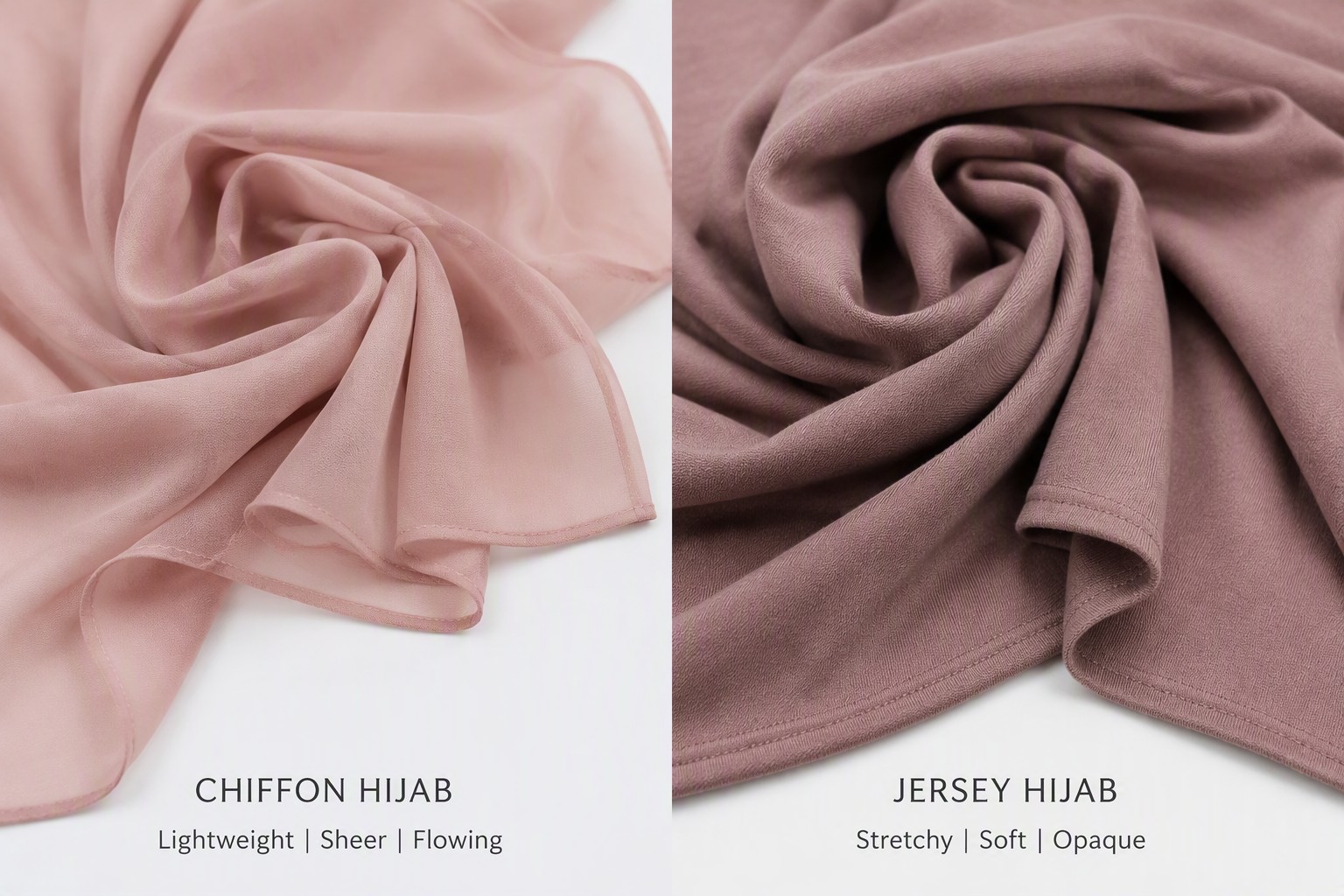
Quick Summary
Jersey modal is one of the most in-demand hijab fabrics for brand builders in 2026 because of its stretch recovery, opacity, and print receptivity. Sourcing from a specialist jersey hijab factory -- rather than a generalist textile supplier -- gives brands access to consistent fabric grades, controlled dye adhesion, and repeatable colourways across reorders. This guide walks through the full sourcing process: fabric specification, print method selection, production data benchmarks, and wash fastness testing standards. Brands that treat the first jersey hijab order as a technical audit of the factory will build the strongest foundation for long-term collection development.
Introduction: Why Jersey Hijab Fabric Has Become the Benchmark for Brand-Ready Collections
Jersey hijab fabric has become the default choice for independent hijab brands building their first collection -- and for good reason. The knit construction gives jersey its characteristic stretch recovery, which means the hijab returns to shape after wearing rather than developing permanent distortion. For brands selling online where fit consistency drives repeat purchases, this is not a minor technical detail; it is a key part of the product experience.
When jersey is made from modal fibre, the material gains additional advantages: plant-based softness, better moisture management, and a print surface that accepts reactive dyes with exceptional colour depth. The combination of jersey construction and modal fibre has produced the fabric that many brand builders are describing in 2026 as the product-market fit sweet spot for everyday hijab wear.
This guide is written for brand owners and buyers who are in the process of identifying or qualifying a jersey hijab factory. It covers what to look for technically, what production benchmarks to ask for, and how to structure the sampling and approval process to protect quality across reorders.
Part 1: The Buyer Problem -- Why Generic Fabric Suppliers Fail Brand Builders
The most common sourcing failure for independent hijab brands is starting with a generalist fabric supplier or a manufacturer that treats jersey hijab as one item in a broad catalogue. Generalist suppliers optimise for volume and variety rather than consistency on any single fabric. This creates a specific and painful problem: the jersey from your first order is not quite the same as the jersey from your second order.
The difference may be subtle -- a slightly different GSM, a marginally different stretch recovery ratio, or a colour that lands 5 to 8 percent brighter than the approved sample. In isolation, these variations are easy to dismiss. Across a growing product range, they undermine the brand consistency that drives customer loyalty.
Brands that have scaled successfully typically identify this problem early and respond by moving to a specialist jersey hijab factory -- a supplier whose production workflow is built around the specific requirements of knit hijab fabric rather than adapted from a woven or general garment line. The difference in output consistency between the two approaches is significant and becomes more visible with each reorder.
Part 2: The Market in 2026 -- What Drives Demand for Custom Printed Jersey Hijabs
The growth in custom printed jersey hijabs is being driven by two converging trends. First, the independent modest fashion brand segment has expanded significantly, with more creators and boutique owners moving from reselling to developing their own labelled products. Second, print technology has matured to the point where small-run custom printing on jersey modal is cost-effective at the 100 to 200 piece range that independent brands actually need.
The brands gaining traction in this space share a recognisable pattern: they are not competing on price, and they are not trying to stock every colourway. They develop two or three signature prints or colours per season, photograph them consistently, and build a recognisable visual identity that makes their product identifiable without a logo visible. This approach requires a factory partner who can hold colour precisely enough that the product in the photograph matches the product in the customer's hands.
The TikTok and Instagram channels that drive most sales in this segment also create a demand for novelty -- new prints and colourways on a seasonal or even monthly cycle. Brands sourcing from a factory with short-run custom capability can respond to this cadence without over-committing inventory. This is why MOQ flexibility has become as important as price in the factory qualification conversation.
Part 3: Technical Standards -- What a Quality Jersey Hijab Factory Must Deliver
When evaluating a jersey hijab factory, the technical conversation should cover four areas: fabric specification consistency, print method and dye chemistry, colourway management across reorders, and dimensional stability after washing.
Fabric specification consistency means that the jersey delivered for bulk production matches the approved sample in GSM, stretch percentage, and fibre composition. For modal jersey, the modal content should be verified -- some suppliers blend modal with polyester at varying ratios to reduce cost, which changes the hand feel and print behaviour. Request a fibre composition certificate from a third-party lab for the bulk fabric lot before production begins.
Print method selection determines the range of designs achievable and the wash fastness of the finished product. Reactive digital printing is the most versatile option for custom jersey hijabs at low MOQ -- it supports unlimited colour depth and complex pattern work without the setup cost of screen printing. The key technical requirement is that the fabric must be correctly pretreated with an alkali solution before printing to ensure the reactive dye bonds to the modal fibre rather than sitting on the surface.
Colourway management across reorders is the technical capability that separates factories with genuine colour management infrastructure from those who are estimating. A factory with proper colour management runs incoming fabric through spectrophotometric measurement before printing begins, and matches the approved Pantone or physical sample to a measurable Delta E tolerance. Delta E below 1.0 is imperceptible to the eye; Delta E above 2.0 is noticeable in side-by-side comparison. Request the factory's stated Delta E tolerance and ask how it is measured.
Part 4: Production Data -- What the Numbers Look Like at a Specialist Jersey Hijab Factory
Production data is the clearest differentiator between factories that are experienced with jersey hijab and those who are adapting from other product categories. Our team tracks production metrics at a granular level because the numbers expose process quality more honestly than any factory tour.
Our standard production cycle for a custom printed jersey hijab order runs 18 to 22 days for repeat orders with approved colourways, and 28 to 32 days for first-time orders including colour development and strike-off approval. These timelines include fabric receipt and incoming inspection, pretreatment, printing, fixation washing, quality inspection, and packing -- not just cut-and-sew time.
Our rework rate on jersey modal print orders sits below 2.8 percent of total pieces shipped. This is measured as pieces that required any form of rework -- reprinting, re-inspection, or reprocessing -- before passing final QC. The target for new client orders is the same as for established accounts; the incoming inspection and first-piece confirmation steps are applied consistently regardless of order value.
Our production capacity for jersey modal custom print orders is 8,000 to 12,000 pieces per month depending on design complexity. Short runs of 100 to 300 pieces are scheduled within the regular production calendar rather than as exceptions, which means lead times for small orders are predictable rather than variable. Our production experience allows brands at early stage to access the same quality controls applied to larger accounts.
Part 5: Quality Control -- Wash Fastness Testing for Custom Printed Jersey Hijabs
Wash fastness is the quality dimension that matters most to end customers in the jersey hijab category, because the product is worn close to the face and washed frequently. A hijab that loses colour intensity after three washes, or that transfers dye to a light-coloured garment, generates returns and negative reviews that are difficult to recover from in a community-driven market.
Our wash fastness testing protocol follows ISO 105-C06, which simulates accelerated washing cycles to evaluate colour change and staining. Tests are run on fabric samples from each new colourway before bulk production is approved. For reactive-dyed jersey modal, we target a minimum grade of 4 on colour change and 4 on staining against both cotton and synthetic adjacent fabrics. Colourways that do not meet this threshold are reformulated before production proceeds.
In addition to wash fastness, we test rubbing fastness (dry and wet) per ISO 105-X12 and light fastness per ISO 105-B02 on all printed jersey fabrics. Light fastness testing is particularly relevant for brands selling in high-UV markets such as the Gulf states and Southeast Asia, where displayed products or outdoor wear can accelerate colour fade if the dye selection has not been validated. Test certificates for all three fastness dimensions are available to clients on request.
The internal QC process for each production batch includes a dimensional stability check after the fixation wash -- we measure the fabric against the approved specification to confirm that the washing step has not caused shrinkage beyond the acceptable tolerance of plus or minus 3 percent in both warp and weft directions. Shrinkage outside this range affects the finished dimensions of the hijab and is caught at this stage rather than after cut-and-sew.
Part 6: Brand Development -- Building a Jersey Hijab Collection That Scales
The brands that build the most durable collections in the jersey hijab category follow a consistent development sequence. They begin by confirming a fabric specification -- GSM, fibre composition, stretch percentage, and surface finish -- and treating that specification as fixed across seasons. The colourways and prints change; the base fabric does not. This consistency builds a reliable product experience that customers return to.
The second element of a scalable jersey hijab collection is a print archive. Each season's approved colourways and print files are documented and stored with the factory, so reorders in subsequent seasons do not require full colour development from scratch. This archive becomes more valuable with each season -- it represents the brand's visual DNA in a form that can be reproduced accurately regardless of which team member manages the reorder.
The third element is a reorder protocol. Brands that scale without quality drift establish a practice of ordering a small reference batch -- typically 20 to 30 pieces -- before committing to a full seasonal reorder. This reference batch is compared against the previous season's archive sample to confirm that fabric and colour specifications have been held. If there is any variation, it is resolved before the full order proceeds. Our team supports this process by maintaining a physical swatch archive for each active client account.
If you have a jersey hijab design brief ready -- whether that is Pantone colour references, a print file, or a physical sample you would like matched -- send it to our team and we will return a detailed production proposal within 48 hours. The proposal covers fabric grade options, print method recommendations, pricing by quantity tier, and a production timeline. We work with brands at the design brief stage as readily as with confirmed purchase orders, because getting the specification right before production begins is how we protect both sides of the relationship.
Frequently Asked Questions
What is the difference between jersey hijab fabric and modal hijab fabric?+
Jersey refers to a knit fabric construction that can be made from various fibre types including cotton blends, polyester, or modal. Modal jersey combines the knit structure of jersey with the plant-based fibre of modal, giving it superior softness, moisture management, and a slightly elevated hand feel compared to standard jersey. For custom printing, modal jersey accepts reactive dyes with excellent colour depth and maintains that colour through multiple washes more reliably than synthetic-blend jersey.
What GSM range is best for a custom printed jersey hijab?+
For everyday wear, 160 to 190 GSM jersey modal performs well -- it is opaque without a hood underscarf for most wearers, drapes cleanly, and holds print detail without bleed. Lighter jersey below 140 GSM tends to be semi-sheer and requires an underliner for most markets. Heavier jersey above 210 GSM can feel stiff and is better suited for cooler climates or structured styles rather than everyday hijab drape.
How many colours can be printed on a custom jersey hijab?+
With reactive digital printing, there is no practical colour limit -- the process works from a digital file, so gradient prints, photographic patterns, and multi-colour geometric designs are all achievable at the same cost. Screen printing limits colour count more significantly; each colour requires a separate screen, so complex designs become expensive at low MOQ. For brands developing signature prints, reactive digital printing on jersey modal is the most flexible entry point.
What wash fastness standard should I expect from a quality jersey hijab factory?+
ISO 105-C06 is the standard used to test colour change after washing. A reputable factory should achieve a minimum grade of 3-4 on a scale of 1 to 5 for both colour change and staining. For reactive-dyed jersey modal, grade 4 to 4-5 is achievable with correct fibre pretreatment, dye selection, and post-fixation washing. Always request a wash fastness test certificate before approving bulk production.
What is a realistic production timeline for a custom printed jersey hijab order?+
For a first-time custom order including colour matching and strike-off approval, allow 25 to 35 days from confirmed order to ex-factory. Repeat orders with approved colourways reduce to 18 to 25 days. Rush production is available for existing clients with no colour development required, typically 12 to 15 days for quantities under 500 pieces.
What MOQ do jersey hijab factories typically require?+
Factory MOQs vary significantly. Large volume factories often require 500 to 1,000 pieces per colourway. Specialist custom manufacturers working with independent brands can typically accommodate 100 to 200 pieces per colourway for first orders, with the understanding that repeat orders build toward higher volumes. For brands testing a new design, starting at the minimum MOQ protects cash flow while validating market response before committing to bulk.
Need a quote for your next order?
Free samples available. MOQ from 100 pieces. Ships to 50+ countries.
Request a Quote