Quick Summary
Building a hijab brand requires more than a strong aesthetic -- it requires a printed hijab supplier who can translate design intent into consistent, washable, scalable production. The right supplier supports sample development with low MOQ, maintains colour accuracy across repeat orders, and provides documented QC at every production stage. Brands that grow sustainably treat supplier selection as a strategic decision, not just a cost comparison. Evaluating wash fastness test results, production lead times, and communication responsiveness before placing a bulk order separates brands that scale from those that stall.
Building a hijab brand in 2026 is more accessible than it has ever been. Instagram and TikTok have flattened the distribution barrier, and the global modest fashion market continues to grow year on year. But accessibility cuts both ways. More brands entering the market means more competition, and the brands that build loyal customer bases are the ones that get product quality right from the beginning -- and that starts with choosing the right printed hijab supplier.
This guide is written for modest fashion entrepreneurs at the early to mid stage of building their brand: those who have a design direction, a target customer, and a rough idea of their first collection, but are still navigating the supplier selection and sample development process. We will cover what to look for, what to ask, and how to structure your first production run to give your brand the best possible foundation.
Part 1: The Supplier Problem Most New Hijab Brands Face
The most common mistake early-stage hijab brands make is choosing a supplier based on price per unit and product photos alone. A low unit cost from a supplier who cannot maintain colour consistency, meet lead times, or provide QC documentation will cost far more in returns, reshipping, and brand reputation damage than the initial savings justify.
The second mistake is placing a large first order without a validated sample. Many brands skip the sample stage to save time and cost, only to discover that the print colour is off by two shades, the fabric weight is lighter than specified, or the stitching quality does not meet expectations. A sample order of 30 to 50 pieces, even at a higher unit cost, is the cheapest insurance a new brand can buy.
The third and perhaps most critical mistake is not asking about wash fastness before approving production. Hijabs are worn close to the face and washed frequently. A print that fades or bleeds after a handful of washes is not just a quality problem -- it is a brand-ending problem for a business that depends on repeat customers and word-of-mouth in a community-driven market.
Part 2: The Modest Fashion Market in 2026 -- What Growing Brands Are Doing Differently
The modest fashion market is estimated at over 300 billion USD globally, with hijab apparel representing a significant and growing segment. What distinguishes the brands capturing market share right now from those that launched and stalled is not follower count -- it is product consistency and brand positioning.
Brands that have successfully grown from launch to sustainable revenue share a few common patterns. They invested in developing a signature colourway or print before scaling. They built a relationship with one supplier rather than constantly switching for marginal cost differences. And they used social media not just to sell, but to document the product development process -- which builds trust in a market where authenticity matters enormously.
The printed hijab segment specifically has benefited from the democratisation of custom print technology. What once required minimum orders of several thousand pieces can now be developed at 100 to 300 pieces per colourway, making custom-printed collections accessible to brands at the early stage. This has created a new tier of independent hijab brands that compete on design originality rather than price.
Part 3: What to Look for in a Printed Hijab Supplier -- Technical Standards
Not all hijab suppliers offer the same print capabilities. Understanding the technical standards that distinguish quality suppliers from average ones will help you ask better questions and evaluate samples more accurately.
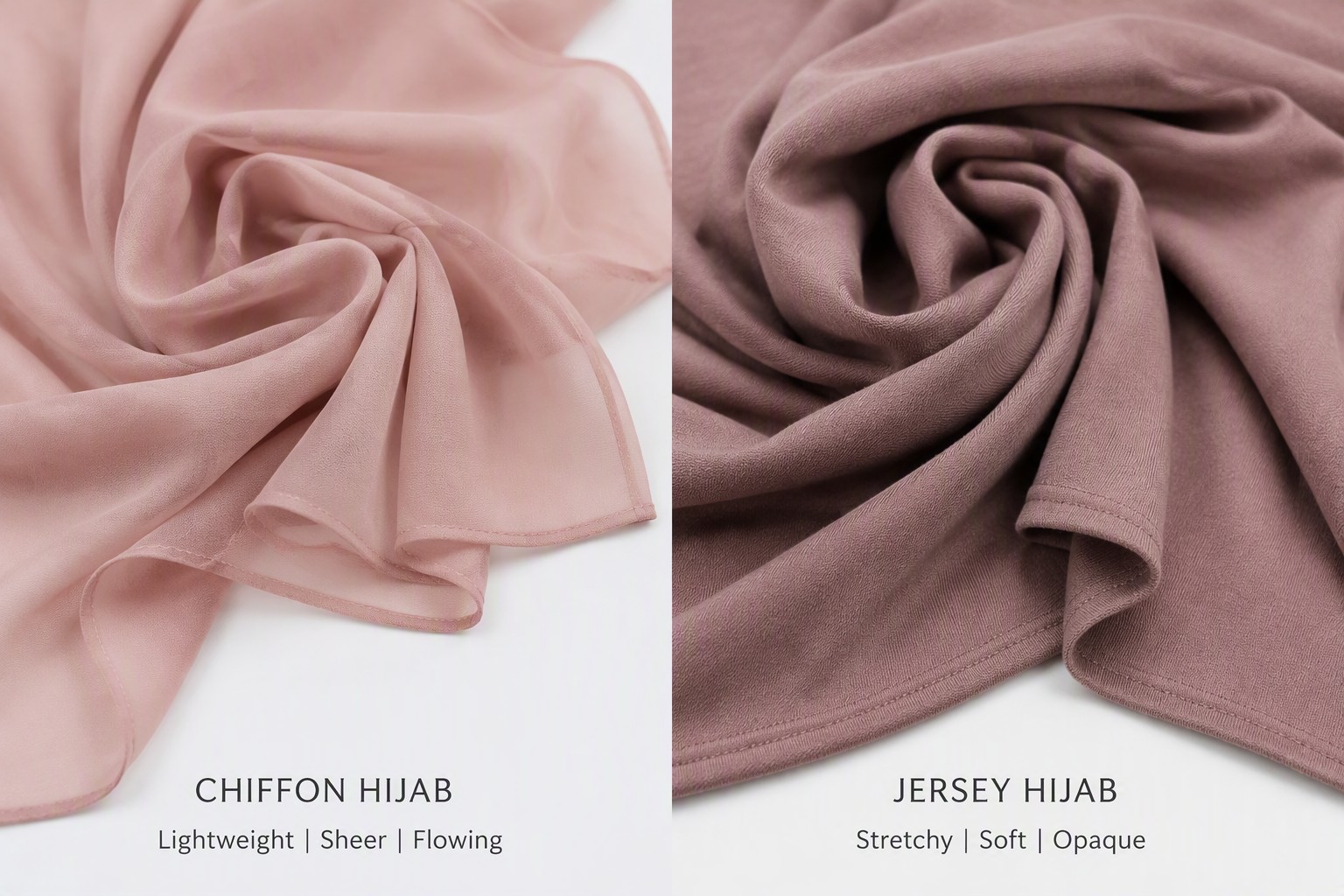
Fabric weight (GSM) matters more than most new brands realise. A chiffon hijab should typically fall between 50 and 75 GSM for adequate drape without transparency. Jersey hijabs for everyday wear generally sit between 200 and 240 GSM for proper opacity and stretch recovery. Modal fabrics for premium collections typically run between 120 and 180 GSM. Ask your supplier for a fabric test report that confirms the actual GSM of the fabric you are ordering -- not just the specified GSM.
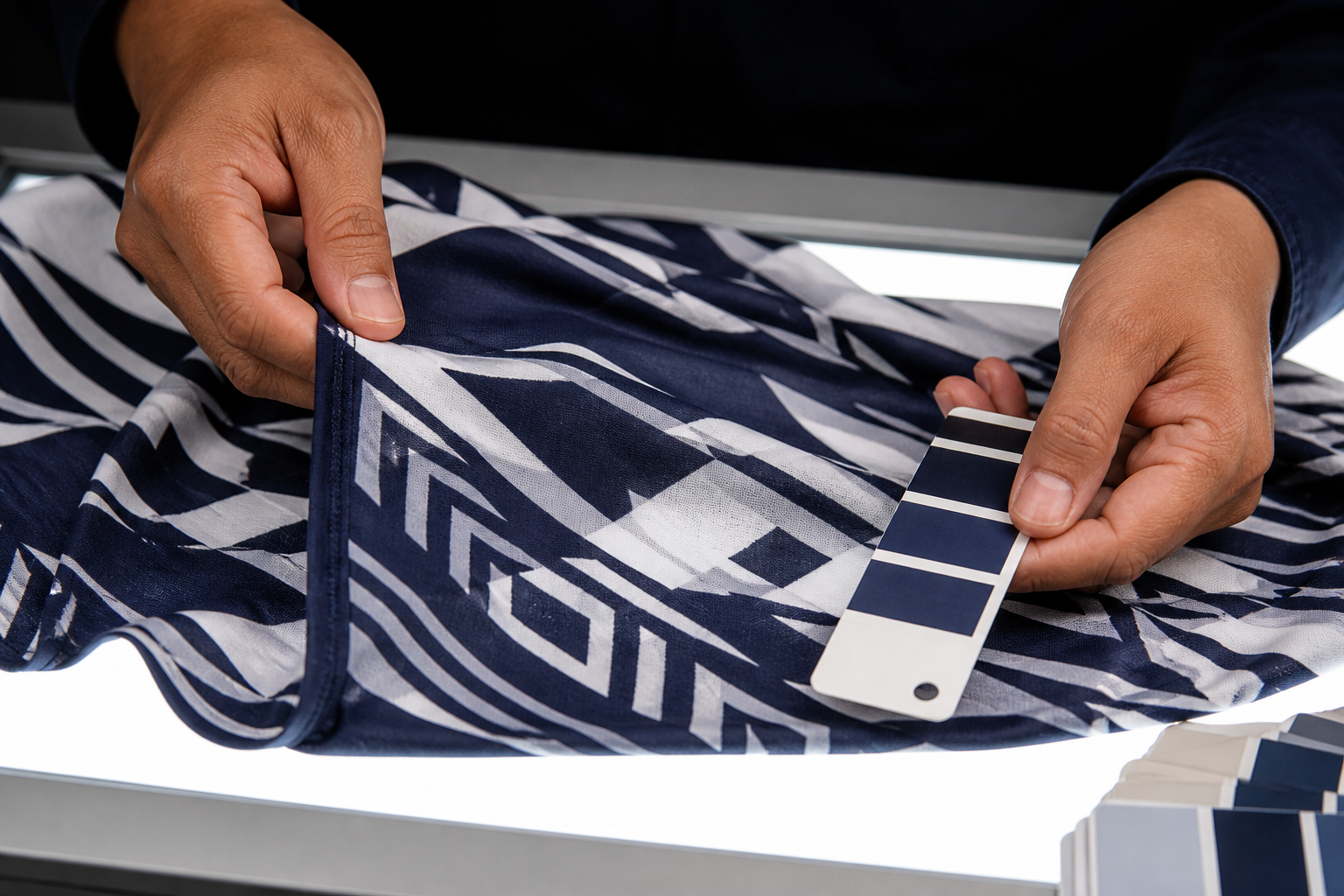
Colour accuracy is the most visible quality indicator for printed hijabs. Suppliers who work with calibrated colour management systems and reference Pantone values will consistently produce colours closer to your original design than those working from JPEG files alone. Ask whether the supplier can match to a Pantone reference and what their acceptable Delta E variance is before approving production. A Delta E of 2 or below is considered visually indistinguishable to the human eye.
Wash fastness -- the ability of a dyed or printed fabric to retain colour through repeated washing -- should be verified before bulk approval. The ISO 105-C06 standard is the most widely referenced test for wash fastness in textile production. Ask for test results showing a Grade 4 or above for both colour change and colour staining. This is not an optional quality check; it is the minimum standard for a product that customers will wash regularly.
Part 4: Factory Capability -- What the Production Numbers Tell You
When evaluating a printed hijab supplier, production data reveals more than a factory tour or marketing material ever can. The metrics that matter most for brand builders are production cycle time, order accuracy rate, and capacity relative to your growth trajectory.
Production cycle time -- the number of days from fabric intake to finished goods ready for shipment -- varies significantly depending on order complexity and factory workload. For custom printed hijabs with standard colourways and no special finishing, a typical cycle runs 18 to 28 days after sample approval. Complex orders involving custom weaving, embroidery, or special packaging can extend to 35 to 45 days. A supplier who can give you a concrete production timeline and hold to it is worth more than one who quotes the fastest turnaround without supporting data.
Our production team tracks rework rates by order line. For custom printed modal and jersey hijabs, our rework rate for colour-related issues runs below 2%, which reflects the investment we have made in calibrating our printing equipment to maintain consistency across long production runs. Brands ordering repeat colourways see even tighter tolerances, because our equipment settings for approved colourways are retained and reapplied on reorders.
Capacity relative to your growth trajectory matters because the worst time to discover your supplier cannot scale with you is when you have just run a successful launch and need to double production volume in 30 days. Our facility handles orders from 100-piece sample runs through to bulk repeat orders, and we structure production scheduling to accommodate scaling brands without de-prioritising smaller orders.
Part 5: Quality Control -- Wash Fastness Testing and Long-Term Brand Protection
QC for printed hijabs has three stages -- incoming material inspection, inline production checks, and outgoing shipment verification -- but for brand builders, the most strategically important is wash fastness testing, because it is the quality failure that shows up after the product is already in a customer's hands.
We conduct wash fastness testing on all printed fabric batches using the ISO 105-C06 standard, which simulates accelerated domestic washing conditions. The test is run at 40 degrees Celsius and evaluates both colour change on the tested fabric and colour staining on adjacent white fabric. Our minimum acceptance standard is a Grade 4 on both measures, which means the colour is retained with minimal visible change through repeated washing.
For brands using reactive dyes on modal or jersey, we run additional tests after the fixing process to confirm that the dye has bonded correctly with the fibre. Prints that pass the visual inspection stage but fail wash fastness are always traced back to the fixing temperature or dwell time in our equipment, and those parameters are adjusted before production continues. This upstream identification prevents wash fastness failures from reaching finished goods.
We provide brands with a QC summary document for each production run that includes fabric test results, inline colour check records, and final shipment inspection findings. This documentation is useful for brands that sell to wholesale buyers or boutiques who require supplier quality certifications.
Part 6: Brand Development Advice -- Building for Longevity, Not Just Launch
The brands that build lasting businesses in the hijab space share one quality: they treat product development as an ongoing investment rather than a one-time event. Launching with a strong first collection matters, but the brands that retain customers and grow revenue year over year are the ones that develop new colourways systematically, improve packaging and presentation progressively, and listen closely to what their customer base is telling them about fit, fabric, and care.
From a supplier relationship perspective, the most effective approach for scaling brands is to concentrate development with one trusted manufacturer rather than dispersing orders across multiple suppliers for small marginal cost differences. A single supplier who knows your colourway preferences, your packaging specifications, and your quality tolerance will produce better results on reorders than a new supplier starting from a brief for the first time.
Start your brand with a clearly defined signature -- whether that is a specific fabric, a colour palette, a print style, or a packaging approach -- and build your supplier relationship around that signature. Consistency is what customers return for and what creates word-of-mouth in a community-driven market. A supplier who supports your signature rather than pushing you toward whatever is easiest to produce is the right long-term partner.
If you are at the stage of validating your first collection or preparing to place a sample order to test quality before scale, our team offers sample runs starting at small quantities. Send us your design brief and we will walk through fabric options, print process suitability, and expected lead time so you can make an informed decision before committing to bulk production.
Frequently Asked Questions
How do I find a reliable printed hijab supplier for my brand?+
Start by requesting fabric swatches and a printed sample in your colourway before committing to any order. Evaluate response time, willingness to share QC documentation, and whether the supplier can provide wash fastness test results. A reliable printed hijab supplier will discuss your design brief in detail rather than pushing you toward in-stock options.
What MOQ should I expect when starting a hijab brand?+
Most quality printed hijab suppliers set MOQs between 100 and 300 pieces per colourway for custom print orders. Some factories accommodate lower sample runs of 30 to 50 pieces at a higher unit cost to allow brand testing before scale. Starting with a small sample order to validate quality before committing to full production is standard practice for new brands.
How important is wash fastness when choosing a hijab fabric and print?+
Wash fastness is one of the most critical quality indicators for hijab products. A print that fades or bleeds after two washes will generate returns and damage brand reputation quickly. Ask suppliers for ISO 105-C06 wash fastness test results and check that colour ratings meet at least a Grade 4 standard before approving bulk production.
Should I choose modal or jersey fabric for my brand launch?+
Jersey is generally more forgiving for first-time brand launches -- it is widely understood by consumers, drapes well, and holds pigment print reliably. Modal offers a premium positioning advantage with its softer hand feel and lighter weight, but requires more precise print calibration. If your brand targets the premium segment, modal is worth the additional development cost.
How long does sample development typically take with a custom hijab manufacturer?+
Sample development from brief submission to approved sample typically takes 10 to 21 days, depending on print complexity and fabric availability. Brands that provide complete briefs including vector artwork, Pantone colour references, and size specifications at the start of the process will receive samples faster and with fewer revision rounds.
What documentation should a printed hijab supplier provide before bulk production?+
Before approving bulk production, request a pre-production approval sample, fabric test report covering GSM and wash fastness, and a production timeline with milestone dates. During production, ask for an inline QC report after the first production run is completed. These documents give you visibility into quality before the goods ship.
Need a quote for your next order?
Free samples available. MOQ from 100 pieces. Ships to 50+ countries.
Request a Quote