Quick Summary
Instagram hijab brands operate under a different set of supply chain pressures than traditional wholesale buyers -- faster product cycles, smaller initial quantities, and a customer base that notices and publicly comments on any inconsistency between the photographed product and the delivered one. Choosing the right hijab supplier for an Instagram brand means finding a manufacturer whose print equipment, colour management process, and documentation systems are built for repeatable small-run output rather than high-volume commodity production. This guide covers the equipment and process questions that matter most when evaluating a manufacturing partner for a social-commerce-driven hijab brand, including how to use documentation as a quality assurance tool across seasons.
Introduction: Why Social Commerce Changes What You Need From a Hijab Supplier
An Instagram hijab brand operates under a fundamentally different set of supply chain demands than a traditional boutique or wholesale buyer. The product cycle is faster, the quantities per colourway are smaller, and the customer's ability to compare the photographed product against the delivered product is immediate and public. A review that notes "the colour is different from the photo" on a product that has generated 10,000 link-in-bio clicks is not just a customer service problem -- it is a brand reputation event.
The hijab supplier that works well for an Instagram brand is not simply the lowest-cost manufacturer or the one with the shortest lead time on the day you place the order. It is the one whose print equipment, colour management process, and order documentation systems are built for the kind of repeatable, accurate, small-run output that social commerce demands season after season.
This guide is written for Instagram brand founders and buyers who are evaluating hijab suppliers, or who are experiencing quality inconsistency with their current manufacturer and want to understand what to look for in a replacement. It covers the equipment questions that matter, the documentation systems that protect brand integrity, and how to structure a supplier relationship that can support rapid growth without sacrificing the quality consistency that built the audience.
Part 1: The Buyer Problem -- What Goes Wrong When Suppliers Are Not Built for Social Commerce
The most common supplier failure pattern for Instagram hijab brands is not dramatic -- it is cumulative. The first order looks good. The second order is slightly different in a way that is hard to articulate but is immediately noticeable in photography. The third order has a colour that reads differently on screen than it did in the approved strike-off. By the fourth order, the brand is using heavy post-processing on product photography to compensate for inconsistency that the supplier insists is within acceptable variation.
Each of these variations has a specific technical cause: a different fabric lot with slightly different dye uptake characteristics, a print machine calibration that drifted between runs without being reset to the approved reference, or a fixation wash duration that was shortened to meet a deadline and resulted in under-fixed dye that photographs well but fades within weeks of regular use.
The supplier that is not built for social commerce will describe these variations as normal and unavoidable. The supplier that is built for it has invested in equipment calibration protocols, colour management infrastructure, and production documentation that specifically address these failure modes. The difference in outcome for the brand is the difference between a product that photographs consistently across seasons and one that requires constant correction.
Part 2: How Instagram Commerce Has Reshaped Hijab Supplier Requirements in 2026
The growth of Instagram and TikTok as primary sales channels for independent hijab brands has reshaped the supplier qualification conversation in ways that were not anticipated five years ago. Colour accuracy used to be evaluated primarily against a physical reference sample held by the brand's buyer. Now it is evaluated by thousands of customers who see the product in a social media post and then receive it at home and immediately compare the two under their own lighting conditions.
This comparison pressure has elevated the importance of print consistency from a manufacturing quality metric to a brand reputation driver. Brands that hold colour accurately across reorders build an Instagram identity that customers describe as reliable and premium. Brands that do not create a pattern of customer comments that -- even if individually minor -- establish a narrative of inconsistency that undermines conversion on future launches.
The other significant change driven by social commerce is the product release cadence. Successful Instagram hijab brands in 2026 typically release new colourways every four to six weeks, with seasonal statement pieces supplemented by reactive colourways responding to trend signals. This pace requires a supplier who can move from colour development to strike-off to approved sample to small-run bulk production within 15 to 25 days. Factories whose workflow is optimised for large quarterly orders cannot accommodate this cadence without compromising quality or lead time.
Part 3: Technical Knowledge -- What Print Equipment Capability Means for Your Product
Print equipment capability is the technical variable that most directly affects the quality of a custom hijab print, and it is the area where supplier differences are most pronounced. Understanding the key equipment parameters allows brand owners to ask specific questions during supplier evaluation rather than relying on subjective descriptions like "high quality printing."
The most relevant equipment parameters for custom hijab printing on modal or jersey fabric are: droplet size (measured in picolitres, with smaller droplets producing finer detail resolution), printhead configuration (the number and arrangement of printheads determines the colour gamut achievable and the print speed), and the precision of the fabric feed mechanism (which determines whether repeat patterns maintain registration across the full width and length of the fabric). A supplier who can provide these specifications has the technical literacy to discuss print quality in terms of measurable outcomes rather than marketing claims.
The fixation equipment used after printing is equally important but less frequently discussed. Reactive dye printing on modal fabric requires either steam fixation or a high-temperature heat-fixation process to bond the dye to the fibre. The temperature, duration, and uniformity of this fixation step determine the final colour depth and wash fastness of the print. Underfixation -- insufficient temperature or time -- leaves dye on the surface of the fibre rather than bonded within it. The product photographs beautifully because the surface dye is vibrant, but fades significantly after the first two or three washes.
Part 4: Equipment at Our Factory -- What We Have Invested in for Print Accuracy
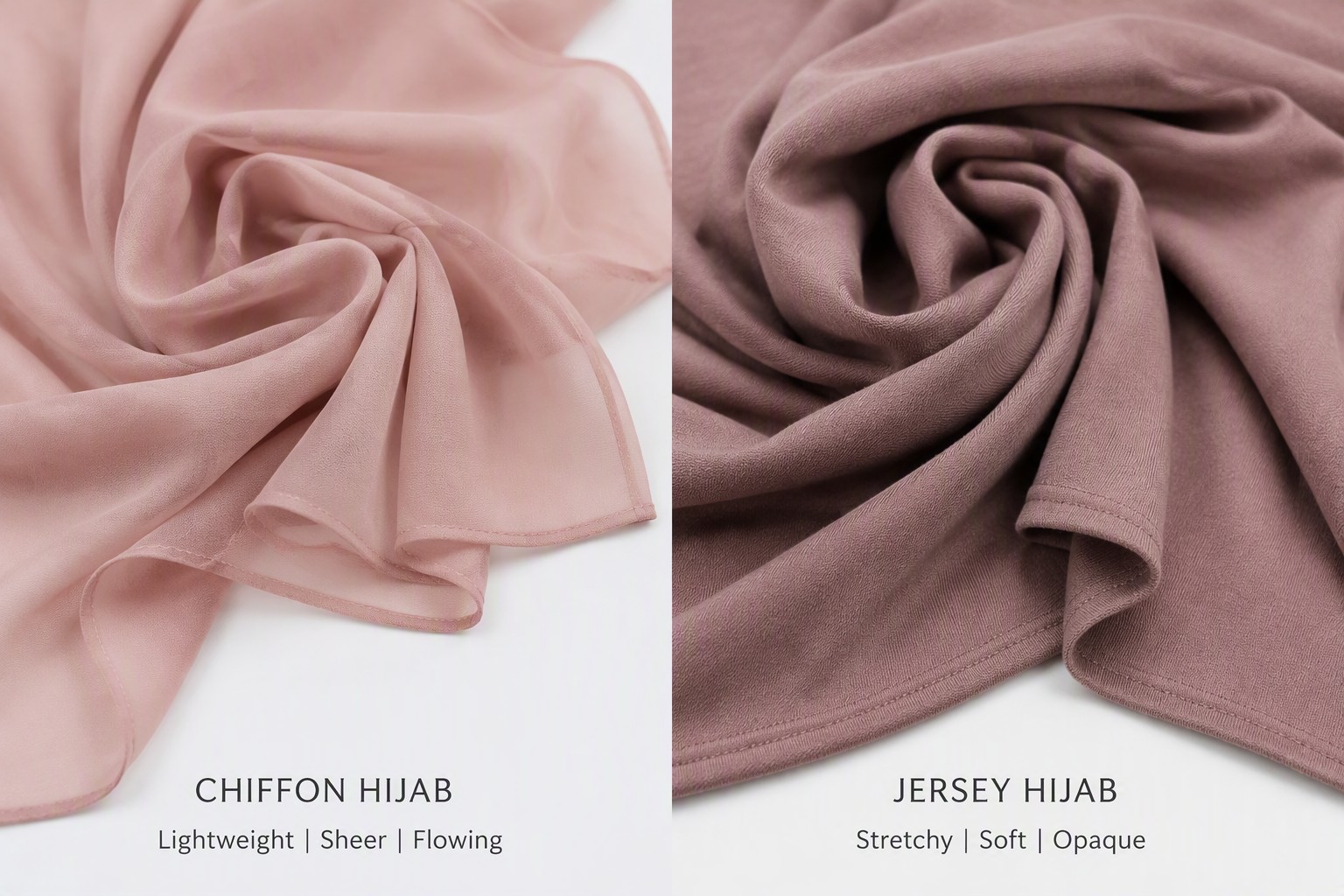
Our team has made deliberate investments in print equipment optimised for custom modal and jersey hijab production at small run sizes. The digital textile printers we operate are calibrated specifically for the fibre types and GSM ranges we work with most frequently -- we do not apply a single universal print profile across all fabric types, because modal, cotton-blend jersey, and lightweight chiffon each behave differently in terms of ink absorption rate and surface spread.
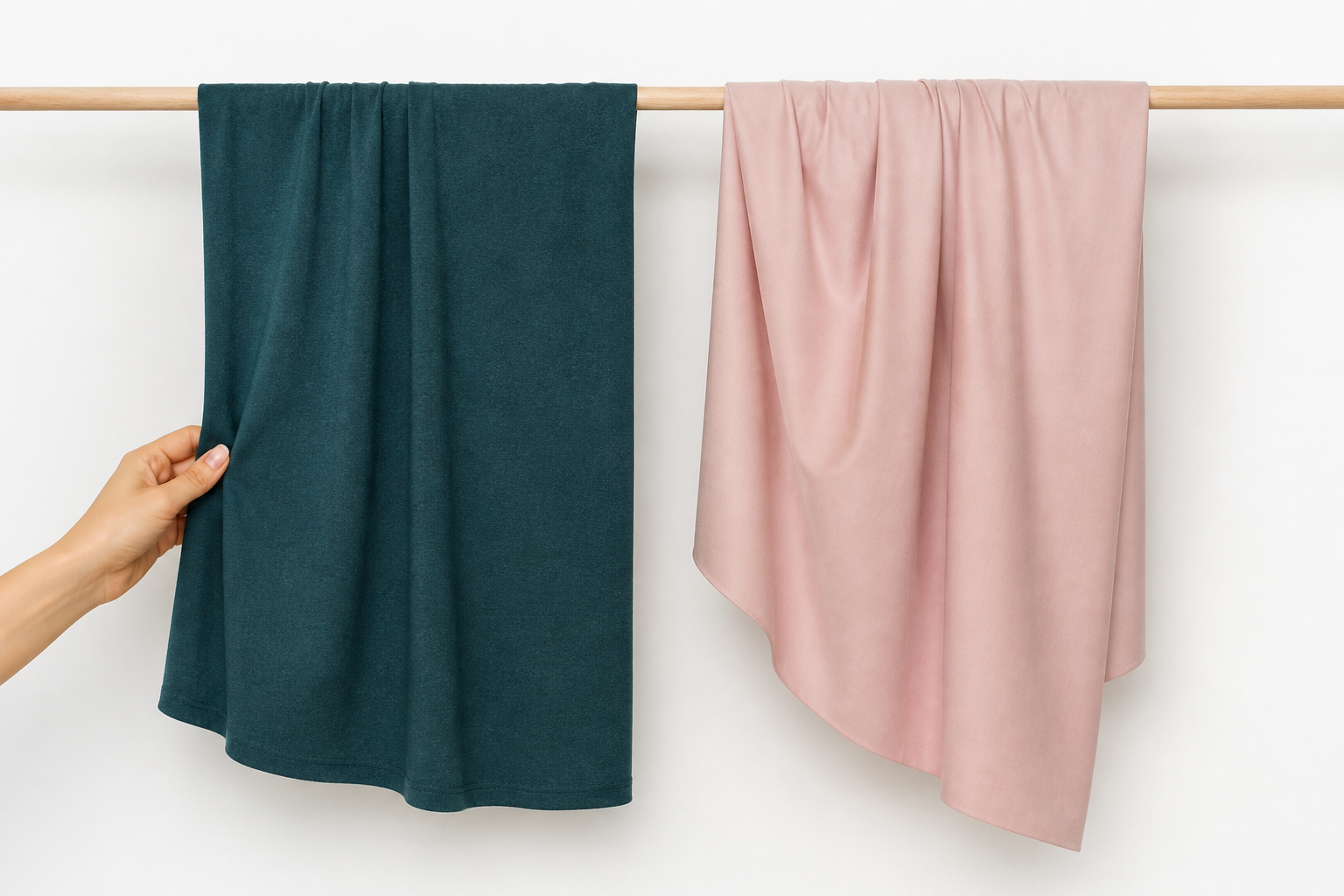
Tension control during printing is a specific investment we have made for jersey knit fabrics. Jersey fabric is inherently elastic, and if the fabric feed tension is not controlled precisely throughout the print run, the fabric will stretch unevenly, causing the printed pattern to distort across the width of the roll. Our feed mechanism maintains consistent tension through electronic tension monitoring rather than mechanical resistance alone, which means the pattern registration holds from the first metre of a print run to the last.
Fixation temperature calibration is checked at the start of each production day against a reference sample from the approved colourway archive. Our steam fixation process runs at a defined temperature range specific to the dye formulation being used that day -- not a single setting applied across all dye types. This means that a deep navy and a pale blush, which require different fixation parameters to achieve their target depth and fastness, are processed at the conditions that optimise each colour rather than a compromise setting that serves neither well.
Our production experience allows brands to specify designs with fine repeat patterns, gradient transitions, and multi-colour compositions that push the resolution limits of lower-specification equipment. Our team tests a design's technical requirements against our equipment capability before accepting a brief, and we communicate clearly when a design element will not reproduce at the expected quality rather than accepting the brief and delivering a disappointing result.
Part 5: Quality Control -- Documentation That Protects Your Brand Across Seasons
For Instagram brands, quality documentation serves a dual purpose: it is both a production control tool and a brand protection mechanism. When a customer raises a quality concern publicly, the brand's ability to investigate and respond with specifics depends entirely on the traceability of the production record. Without documentation, the investigation cannot proceed beyond the factory's general assurance that production was normal.
Our documentation system records the key production variables for every order at batch level: the fabric lot number and incoming inspection results, the dye formulation used for each colourway with the Pantone reference matched, the print machine ID and calibration record for the print run date, the fixation process parameters, and the outgoing inspection results. Each of these records is maintained in the client's production file and is available on request.
The client-facing production report issued with each shipment includes the batch reference, fabric lot, colourway identifiers, approved Delta E tolerance measurement taken from the finished goods sample, and the quantity shipped versus ordered with any shortfall explanation. This report gives the brand a standing record that can be cross-referenced if a quality question arises after the goods have been received and distributed to customers.
For brands managing multiple colourways across seasons, we maintain a physical swatch archive at our factory. The archive holds the approved production sample for each active colourway, kept under controlled storage conditions to prevent colour shift. When a reorder is placed, the incoming fabric and strike-off are compared against the archived reference before production begins, not against the buyer's memory of what the colour should look like. This archive-based comparison is how we hold colour consistency across seasons rather than relying on the subjective judgement of the production team on the day.
Part 6: Building Your Brand -- Using Supplier Quality as a Content Asset
The supplier relationship for an Instagram brand is not just an operational input -- it is a content source. Brand owners who understand the production process behind their hijabs have genuinely interesting things to say about their product that competitors sourcing from generalist factories cannot match: the reactive dye process that makes the colour stay vibrant after 20 washes, the tension-controlled printing that makes the pattern line up perfectly at the fold, the fixation protocol that is adjusted for each colourway to achieve the correct depth rather than a compromise setting.
This kind of content builds trust with an audience that has been burned by inconsistent product quality before. It also provides a defensible positioning that is not based on price -- a conversation that Instagram brands should avoid because there will always be a cheaper option and the audience that buys on price alone is not the audience that builds a brand community.
The practical development path for most Instagram hijab brands is to establish one base fabric and construction as the brand standard, build a colourway library on that base over two or three seasons, and use the documentation and colour archive at the factory to protect consistency across each release. This path is more methodical than it sounds in practice -- the first approved colourway takes the longest, and each subsequent one builds on the established fabric-dye-equipment profile at the factory.
Our team supports brands from the first inquiry through to ongoing seasonal reorders. If you are at the stage of a first inquiry -- with a colourway direction, a print concept, or simply a fabric reference from a competitor product you want to understand and improve on -- share it with us and we will walk through the production path from that starting point to a finished approved sample. The inquiry-to-delivery process at our factory is designed to be transparent at every stage, so brands understand where their order is and what decision point comes next without having to chase for updates.
Frequently Asked Questions
What makes a hijab supplier suitable for an Instagram brand versus a wholesale buyer?+
Instagram brands have fundamentally different supply requirements from wholesale buyers. The key differences are: smaller order quantities per colourway (100 to 300 pieces rather than 1,000-plus), faster development cycles (new colourways or prints on a seasonal or monthly basis), and a much higher sensitivity to colour accuracy and consistency because social media audiences compare product photographs directly to received goods. A supplier suited to Instagram brands has the equipment resolution and colour management process to hold print accuracy at small run sizes, and the administrative systems to process frequent small orders without the delays that slow larger factories.
How does print equipment quality affect the outcome of an Instagram hijab brand's product?+
Print equipment directly determines the resolution, colour gamut, and edge definition of a custom print. Entry-level digital textile printers produce output that looks acceptable in product photography but shows visible dot patterns or colour banding in close-up or macro photography -- the exact photography format that performs best on Instagram. Higher-specification equipment with finer droplet control and wider colour gamut produces prints that hold detail and colour depth in all photography formats and maintain that quality after washing. The fixation equipment used after printing -- the steamer or heat-fixation tunnel -- also affects colour depth and wash fastness. Underfixation is one of the most common causes of faded hijab prints in customer hands.
What order size should an Instagram hijab brand start with when testing a new supplier?+
A test order of 100 to 150 pieces per colourway is the standard starting point for brand-supplier qualification at this market level. This quantity is large enough to generate a statistically meaningful quality sample and to test the supplier's ability to hold consistency across a production run, but small enough to manage cash flow risk if the output does not meet expectations. The test order should be treated as a quality audit: photograph and measure a cross-section of pieces, wash-test a sample set, and compare the finished goods against the approved strike-off before committing to a reorder or seasonal volume.
How important is documentation when working with a hijab supplier as an Instagram brand?+
Documentation is more important for Instagram brands than most suppliers acknowledge. When a colour or quality issue generates public comment on a social media post -- which happens -- the brand needs to be able to investigate quickly: which production batch, which fabric lot, which dye formulation. Without production records, the investigation cannot go deeper than "we will check with the factory." A supplier that maintains batch-level production records and provides them to clients on request gives the brand the information needed to respond to quality questions with specifics rather than generalities.
How do I protect my print designs when working with a hijab supplier?+
Design protection in hijab manufacturing is primarily a contractual rather than a technical matter. A non-disclosure agreement covering your print files and colourways, combined with a clause specifying that your designs will not be reproduced for other clients, is the standard protection mechanism. For brands with genuinely original prints, a design registration in your home market adds a layer of legal recourse. Practically, working with a factory that maintains clear client file separation -- where your print files are stored in a named account folder and not accessible to other clients' development teams -- provides the operational protection that matters most.
Can I add seasonal colourways to an existing product without re-sampling the base fabric?+
Yes, for the same base fabric and construction this is the standard reorder model for Instagram brands building a growing colourway library. Once the base fabric specification, hem style, and dimensions have been approved and documented, new colourways require only a strike-off review rather than a full re-sample. This reduces the development timeline for new colourways from 25 to 35 days to 10 to 15 days, which is well suited to the monthly or seasonal release cadence that social commerce channels reward.
Need a quote for your next order?
Free samples available. MOQ from 100 pieces. Ships to 50+ countries.
Request a Quote