Quick Summary
Sourcing a custom printed hijab supplier is mainly a judgement about people and decisions, not only machines and prices. The technicians who prepare artwork, set colour and decide when to stop a run determine whether your print looks the same on the hundredth piece as on the first. A well-planned sampling round should test the real fabric, real print method and real finishing, so that the sample predicts bulk production. Before shipment, an AQL-based inspection with clear dimensional tolerances gives brands an objective release decision instead of a promise.
Introduction: Sourcing a Print, Not Just a Product
When a brand sources a plain hijab, it is buying a fabric and a finish. When it sources a custom printed hijab, it is buying an interpretation: someone has to take your artwork and decide how it will sit on a long rectangle of soft fabric, which colours the ink system can reach, how the pattern repeats across the width, and what to do when the first output does not look like the screen. Those decisions are made by people, and the quality of a custom printed hijab supplier is largely the quality of those decisions.
This sourcing guide is written for Instagram fashion brands, TikTok sellers, boutique owners and modest fashion startups who are comparing custom printed hijab suppliers. It covers three areas that buyers often underestimate: the print technicians who control your result, the sampling round that should predict your bulk order, and the AQL pre-shipment inspection that decides whether goods are released. Our team focuses on custom printed modal and jersey hijabs, and the guidance reflects what we see when brands move from first contact to a repeatable production programme.
Part 1: Buyer Problem -- Comparing Suppliers on Photos and Price
Most first comparisons between suppliers are made on three inputs: product photos, a unit price and a minimum order quantity. All three are easy to collect and easy to compare, which is why they dominate early conversations. None of them tells you how the supplier will handle your specific artwork.
Product photos show the best output from past orders, often in flattering light. They do not show how many attempts were needed to reach that result or whether the same result was repeated on the reorder. A unit price tells you the cost of the finished piece, but not what is included: artwork preparation, colour development, edge finishing, labelling and inspection can each be priced in or left out. A minimum order quantity tells you how small you can start, but not whether a small order receives the same attention as a large one.
The result is a familiar pattern. A brand chooses a supplier with attractive photos and a competitive price, approves a sample, and then receives a bulk order where the print is slightly misaligned at the edges, the colours are a step duller than the sample, or a share of the pieces are shorter than expected. The sample was real, but it did not predict production, and there was no agreed inspection method to stop the goods before they shipped.
Part 2: Industry Trend -- Print Complexity Is Rising Faster Than Order Size
Custom printed hijabs used to be dominated by simple repeats and a limited palette. Social-first brands have changed that. Designs now include photographic florals, hand-painted textures, gradients across the full length, border prints that must align with the hem, and colourways adjusted to match a seasonal campaign. Each of these increases the technical demand on the print room.
Order sizes, meanwhile, have moved in the other direction. Many brands release smaller drops more often and use real customer response to decide what to reorder. This means a supplier must deliver complex prints in small runs, and then repeat them accurately weeks or months later. That combination rewards suppliers with experienced technicians and documented decisions, and it exposes suppliers who rely on a single skilled operator or on trial and error.
Buyers are also more exposed to public comparison. A border print that is off-centre or a colour that shifts between drops is visible in customer videos and reviews. For a brand selling on Instagram or TikTok, print accuracy is not a back-office detail; it is part of how the brand is judged.
Part 3: Technical Knowledge -- How Artwork Becomes a Printed Hijab
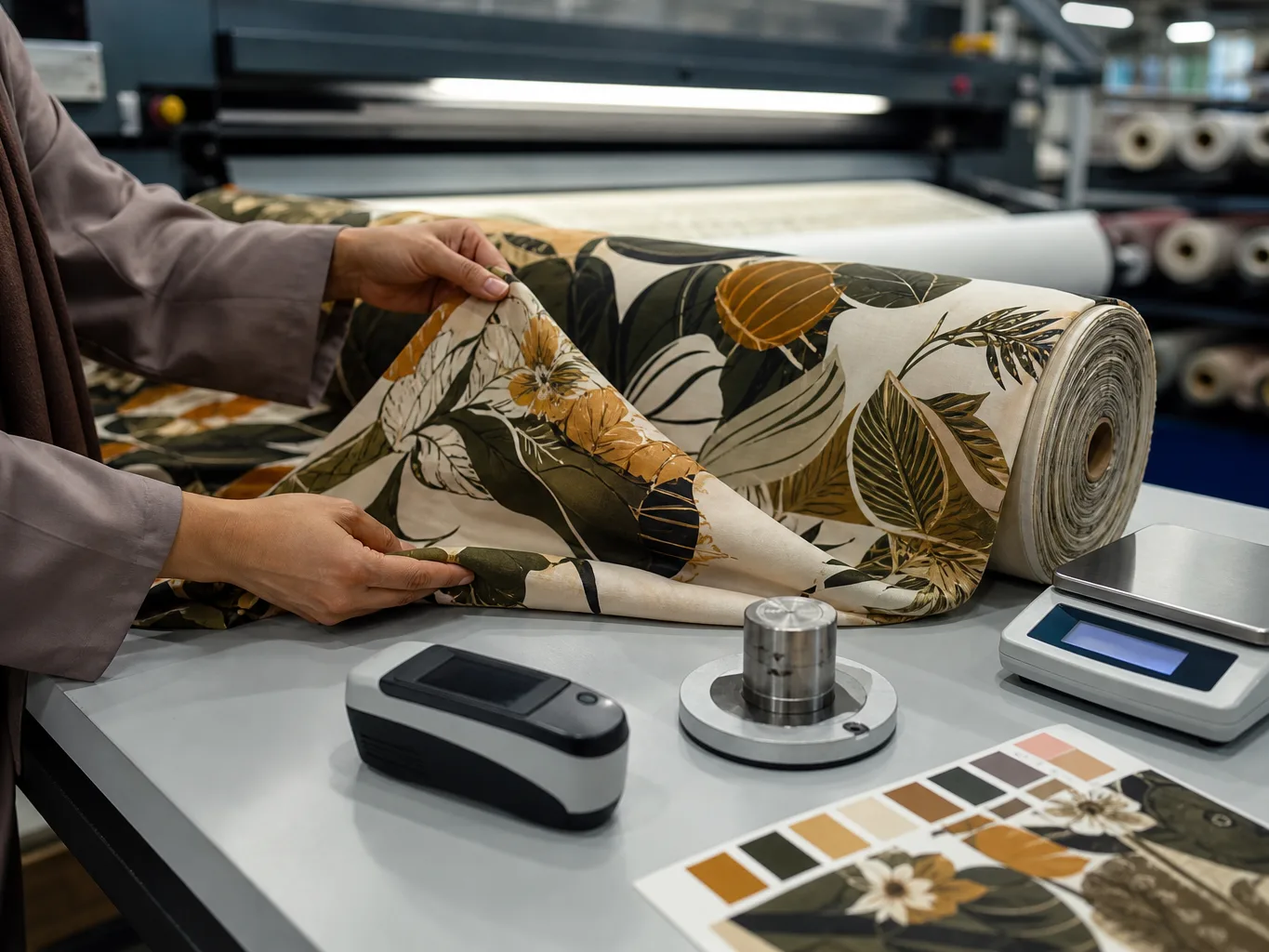
Understanding the path from artwork to finished piece helps you ask suppliers precise questions. The first step is artwork preparation. Your design must be sized to the finished hijab dimensions plus allowances for shrinkage and hemming, and the repeat or placement must be set so that key motifs land where you want them after cutting. Border and placement prints need especially careful positioning because a few centimetres of shift is visible at the hem.
The second step is colour separation and profiling. Digital reactive printing on modal and jersey uses a limited set of inks, and each fabric absorbs them differently. A technician builds or selects a colour profile that translates your on-screen colours into ink quantities for that fabric. Some screen colours, especially very bright or neon tones, sit outside what reactive inks can reach, and an honest supplier will tell you this at the start.
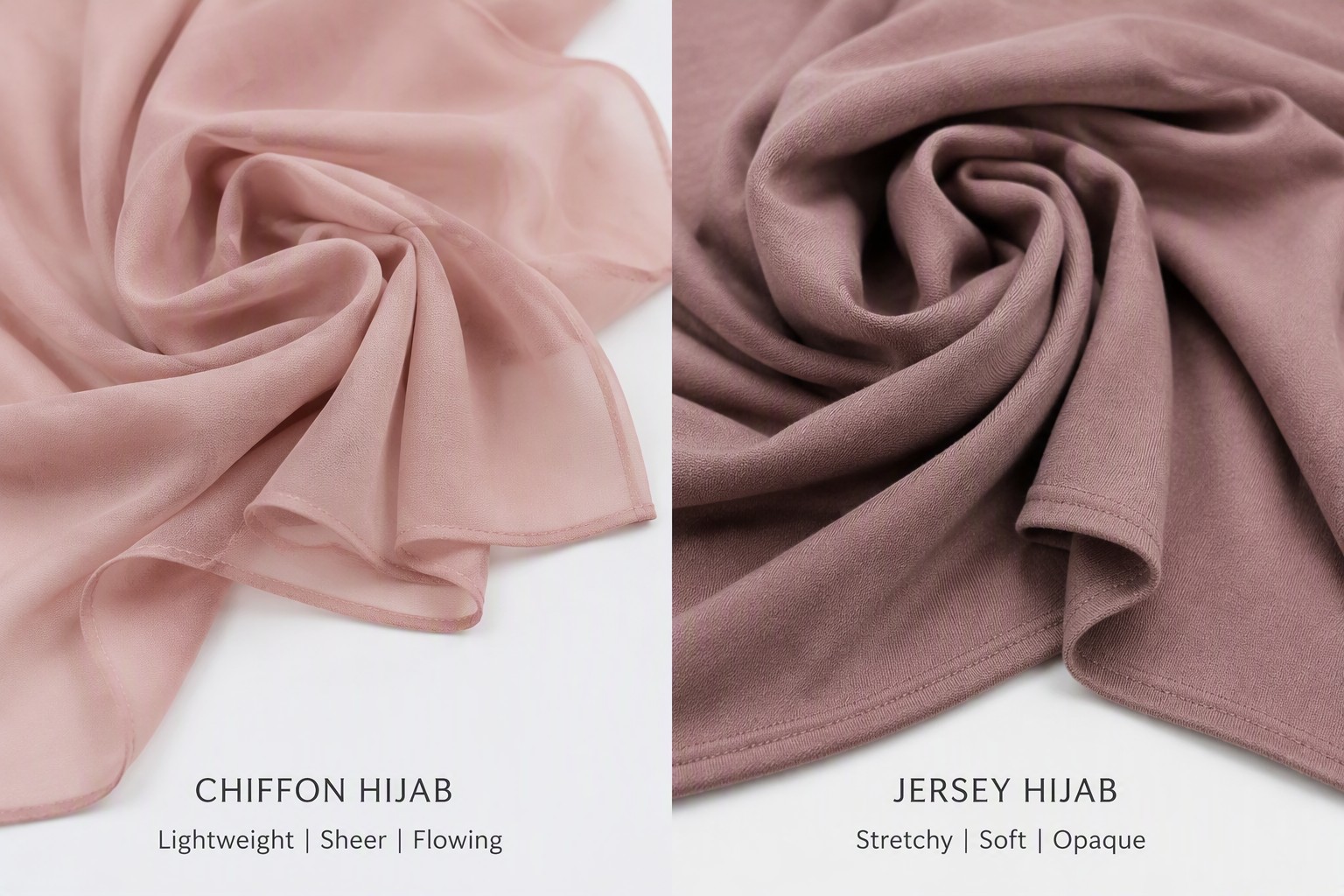
The third step is printing and fixation. Jersey stretches, so it must be fed with controlled tension to avoid pattern distortion. Modal is smooth and absorbent, which gives deep colour but makes it sensitive to moisture and fixation conditions. After printing, steaming fixes the dye, and washing removes unfixed colour. Finally, finishing covers softening, drying, cutting and edge work such as rolled hems or overlocking. Each step can move dimensions and appearance slightly, which is why both sampling and final inspection must be done on fully finished pieces.
Part 4: Factory Capability -- The Print Technicians and Decision Rights Behind Your Order
Machines matter, and we have optimised our own print equipment for hijab widths and for the feed behaviour of modal and jersey. But two suppliers with similar machines can produce very different results, because the outcome depends on who prepares the files, who judges colour and who decides when to adjust or stop. When you evaluate a custom printed hijab supplier, ask about these roles directly.
In our print room, artwork preparation is handled by a pre-press technician who checks every file against the hijab size, sets placement and repeat, and flags motifs that will be cut by the hem or distorted by stretch. This person speaks with the brand before printing starts if a design needs adjustment, rather than silently changing it.
Colour development is handled by a colour technician who has worked on modal and jersey substrates long enough to know how each one shifts after fixation and washing. This technician builds the colour profile for your order, produces strike-offs and records the settings once you approve them. Because colour management sits with one accountable role, a reorder starts from a recorded standard instead of from memory.
On the production floor, the print line supervisor holds the authority to stop a run. If a first article does not match the approved strike-off, or if a mid-run check shows drift, the supervisor pauses the line and calls the colour technician before more fabric is used. Clear decision rights matter more than they appear: in factories where no one is sure who can stop a run, problems are often noticed only after the whole lot is printed.
Our production experience allows brands to talk to the people who make these decisions. During sampling, brands can discuss placement with pre-press and colour targets with the colour technician, which shortens the loop between brief and approved sample. For OEM projects, these technicians work to your supplied artwork and specification; for ODM projects, they also contribute layout and colour options developed from your references.
Part 5: Quality Control -- AQL Pre-Shipment Inspection and Dimensional Tolerances
Our quality control runs in three stages: incoming fabric inspection, inline production checks and pre-shipment inspection. The first two stages prevent problems; the third decides whether the finished lot is released. For a buyer comparing suppliers, the pre-shipment stage is where you should ask the most specific questions, because it turns quality from an opinion into a measured result.
Pre-shipment inspection on our custom printed hijab orders follows AQL sampling based on ISO 2859-1. The lot size determines how many pieces are drawn at random from finished, packed stock. We commonly work at General Inspection Level II, with acceptance limits agreed separately for critical, major and minor defects. Critical defects, such as a safety-related issue or a wrong label content, are not accepted. Major defects, such as visible print misalignment at the hem, colour clearly outside the approved standard or an open seam, have a tight limit. Minor defects, such as a small loose thread that does not affect use, have a wider limit. The exact numbers are written into the order before production.
Dimensional checks are part of the same inspection. Inspectors measure length and width on the sampled pieces and compare them against the tolerance set during sampling. Modal styles generally hold a tighter tolerance than stretch jersey styles, which relax after finishing, so each style carries its own written range. Hem width and evenness are also checked, along with print placement relative to the edge for border designs.
Inspectors compare print colour against the approved strike-off under the agreed light source, check label content and position, and confirm packing against the packaging specification. The inspection result, including measured dimensions and any defects found, is recorded and shared with the brand before shipment. If the lot does not pass, it is not shipped; affected pieces are sorted or reworked and the lot is re-inspected. This is what a strict QC process means in practice: a release rule that applies to every order, including small test orders.
Part 6: Brand Development Advice -- Use Sampling to Answer Production Questions
The most useful sourcing tool a brand has is the sampling round, but only if it is designed to answer questions about production rather than to produce a beautiful one-off. Before you request samples, write down what you need to learn: whether the colours are reachable on the chosen fabric, whether border motifs land correctly after hemming, how the fabric drapes and how the finished size measures.
Ask for samples on the same fabric quality and through the same print and fixation route that will be used for bulk. A sample printed on a different base or finished by hand tells you little about the bulk order. Ask the supplier to measure the finished sample and record the dimensions, so that the tolerance used in pre-shipment inspection is based on a real piece.
Use sampling to compare suppliers on process, not only on output. Notice who asks clarifying questions about your artwork, who tells you when a colour is outside the ink range and who explains what will change between sample and bulk. These conversations are a preview of how problems will be handled later.
Finally, agree the inspection terms during sampling. Confirm the AQL level, defect classifications, dimensional tolerances and colour reference before you place the order. When these are settled early, the pre-shipment inspection becomes a confirmation of what was already agreed rather than a negotiation at the end.
If you are comparing custom printed hijab suppliers, the clearest way to judge our team is to run a sampling test. Send us one or two designs you are considering, tell us whether you prefer modal or jersey, and we will produce finished samples through our bulk print and fixation route, record their measured dimensions and propose the AQL level and tolerance range we would use for your order. You can then compare the samples and the proposed inspection terms side by side with any other supplier on your shortlist.
Frequently Asked Questions
What should I ask a custom printed hijab supplier about its print team?+
Ask who prepares your artwork for print, who approves colour, and who has the authority to stop a run if something looks wrong. Ask how long the key technicians have worked with modal and jersey specifically, because printing on stretch knit and on smooth regenerated cellulose requires different handling. A supplier that can name these roles and explain how decisions move between them usually runs a more predictable production process.
How many sampling rounds are normal for a custom printed hijab?+
Many projects are approved after one or two rounds when the brief is clear. Extra rounds are usually caused by unclear colour references, artwork that has not been prepared for the hijab dimensions, or a change of fabric between rounds. Our team focuses on reducing rounds by confirming fabric, print method, colour reference and finishing before the first sample is produced.
What is AQL and which level is used for hijab orders?+
AQL stands for Acceptance Quality Limit. It is a statistical sampling method, defined in ISO 2859-1, that sets how many pieces are inspected from a lot and how many defects are allowed before the lot is rejected. General Inspection Level II is commonly used for apparel accessories, with separate acceptance limits for critical, major and minor defects. The exact limits should be agreed in writing before production starts.
What dimensional tolerances should a custom printed hijab have?+
Tolerances depend on the style and fabric. Woven or modal rectangular hijabs typically hold tighter length and width tolerances than stretch jersey styles, which relax after cutting and finishing. The important point is that the tolerance is written into the specification, measured during pre-shipment inspection and applied the same way on every reorder. Our team confirms the tolerance range for each style during sampling.
Can I test a custom printed hijab design with a small quantity first?+
Yes. Our small MOQ structure allows brands to test a print, colourway or fabric before committing to larger volume. The exact minimum depends on fabric, print method and the number of colourways, and we confirm it per project. A test order goes through the same three-stage QC process as a larger order, so the result is a reliable preview of bulk quality.
Does a supplier with OEM and ODM capability help if I only have a mood board?+
It can. With ODM support our team can develop print layouts and colour options from a mood board or reference images, then turn the selected direction into production artwork sized for the hijab format. Brands that already have finished artwork can use the OEM route, where we produce exactly to the supplied files and specification.
Need a quote for your next order?
Free samples available. MOQ from 100 pieces. Ships to 50+ countries.
Request a Quote