Quick Summary
A professional custom printed hijab requires precision balance across droplet resolution, reactive dye formulation, and fabric tension geometry to prevent common commercial defects such as white-backed prints and wavy rolled edges.High-end modest fashion labels prioritize double-sided color penetration (≥92%) on micro-modal and chiffon weaves so that scarves drape naturally without exposing an unsightly pale, unprinted reverse face.Technical quality verification relies on AQL 1.5 outgoing audits on backlit transmission tables to inspect vector sharpness, reverse densitometry, and micro pin-hem stitch consistency (14–16 stitches per inch).Brands can reduce sampling lead times and bulk reworks by partnering with an OEM factory that supports pre-press color separation, digital strike-off profile archiving, and low-MOQ pilot production.
Introduction: The Shift Toward Precision-Engineered Custom Printed Hijabs
In the contemporary modest fashion landscape, custom printed hijabs have evolved from seasonal novelty items into cornerstone brand assets. As consumers across North America, the UK, Europe, and the GCC region become increasingly discerning, their expectations for print definition, fabric drape, and finishing craftsmanship have reached unprecedented levels. A headscarf is worn in intimate proximity to the face and under direct natural and studio lighting; consequently, minor imperfections that might pass unnoticed on a casual garment -- such as blurry line registration, uneven color saturation, or a stiff, chalky reverse side -- become immediately glaring to the customer.
For brand founders, creative directors, and boutique sourcing managers, developing a commercially successful custom printed hijab collection requires navigating a delicate intersection of textile physics, color chemistry, and finishing precision. When working with an OEM manufacturing partner, sourcing decisions cannot rely solely on aesthetic digital mockups. Sourcing professionals must understand the technical mechanisms that govern ink droplet dynamics, dye fixation chemistry, and edge tension geometry to ensure that the physical finished product matches their brand’s premium retail positioning.
Part 1: Common Buyer Problems in Custom Printed Hijab Production
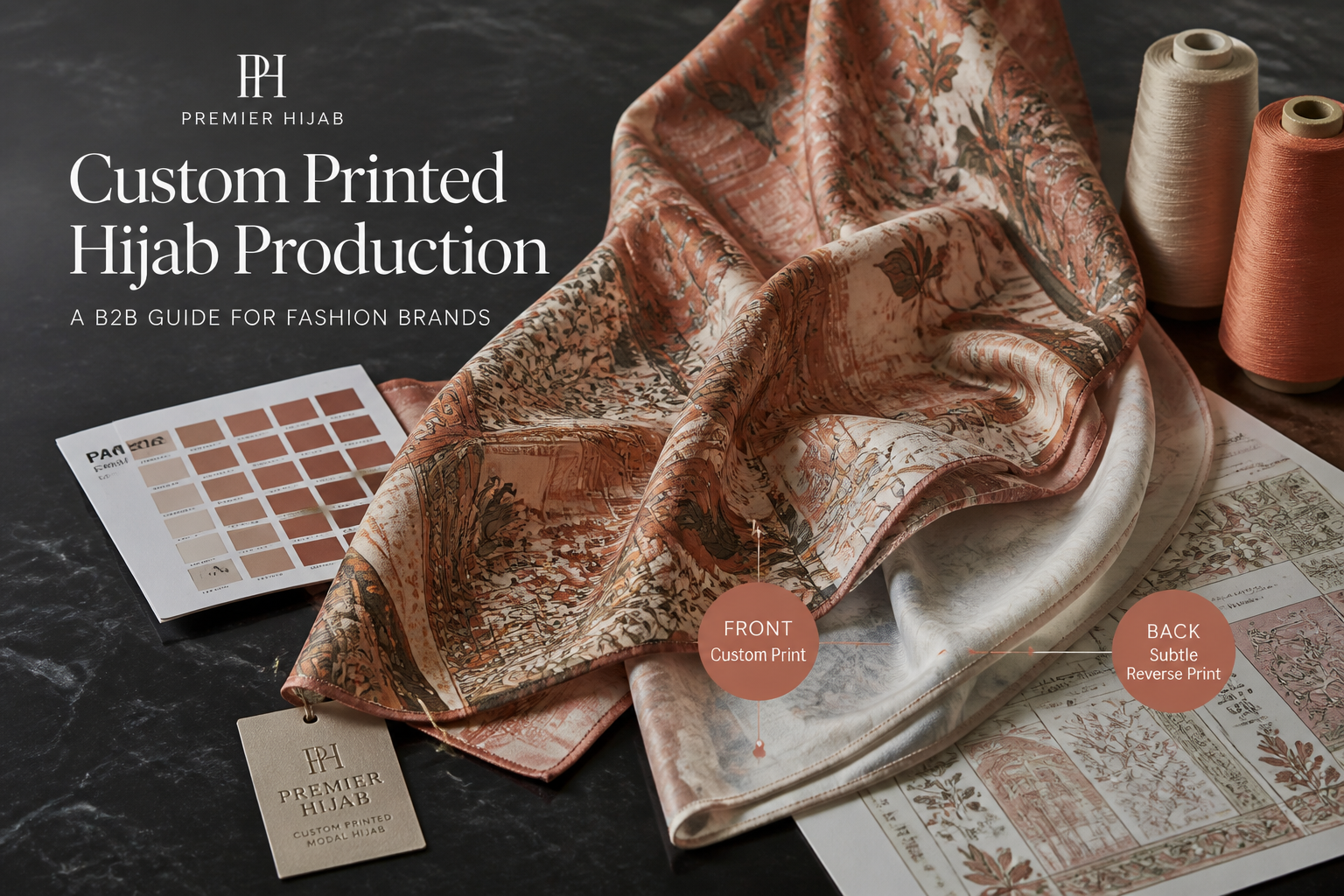
The most frequent challenge encountered by emerging and scaling fashion labels is the dreaded "white-back disconnect." Many commercial digital printers apply ink solely to the face of the fabric. While the top side may appear vibrant on flat inspection, the moment the scarf is folded, draped, or wrapped around the shoulders, the pale, unprinted reverse face is exposed. This stark contrast immediately cheapens the visual appeal of the scarf and generates high return rates from consumers who expect seamless, two-sided luxury.
A second recurring defect is edge distortion and curl along the perimeter seams. Fine woven modal and ultra-lightweight viscose are mechanically delicate fabrics with fluid drape. When inexperienced sewing workshops feed these lightweight textiles through high-speed overlock or narrow-hem machines without proper differential feed calibration, the feed dogs stretch the fabric unevenly. Once released, the sewn edge puckers into permanent waves, creating an unlevel perimeter that prevents the hijab from framing the face cleanly.
Finally, brands frequently experience severe color drift between initial pre-production strike-off swatches and bulk production runs. A terracotta or dusty rose shade approved on a 30 cm sample square can easily turn muddy or oversaturated across a 500-piece production run if the factory fails to control environmental humidity, ink bath viscosity, or post-print steaming temperatures. These inconsistencies disrupt collection launches and erode customer trust across repeat purchases.
Part 2: Industry Trends -- The Demand for Double-Sided Saturation and Natural Fiber Softness
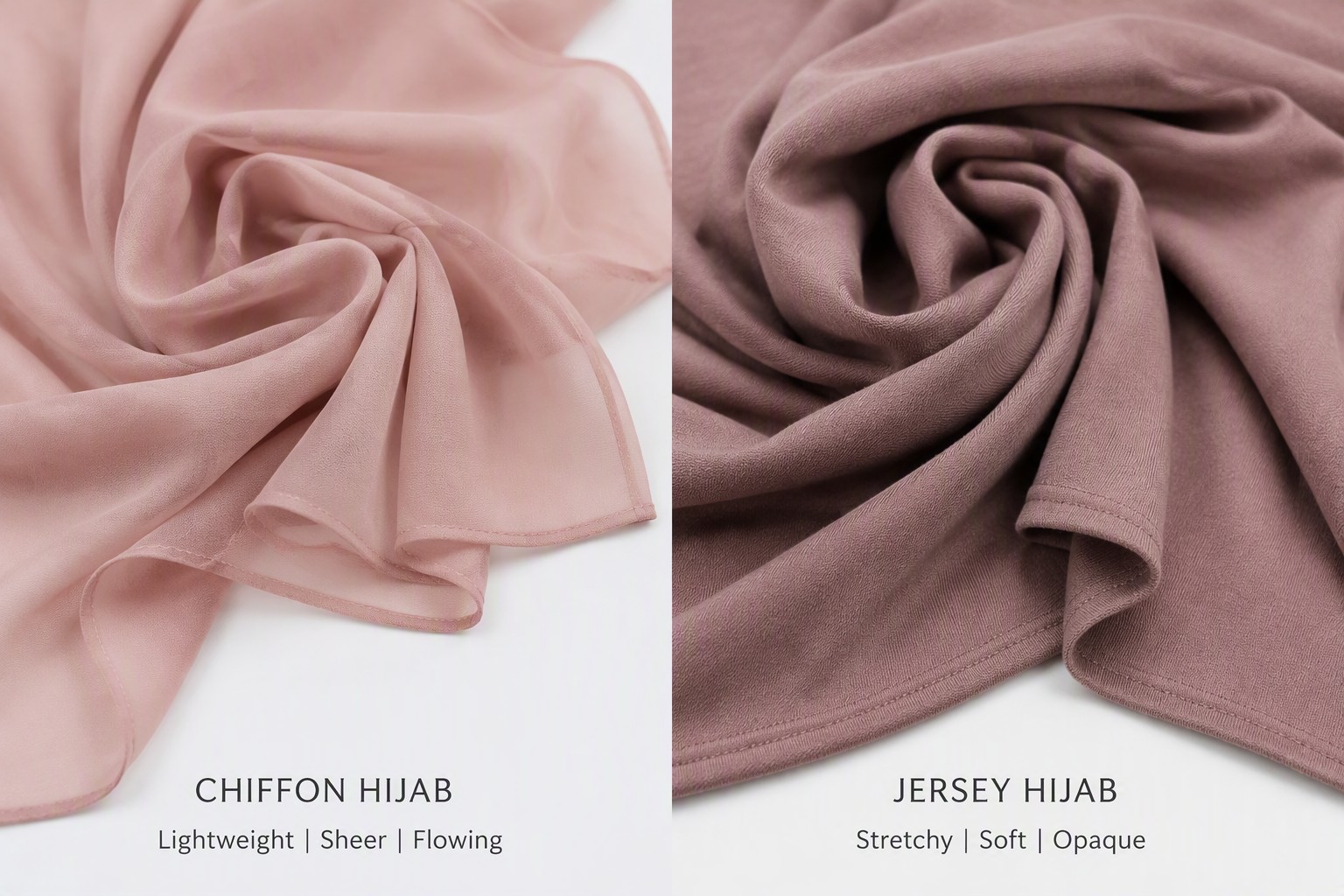
The global modest fashion market has witnessed a decisive shift away from static synthetic polyesters toward breathable, sustainably sourced cellulosic fibers, most notably micro-modal and modal-silk blends. Consumers are demanding headscarves that combine all-day breathability, non-slip friction, and cloud-like tactile softness. However, printing intricate patterns on modal requires fundamentally different production disciplines than printing on polyester chiffon.
Modern luxury brands are also moving toward painterly, multi-tonal botanicals, watercolor washes, and subtle ombre gradients. These complex motifs demand advanced digital reactive inkjet printing rather than traditional rotary screens. Reactive printing enables photographic tonal gradients and unlimited color separations within a single pattern, granting designers total creative freedom while eliminating costly screen-setup charges.
Furthermore, the rise of short-form social video on TikTok and Instagram Reels has elevated packaging and unboxing into critical marketing moments. When an influencer unboxes and styles a hijab on 4K camera, micro-details such as clean pin-hems, flawless tonal depth, and absence of chemical odors become powerful commercial differentiators that drive immediate conversions.
Part 3: Technical Knowledge -- Droplet Physics, Reactive Chemistry, and Fiber Absorption Dynamics
Achieving pristine print sharpness on delicate modal weaves begins with microscopic droplet control. Industrial digital reactive printers utilize piezo-electric print heads capable of firing dynamic ink droplets as fine as 3.5 to 14 picoliters. To achieve razor-sharp line definition without ink feathering, the greige fabric must undergo an engineered pre-treatment padding process. A specialized sizing bath containing natural alginate thickeners, alkaline donors, and hygroscopic agents is applied to the fabric web and dried under uniform tension. This pre-treatment coating holds the liquid ink droplet firmly in place upon impact, preventing capillary spread through fiber pores before the dye can be chemically fixed.
Double-sided color penetration is fundamentally governed by dye chemistry and post-print thermal fixation. Unlike pigment inks that merely adhere a resin binder onto the yarn surface, reactive dyes contain molecular reactive groups that chemically bond with the hydroxyl groups of cellulose molecules. Following ink application, the printed fabric enters a continuous loop steamer chamber maintained at 102°C with 100% saturated, pressure-free steam for 8 to 10 minutes. Under these thermal conditions, the fiber cell walls swell, allowing the reactive dye molecules to migrate completely through the yarn core to the reverse face, forming irreversible covalent chemical bonds.
The finishing wash sequence is equally vital for preserving hand-feel and wash fastness. Once dye fixation is complete, the fabric must pass through multi-stage counter-current washing baths. The initial cold rinse flushes unreacted surface sizing, followed by a hot detergent wash at 80°C to strip hydrolysed unfixed dye molecules, and a final cold bath infused with specialized cationic softening agents. This thorough washing ensures that the printed hijab attains a Grade 4-5 color fastness rating while restoring the signature fluid, liquid drape of pure modal.
Part 4: Our Human Expertise -- Color Master Pre-Press Calibration and Machinist Authority
While advanced machinery provides the foundation for digital textile printing, consistent premium execution ultimately relies on the seasoned craftsmanship of technical personnel. At our factory, every custom print project is overseen by dedicated colorists and pre-press technicians with over a decade of specialized modal experience. When an artwork file is submitted by a client, our color masters do not simply feed the graphic directly into RIP software. They conduct microscopic vector trace audits, adjusting vector line weights and ink density profiles based on the specific yarn count and weave density of the selected fabric batch.
Furthermore, our head printing technicians possess full autonomous authority on the production floor. If a machine operator observes an ambient humidity fluctuation or slight variation in greige fabric absorbency during morning startup, the chief technician has the explicit mandate to halt the printing line immediately, recalibrate piezo head drive voltages, and adjust carriage travel speeds. We prioritize uncompromising lot-by-lot consistency over rushed production volume.
On the finishing line, our senior hemming craftswomen operate specialized baby-hem sewing stations equipped with custom-ground presser feet. Handling ultra-fine 80s and 100s micro-modal requires intuitive human hand-guiding: the machinist gently regulates fabric feed tension in micro-adjustments corresponding to weft and warp grain deviations. This human touch ensures that every hemline remains arrow-straight and completely flat, eliminating wavy perimeter distortion.
Part 5: Quality Control -- AQL 1.5 Backlit Transmission Table Audits and Densitometry
Our quality assurance protocol for custom printed hijabs follows a rigorous three-tier inspection system, culminating in an outgoing audit conducted under strict AQL 1.5 commercial standards. Every production lot is sampled and examined on dual-illumination inspection tables equipped with both calibrated D65 surface daylight tubes and diffuse under-table backlight panels. Backlit transmission reveals any microscopic print pinholes, misaligned nozzle passes, or hidden yarn slubs that remain invisible under standard ambient room light.
To ensure objective color consistency, our QC laboratory utilizes handheld spectrophotometers to measure color coordinate values across both the face and reverse sides of finished hijabs. We mandate a strict double-sided penetration threshold: the color density of the reverse side must reach at least 92% of the primary face measurement across all critical focal tones, with a total color difference Delta E held strictly under 1.0 against the approved physical master swatch.
Perimeter finishing undergoes 100% tactile and dimensional verification. Inspectors verify that narrow rolled hems maintain an exact 1.5 mm to 2.0 mm width tolerance with stitch densities calibrated to 14–16 stitches per inch. Any sample exhibiting thread tension pull, puckered corners, or unclipped thread ends exceeding 1.5 mm is immediately rejected and routed back to finishing.
Part 6: Brand Development Advice -- Optimizing Print Layouts for Yield, Hemming, and Social Impact
When designing a custom printed hijab collection, brand founders can optimize both production costs and retail visual impact by aligning their design files with manufacturing realities. Standard luxury hijab dimensions typically span 180 cm × 70 cm or 190 cm × 75 cm. When laying out repeat patterns, designers should account for a 1.5 cm perimeter perimeter buffer to accommodate edge trimming and baby-hem rolling. Placing delicate borders too close to raw cut edges increases hemming complexity and can lead to minor visual asymmetry if fabric grain shifts slightly during post-wash relaxation.
We strongly advise emerging brands to incorporate deliberate focal contrast into their print compositions. Hijabs styled around the face frame the wearer’s features; having softer, harmonizing tonal fields near the central crown and richer, high-contrast botanical motifs along the ends creates dynamic styling versatility for customers. This intentional composition photographs exceptionally well in natural sunlight and short-form video demonstrations, amplifying organic customer sharing.
Finally, brands should establish a structured sampling-to-scale roadmap. Launching a new collection with a verified pilot run of 100 to 150 pieces per colorway allows brands to confirm customer fit preferences, validate wash durability, and capture high-converting visual marketing assets before committing capital to multi-thousand-piece bulk orders. Our flexible production lines are specifically structured to nurture brands through this exact scaling pathway.
Conclusion: Partnering With a Specialized Custom Printed Hijab Factory
Developing a distinguished, high-performing modest wear brand requires a manufacturing partner that views textile printing not as a commoditized trade, but as an exacting craft. By mastering droplet physics, reactive dye fixation, and delicate hem geometry, our factory empowers fashion brands to deliver headscarves that stand out in crowded online marketplaces and inspire lasting customer loyalty.
If your brand is preparing an upcoming printed collection or evaluating suppliers for private label manufacturing, we warmly invite you to book a 30-minute live virtual factory tour. You can walk through our digital printing facility in real time, inspect live print head calibrations, observe our hemming stations, and speak directly with our engineering team to explore custom solutions tailored to your brand’s vision.
Frequently Asked Questions
What is the minimum color penetration rate acceptable for a luxury custom printed hijab?+
For commercial luxury positioning, a custom printed modal or silk hijab should achieve at least 90% to 94% color penetration to the reverse face. Low-tier transfer or pigment surface prints often deliver less than 50% penetration, leaving a stark chalky white underside that makes styling awkward. Our factory optimizes reactive ink viscosity, pre-treatment chemical baths, and steaming humidity to achieve over 92% deep fiber penetration across dark and vibrant hues.
Why do digitally printed modal hijabs sometimes develop wavy or distorted edges after hemming?+
Wavy or distorted edges (commonly known in apparel manufacturing as the "lettuce leaf effect") occur when sewing machine differential feed dogs apply uneven physical tension across ultra-fine modal fabrics. Because modal yarn relaxes after industrial steaming, any differential tension during edge trimming or baby-hem rolling creates permanent puckering. At our facility, specialized micro-stitch hem operators adjust foot pressure to fabric grain orientation, eliminating curling.
What artwork file resolution and format should brands provide for sharp digital printing?+
Brands should submit native vector artwork (AI or PDF format with all fonts outlined) or raster files scaled at 1:1 true physical dimensions at 300 DPI in RGB color mode. Our color technicians re-check vector stroke weights before RIP processing to guarantee micro-lines finer than 0.25 pt render crisply on open modal weaves without bleeding into adjacent grounds.
What is the primary difference between digital reactive printing and sublimation printing on hijabs?+
Sublimation printing uses disperse dyes that only bond with synthetic polyester fibers, resulting in a sealed plastic hand-feel with zero reverse penetration. Digital reactive printing uses water-based dyes that form covalent chemical bonds with natural cellulose fibers (such as modal, viscose, and cotton), preserving fabric breathability, ultra-soft hand-feel, and deep bilateral color saturation.
How does your factory prevent color drift between initial strike-off samples and repeat bulk reorders?+
We generate and lock custom ICC color profiles for every specific fabric lot and store the spectral spectrophotometer curve (Delta E < 0.8 tolerance) alongside a physical archival master swatch. When a brand places a repeat order months later, our print operators recalibrate piezo jet waveforms to the archived profile under identical room climate control.
Can emerging modest fashion brands order custom printed hijabs with low minimum quantities?+
Yes. Our production structure supports agile brand launches with small MOQ pilot runs starting at 100 to 150 pieces per print design. This enables independent designers and social media brands to test seasonal colorways and verify market sell-through without holding excess deadstock inventory.
Need a quote for your next order?
Free samples available. MOQ from 100 pieces. Ships to 50+ countries.
Request a Quote