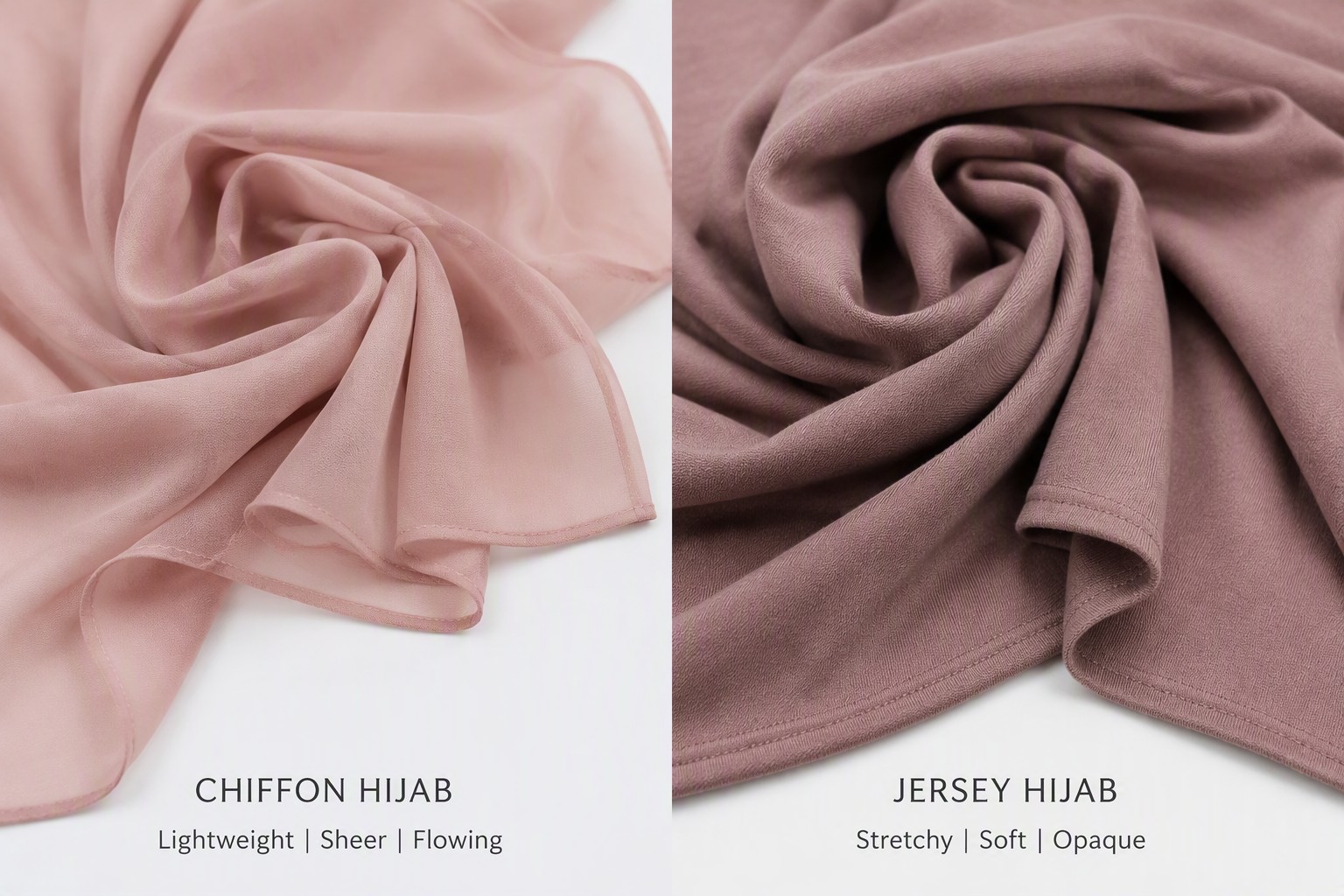
Quick Summary
A custom printed hijab order moves through several production stages where skilled craftspeople make judgement calls that directly affect the final product. Understanding what those decisions are -- and what experience is required to make them well -- helps brands choose the right manufacturing partner and brief their orders more effectively. Our production team brings specific modal and jersey print experience to every stage of the process, from ink formulation and pre-treatment calibration to the outgoing inspection that confirms the finished goods match the approved standard before shipment.
Why the Skills Behind the Machine Matter as Much as the Machine Itself
Most conversations about custom printed hijab quality focus on equipment -- print resolution, machine brand, colour gamut. Equipment matters, but it is not the main variable that separates a good result from a poor one. The main variable is the judgment of the people operating and calibrating that equipment at each stage of the production process. A well-maintained digital textile printer operated by someone without modal-specific experience will produce worse results on modal fabric than a slightly older machine operated by someone who understands how modal behaves during pre-treatment, printing, and steaming.
This is not a comfortable message for brands who want to evaluate suppliers by equipment specification. It means that factory visits and equipment lists tell you less than watching an experienced craftsperson handle a specific fabric type and explain the decisions they are making. It also means that the questions worth asking a potential supplier are not about the model number of their printer -- they are about the experience of the people running it and the decision-making authority those people have when something needs to be adjusted during production.
Part 1: The Buyer Problem -- Designs That Look Right in Files but Wrong in Production
The most frustrating experience in custom hijab development is receiving bulk that looks nothing like the design file. The gradient is banding. The navy is reading as purple. The fine botanical print detail has blurred into an indistinct texture. These are not design problems -- the file was correct. They are production problems caused by decisions made (or not made) at specific stages of the manufacturing process.
Gradient banding is almost always a steaming or ink density issue. When the ink deposit in a gradient transition zone is not properly fixed during steaming, the dye migrates toward the more saturated areas and the smooth transition becomes a series of visible bands. An experienced steaming operator who has seen this failure mode before knows to extend dwell time on high-gradient designs. An operator following a standard programme for all designs will not make that adjustment.
Colour shift -- navy printing as purple, sage printing as grey -- is typically a pre-treatment or ink formulation issue. The pre-treatment chemistry prepares the fabric surface for dye bonding. If the pre-treatment is under-applied or the wrong formulation is used for the specific fabric lot, the dye uptake changes and colours shift toward their secondary components. Matching this correctly requires both the right formulation and an operator who can read the fabric lot behaviour and adjust accordingly.
Part 2: Industry Trend -- Custom Print Has Become the Differentiation Standard for Modest Fashion Brands
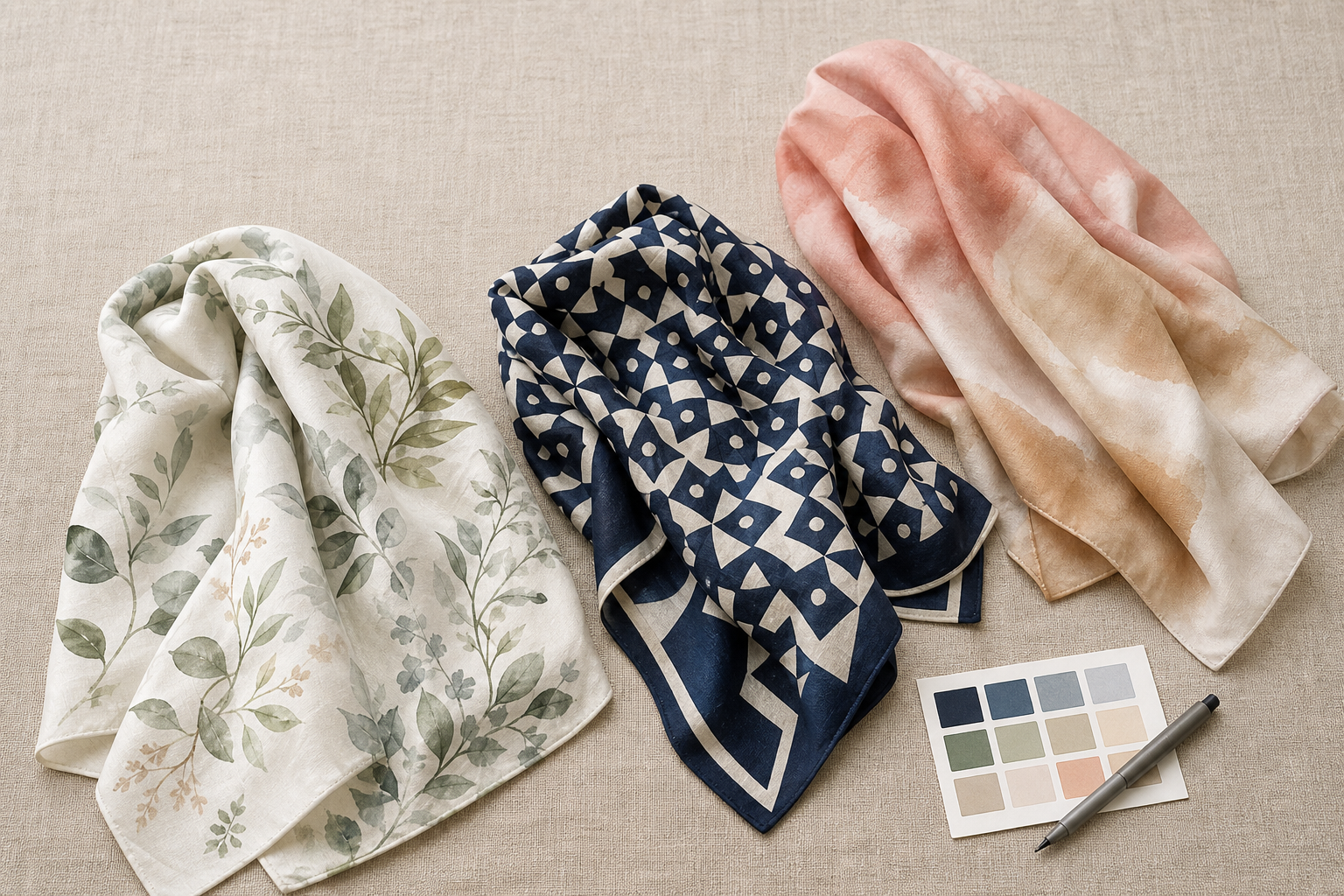
Custom printed hijab has moved from a premium offering to the standard expectation for brands competing in the UK, EU, and North American modest fashion markets. Plain colourway hijabs are still sold, but brands that have built loyal followings have almost universally done so through signature print identities -- a recurring botanical motif, a distinctive geometric language, a seasonal watercolour palette. The print is the brand, not just the product.
This shift has raised the quality bar significantly. In the early years of independent modest fashion brands, getting a print onto fabric at all was the achievement. Now the expectation is that the print is executed to the same standard as a premium womenswear brand -- accurate colour, clean detail, consistent quality across units. Meeting this expectation requires a manufacturing partner with specific print experience and the team behind it, not just access to a digital textile printer.
Social media has made quality differences visible at scale. A brand can no longer ship acceptable-but-imperfect product and expect customers not to notice. Unboxing videos, close-up product shots, and side-by-side comparison posts mean that colour inconsistency, print blurring, or hem quality issues are documented and shared publicly within days of delivery. The reputational cost of a bulk quality failure is now significantly higher than the cost of production rework.
Part 3: Technical Knowledge -- The Stages Where Skilled Decisions Make the Difference
The custom printed hijab production process has five stages where the judgment of an experienced craftsperson directly affects the outcome. The first is fabric selection and incoming inspection: not all modal fabric of the same nominal specification behaves the same way in printing. An experienced production team evaluates each fabric lot's surface uniformity, GSM consistency, and dye uptake characteristics before committing it to a design run.
The second is pre-treatment calibration. Pre-treatment chemistry removes wax and sizing from the fabric surface and prepares it for reactive dye bonding. The concentration and application rate need to be adjusted based on the specific fabric lot. Over-treatment can cause colour shifts; under-treatment reduces dye bond strength and wash fastness. This calibration is made by an operator who understands how this specific fabric type responds, not by following a fixed programme.
The third is printing parameter setup. Digital reactive dye printing on modal or jersey requires specific ink deposit levels, feed tension settings, and pass configurations for each design type. A flat geometric design has different requirements than a watercolour gradient. An experienced printing technician sets these parameters based on the design characteristics rather than using a generic configuration.
The fourth is steaming. Fixing reactive dye in cellulose fabric through steam requires matching the temperature, humidity, and dwell time to the ink density and design complexity of the specific print. Under-steaming reduces wash fastness and can cause colour shift. Over-steaming in high-gradient areas causes dye migration. The fifth stage is finishing tension control: modal and jersey both respond to tension during drying, and the finishing parameters affect the final drape and hand feel of the product.
Part 4: Our Team's Approach -- Experienced Craftspeople With Decision Authority
Our production team is structured so that the experienced craftsperson at each stage has the authority to make calibration adjustments without escalating for approval. This matters in practice because production decisions are time-sensitive. If a printing technician spots a tension drift mid-run and needs to wait for a supervisor approval to correct it, the correction happens late and affects a portion of the run. If the technician has the authority to correct it immediately, the impact is minimal.
Our printing technicians have worked specifically with modal and jersey fabrics across multiple years of production. They recognise the characteristic failure modes of each fabric type and design category before they become bulk problems. The pre-treatment team knows which fabric lot behaviours require formulation adjustments and makes those adjustments as a standard part of incoming fabric assessment. The steaming team calibrates dwell time by design type as a routine decision, not an exception.
Our team focuses on what can go wrong at each specific stage and how to prevent it -- not on following a generic production programme and inspecting the result afterward. This approach reduces rework and produces more consistent first-time-right rates across different design types and colourways. For brands ordering a design for the first time, it means the strike-off is more likely to match the file accurately, which shortens the approval process and reduces the risk of a delay.
Part 5: Quality Control -- Outgoing Inspection That Confirms the Finished Goods
Our outgoing inspection for custom printed hijab orders covers four measurable areas. Colour accuracy is assessed using a spectrophotometer measurement against the approved strike-off under D65 standard illuminant. The ΔE value is recorded for each colourway -- our standard tolerance is ΔE ≤ 1.5 against the approved reference. Orders where any colourway exceeds this tolerance are held for investigation before shipment is authorised.
Dimensional consistency is checked by measuring finished length and width on a sample pulled from finished goods according to AQL 2.5 Level II sampling standards. Our standard tolerance on finished dimensions is ±1 cm on length and ±0.5 cm on width. Hem quality is assessed against the approved sample: stitch density, edge finish uniformity, and hem width are each checked and recorded. Print registration is assessed by comparing the alignment of repeating design elements against the approved layout, with particular attention to edge and corner areas where registration errors are most visible.
The full inspection result is documented in a pre-shipment inspection report that is shared with the brand before the shipping instruction is issued. This report includes the AQL sampling plan used, the number of units inspected, the ΔE measurements by colourway, the dimensional check results, and a photograph of the inspection setup. The brand confirms acceptance before the order ships, which means there are no surprises at the receiving end.
Part 6: Brand Development Advice -- Brief Your Print the Way Your Manufacturer Thinks
The brands that get the most accurate results from custom print development are the ones that brief their designs in terms a production team can work with directly. This means Pantone references rather than hex values (the conversion from digital colour to physical dye formulation goes through Pantone, not hex), high-resolution design files with clearly labelled colour zones, and explicit instructions about which design elements are non-negotiable versus where some variation is acceptable.
It also means being clear about the fabric hand feel you want, not just the colour. A 110gsm modal in a specific finish will drape and feel different from a 130gsm modal in a different finish, even if both are described as "soft modal hijab". If you have a reference piece that represents the hand feel you want, send it. If you have a competitor product that represents the quality level you are targeting, send that too. Physical references communicate more precisely than written descriptions for production decisions.
If you are at the stage of developing a new custom printed hijab collection and would like our team to review your brand positioning and design direction before recommending a fabric, construction, and print approach, we would be glad to do that. Share your brand references -- the aesthetic you are building, the price point you are targeting, and the markets you are selling into -- and our team will come back with specific recommendations matched to your brand profile rather than a generic catalogue of options.
Frequently Asked Questions
What information do I need to provide in a custom printed hijab design brief?+
The minimum useful brief includes: the fabric type and weight you want (e.g. modal 110gsm, jersey 150gsm), your colour references in Pantone or hex format, your print design files in vector or high-resolution raster format (minimum 150 dpi at print size), the finished dimensions, and the edge treatment you require (plain hem, rolled hem, or fringe). If you have a reference piece you want to match for hand feel or drape, a physical sample is more useful than a description.
How do craftspeople at a hijab factory affect print quality?+
At every stage of production, experienced craftspeople make calibration decisions that machines cannot make autonomously. The pre-treatment operator adjusts chemical concentrations based on the fabric lot behaviour. The printing technician monitors ink deposit consistency and makes tension corrections during the run. The steaming operator manages temperature and dwell time based on the ink density of the specific design. Each of these decisions affects colour accuracy, wash fastness, and fabric hand feel. Experience with modal and jersey specifically is important because these fabrics behave differently from woven textiles at each stage.
What is a strike-off and why is it important?+
A strike-off is a printed fabric sample produced on the actual production fabric lot before the bulk run begins. It is the most reliable indicator of how your design will print in production, because it uses the same fabric, ink, and machine configuration that will be used for the bulk order. Approving a strike-off means approving what you will receive -- not what was printed on a different fabric lot or on a different machine during sampling.
How does outgoing inspection work for a custom printed hijab order?+
Outgoing inspection on a custom printed hijab order covers four areas: colour accuracy (spectrophotometer ΔE measurement against the approved strike-off), dimensional consistency (length and width measured against the approved specification with documented tolerances), hem quality (stitch density, edge finish, and hem width checked against the approved sample), and print registration (alignment of repeating design elements checked against the approved layout). The inspection is conducted on a sample pulled from the finished goods according to AQL 2.5 sampling standards, and the results are documented and shared with the brand before shipment is authorised.
Can I customise the edge finish on a printed hijab?+
Yes. The most common options are plain machine hem (clean, durable, appropriate for everyday wear), hand-rolled hem (finer finish, preferred for premium positioning), and raw edge with fringe (used for certain design aesthetics). The edge finish affects both the production cost and the delivery time, as hand-rolled hems require significantly more production time per unit than machine hems. We can advise on which finish is most appropriate for your fabric weight and brand positioning.
How many colourways can I run in a single custom printed hijab order?+
There is no hard limit on the number of colourways, but each colourway requires its own strike-off approval, which adds time to the pre-production stage. Running more than four to six colourways in a single order also affects production scheduling. For first orders, we recommend limiting to two to four colourways to keep the approval process manageable and reduce the risk of a delay on one colourway holding up the entire order.
Need a quote for your next order?
Free samples available. MOQ from 100 pieces. Ships to 50+ countries.
Request a Quote