Quick Summary
A custom printed hijab is not a single product category -- it is a set of technical decisions about fabric, dye chemistry, print method, and finishing that together determine whether the finished product meets the brand promise made in product photography. Brands developing their first custom printed hijab collection face a sourcing landscape where quality claims are difficult to verify without understanding the production process. This guide covers the technical decisions that matter most, the inline quality checks that protect consistency between the approved sample and bulk production, and how to position a custom printed hijab collection to buyers with the kind of technical credibility that justifies a premium price point.
Introduction: What Separates a Good Custom Printed Hijab From a Great One
The custom printed hijab has become the entry product for most independent modest fashion brands, and for good reason. It is visually distinctive, technically straightforward to specify, and -- when produced correctly -- a product that photographs beautifully and holds its quality through repeated wear and washing. When produced incorrectly, it is a product that generates customer returns, disappointing reorders, and a brand reputation built on inconsistency.
The difference between the two outcomes is almost entirely determined at the specification and production process stage, not at the design stage. A custom printed hijab with a competent design but a poorly specified fabric and an underfixed print will underperform a simpler design on a well-specified fabric with correct dye chemistry. Understanding the technical decisions that drive output quality is the most valuable investment a brand can make before placing a first custom printing order.
This guide covers those decisions in sequence -- fabric selection, print method, dye chemistry, quality checkpoints during production, and how to build a product development process that produces consistent results across every order size and every season.
Part 1: The Buyer Problem -- Why Custom Printed Hijabs Fail to Meet Brand Expectations
The most common version of a failed custom printed hijab order is not a dramatically wrong product -- it is a product that is close enough to the approved sample that the factory considers it acceptable, but different enough that it does not perform as expected in product photography and generates a trickle of customer comments about colour discrepancy. This gap between what the factory considers acceptable variation and what the brand needs for its product to perform commercially is the central tension in custom printed hijab sourcing.
The gap exists because most factories calibrate their quality standards to wholesale buyers who evaluate product in bulk at a distance, under variable lighting, without a photographed reference to compare against. Independent brands selling through social commerce channels evaluate product at close range, under controlled photography lighting, with the approved sample photograph directly available for side-by-side comparison. The quality standard required for commercial success is meaningfully higher.
The solution is not to find a factory that makes better claims about quality -- it is to specify the quality standard precisely enough that it can be verified at defined checkpoints during production. This means specifying Delta E colour tolerance rather than "accurate colour," specifying minimum wash fastness grade rather than "good wash fastness," and requiring a strike-off approval before bulk printing begins rather than trusting that the factory will interpret the reference correctly.
Part 2: The Market in 2026 -- What Custom Printed Hijab Buyers Actually Want
The custom printed hijab market in 2026 is defined by two converging buyer profiles. The first is the brand building a signature colourway library -- two or three consistent colours that appear across the brand's visual identity and product line, reproduced precisely enough that customers can identify the brand by colour alone. The second is the brand building a seasonal print programme -- original geometric, botanical, or abstract prints released on a four-to-eight-week cycle that keep the brand's social feed visually active.
Both profiles need different things from a manufacturing partner. The colourway brand needs a factory with strong colour management infrastructure -- spectrophotometric colour measurement, a physical swatch archive, and a reorder process that holds Delta E within a defined tolerance across lots. The print programme brand needs a factory with fast development cycles, the ability to evaluate a print design's technical requirements before accepting a brief, and print equipment with sufficient resolution to reproduce complex patterns at a quality level that holds up in social media close-up photography.
The factories that serve both profiles well are a subset of the broader custom hijab manufacturing market. They have invested in equipment and process capability for precision output, not just volume output. Identifying this subset requires asking specific technical questions during supplier qualification rather than evaluating on price and general responsiveness.
Part 3: Technical Knowledge -- The Five Decisions That Determine Custom Print Quality
Decision one is fabric selection. The fabric base determines the colour depth achievable, the print surface quality, and the hand feel of the finished product. For custom printed hijabs, modal and jersey modal are the standard choices because they accept reactive dyes with excellent colour depth and maintain that colour through repeated washing. The fabric specification should include GSM, fibre composition percentage, surface finish, and construction type -- not just a generic description like "modal fabric."
Decision two is print method. Reactive digital printing is the standard for custom hijab printing at brand-relevant quality levels. It supports unlimited colour depth, complex designs, and gradient transitions without the colour-count limitations of screen printing. The resolution of the output depends on the printhead specification of the equipment used -- this is a question worth asking directly, as equipment quality varies significantly between factories.
Decision three is dye chemistry. Reactive dyes bond chemically with the modal or cotton fibre, producing colour that is integrated into the fibre structure rather than sitting on the surface. This chemical bond is what gives reactive-printed hijabs their wash fastness. The bond quality depends on correct pretreatment of the fabric before printing and correct fixation after printing. Both steps must be specified and verified, not assumed.
Decision four is finishing specification. The hem style -- hand-rolled, machine-rolled, narrow hem, or overlocked -- is visible in product photography and affects the perceived quality of the finished product. A hijab with a beautifully printed design but an inconsistent or poorly specified hem finish will underperform its visual potential. The hem specification should be included in the production brief and confirmed in the first-piece check before bulk sewing begins.
Decision five is the approval workflow. The sequence of strike-off review, first-piece confirmation, and outgoing inspection is not bureaucracy -- it is the structure that ensures the finished bulk goods match the approved sample. Removing any of these steps to save time reduces the probability that the finished goods will meet the brand's quality standard.
Part 4: Factory Capability -- What to Ask When You Cannot Visit in Person
Most independent hijab brands evaluating a custom printing supplier are doing so remotely, without the option of a factory visit before placing a first order. This makes the quality of the remote evaluation more important, not less. Our team has developed a structured remote evaluation process for brands that want to verify factory capability without travelling to Yiwu.
The first component is a video walkthrough of the production floor, scheduled during active production rather than during a quiet period. A video tour conducted while the printing line is running shows the actual equipment, the fabric handling process, and the scale of the operation in a way that photographs and marketing materials cannot. During the walkthrough, our team can answer technical questions in real time -- about the specific equipment model, the tension control mechanism for jersey fabric, the fixation process parameters, and the colour management workflow applied between orders.
The second component is a sample evaluation package. Rather than sending a single finished sample, our team provides the sample alongside its production documentation: the incoming fabric inspection result, the strike-off approval photograph, the Delta E measurement taken from the printed sample against the approved reference, and the GSM certificate for the fabric lot used. This package gives the brand the information needed to evaluate process capability alongside product quality.
The third component is a reference client conversation, where a brand at a similar stage can speak directly with an existing client about their experience working with our factory. Our production experience allows brands to verify our claims through peer conversation rather than relying solely on our own description of our capabilities. We can arrange this conversation for brands who request it as part of their evaluation process.
Part 5: Quality Control -- Inline Checks That Protect the Gap Between Sample and Bulk
The inline quality check is the most important single intervention in a custom printed hijab production run, because it is the point where a deviation from the approved sample can be identified and corrected before it is replicated across the full quantity. Our inline process has two formal checkpoints for every custom printed order.
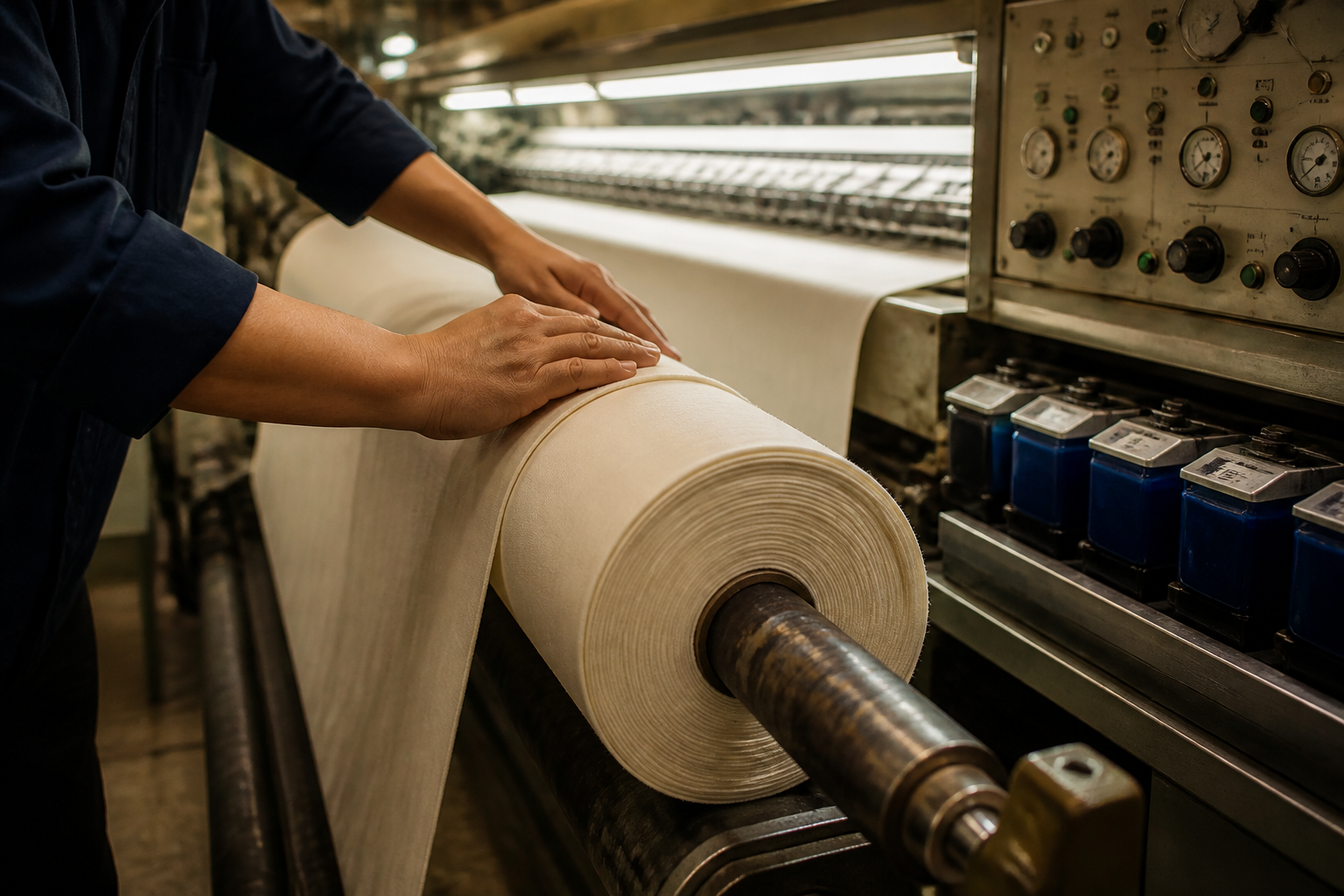
The first checkpoint is the fabric entry inspection after printing and before cutting. A sample section from the printed fabric is compared against the approved strike-off under a D65 standardised light source. The comparison covers colour accuracy -- assessed with a spectrophotometer against the approved Delta E tolerance -- pattern registration across the fabric width, surface quality, and print edge definition at the finest detail level in the design. Fabric that fails this check is not cut; the print issue is diagnosed and resolved, and the relevant section of fabric is reprinted before cutting begins.
The second checkpoint is the first-piece confirmation after sewing begins. The first finished hijab from the production run is measured against the approved template -- length, width, diagonal, and hem width -- and inspected for construction quality across all seam lines. The colour of the finished piece is checked under the D65 light source against the approved sample, because the sewing and finishing process can introduce slight surface changes that affect how colour reads. Any dimension outside the tolerance or construction quality below the approved standard triggers a sewing adjustment before the bulk run continues.
Both checkpoint results are photographed and documented. The documentation travels with the order file and is available to the client on request. For brands that want to participate in the first-piece review remotely, our team can conduct the inspection via video call at the confirmed time, sharing the measurement data and comparison photographs in real time so the brand can give or withhold approval before the bulk run proceeds.
Part 6: Brand Development -- Presenting Your Custom Printed Hijab With Technical Credibility
The brands that convert the most effectively from product discovery to purchase in the custom hijab category are the ones that can explain their product with technical specificity. Not in the language of a product datasheet, but in the language of a brand that understands its own product well enough to talk about why it looks and feels the way it does.
This kind of content takes forms that perform well across different channel types. For Instagram and TikTok, it appears as behind-the-scenes content -- the print process, the fabric selection decision, the colour approval moment. For the product page, it appears as specific product claims with verifiable foundations: "reactive-dyed modal, wash-tested to grade 4 fastness on ISO 105-C06." For email and long-form content, it appears as a brand story that explains the production choices that distinguish the product from cheaper alternatives.
Building this content requires understanding the production process at a level that most brands do not invest in at the beginning, but it is the kind of competitive advantage that compounds over time. Competitors selling stock or semi-custom products cannot make the same claims because they do not control the technical decisions behind their product. A brand that does control those decisions, and can explain them clearly, occupies a distinct position in the market.
If you are developing your first custom printed hijab collection and would like help mapping the technical decisions to your brand positioning -- fabric direction, colourway strategy, print style, and the claims you will be able to make about the finished product -- share your brand brief with our team. We will review your positioning and suggest the production options that best support the story you are building, so that the product development process and the brand development process move forward together rather than in parallel.
Frequently Asked Questions
What is the difference between a custom printed hijab and a stock printed hijab?+
A stock printed hijab uses a design owned by the manufacturer or sourced from a shared design library, and the same print may be available to multiple buyers. A custom printed hijab uses a design, colourway, or print specification owned or exclusively licensed by the brand -- the print file, Pantone reference, and production approval are held for that brand only. Custom printing gives the brand a product that cannot be replicated by competitors sourcing from the same factory, and it gives the factory a technical brief that can be reproduced consistently across reorders.
Which fabric works best for custom printed hijabs -- modal or jersey?+
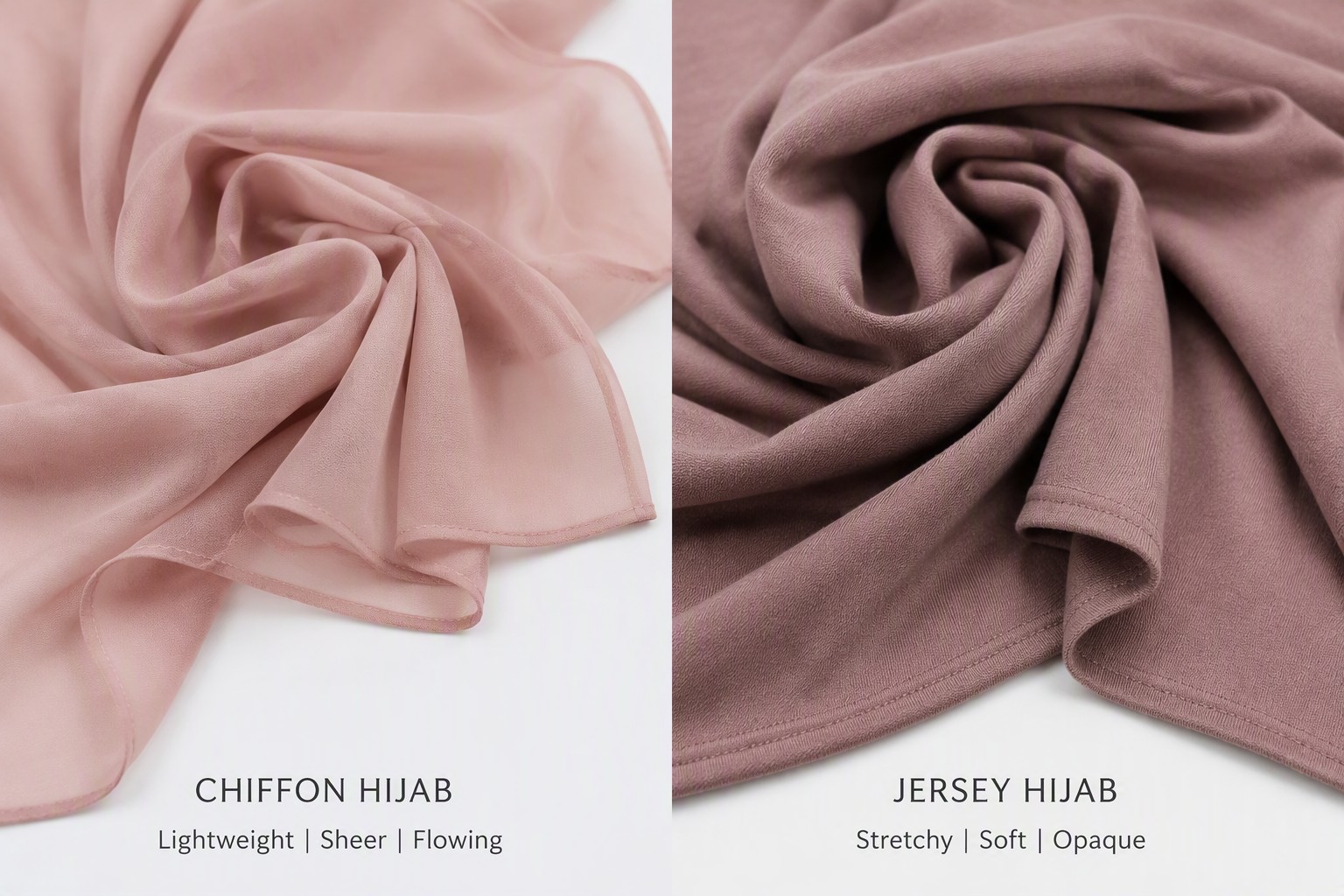
Modal and jersey modal are the most widely used fabrics for custom printed hijabs in the independent brand segment. Woven modal produces a smooth, draped surface with excellent print receptivity for detailed patterns and gradient transitions. Jersey modal has a knit construction with four-way stretch recovery, which makes it more forgiving to wear but requires controlled tension during printing to prevent pattern distortion. The choice depends on your target customer's preference for drape versus stretch, and on the design style -- fine detailed prints read better on woven modal, while bold colourway designs work equally well on both.
How many wash cycles should a custom printed hijab withstand without significant colour loss?+
A well-produced custom printed hijab using reactive dyes on modal or cotton-blend jersey should maintain colour integrity for at least 30 machine wash cycles at 30 degrees Celsius without visible fading or staining of adjacent fabrics. This level of performance requires correct pretreatment of the fabric before printing, a reactive dye formulation matched to the fibre type, a fixation process run at the correct temperature and duration, and a post-fixation wash that removes unfixed dye. Products that fade within five to ten washes have typically failed at the pretreatment or fixation stage, not because reactive dye printing is inherently impermanent.
What file format should I supply to a factory for custom hijab printing?+
For digital reactive printing, supply your print design as a high-resolution file at 150 to 200 DPI at the intended print dimensions. Vector formats (AI, EPS, PDF) are preferred for geometric and flat-colour designs because they scale without quality loss. Raster files (TIFF, PNG) at the correct resolution are suitable for photographic or complex gradient designs. Include a Pantone reference or physical swatch for each colour in the design, as screen-calibrated RGB values will not reproduce accurately on fabric without a conversion step that should be validated with a strike-off before bulk production begins.
What is a strike-off and why is it essential for custom printed hijab orders?+
A strike-off is a test print produced on the actual production fabric, using the actual ink formulation and print settings, before the bulk print run begins. It allows the brand to review colour accuracy, pattern registration, and surface quality under real production conditions -- not the idealised conditions of a fabric swatch or computer screen. Approving a strike-off before bulk production protects both the brand and the factory: the brand confirms that the output meets its visual standard, and the factory has documented approval before committing to the full production run. Orders placed without a strike-off approval step carry significantly higher colour deviation risk in the finished goods.
Can I add my own label and packaging to a custom printed hijab order?+
Yes, private label and custom packaging are standard options for custom printed hijab orders at specialist manufacturers. Woven neck labels, printed care and composition labels, hang tags, and branded polybag or tissue wrap packaging can all be incorporated within the production workflow. For brands selling into EU or UK markets, care labels must include fibre composition percentage and country of origin. Confirm these requirements with the factory at the brief stage so that label production is scheduled within the overall lead time rather than added as an afterthought.
Need a quote for your next order?
Free samples available. MOQ from 100 pieces. Ships to 50+ countries.
Request a Quote