Quick Summary
Custom printed hijab OEM production requires four documented records -- artwork production file, colour standard record, construction specification, and production batch record -- to achieve reproducible results across orders rather than variable results that require renegotiation at every reorder. This guide explains the two most common OEM project failure modes (colour approval mismatch and reorder inconsistency), the documentation structure that prevents them, and what brands should expect from a transparent OEM factory partnership. Our production records for active brand accounts are available for review through scheduled factory visits or video line tours, and every order produces a complete documentation set that the brand can retain as their production archive. Brands with a ready design brief can send it to receive a production proposal covering fabric options, colour development timeline, construction specification process, and pricing.
Introduction: What Custom Printed Hijab OEM Production Actually Requires
Custom printed hijab OEM production is not a catalogued service. It is a development process that starts with a brand concept and ends with a finished product that represents that brand consistently across every unit in every order. The production partner a brand works with determines whether that development process is efficient and documented, or slow and approximate.
Most brands entering custom printed hijab production underestimate the number of decisions that need to be made before a single piece of fabric is cut. The print design needs to be adapted for the specific fabric substrate. The colour references need to be translated from screen or Pantone codes into reactive ink formulations that behave correctly on modal or jersey. The construction details -- hem width, edge finish, seam allowance -- need to be specified in a technical document that the production team can follow consistently. None of these decisions can be made correctly by looking at a mood board or a reference image from a competitor.
This OEM guide explains what the custom printed hijab development process looks like at each stage, what documentation a brand should expect from their OEM factory, and how to use the development process to build production records that make each subsequent order faster and more predictable than the one before.
Part 1: Buyer Problem -- Why Custom Printed Hijab OEM Projects Stall or Deliver Wrong Results
Custom printed hijab OEM projects most commonly fail at two points: the colour approval stage and the first reorder. At the colour approval stage, brands receive a sample that looks correct on screen but does not match their reference when printed on the actual fabric. At the first reorder stage, brands receive products that look different from the original order even though nothing appears to have changed.
Both failures trace back to the same root cause: the OEM factory did not build a reproducible production record during the first order. The colour approval was done visually, without documenting the reactive ink formulation, the fixation temperature, and the fabric batch reference. The construction was approved from a physical sample, without a written technical specification that covers seam allowance, hem tension, and edge finish standard. When the reorder begins with a different production team member, or a different fabric batch, or a different season, the production team has no documented reference to reproduce the approved result.
A second common failure is artwork preparation. Brands frequently provide print files in formats that are unsuitable for textile production -- screen-optimised JPEG files, RGB colour mode, or low-resolution files. An OEM factory that accepts these files without flagging the issues and converting them to production-ready formats will produce colour results that diverge from the brand expectation, because the file used for production is not the same as the file the brand approved.
The solution to both failure modes is documentation discipline: a production record for each order that captures the ink formulation, the fabric batch reference, the fixation profile, and the construction specification in enough detail that any competent production team member can reproduce the approved result from the record alone.
Part 2: Industry Trend -- OEM Brands Are Demanding Reproducibility, Not Just Samples
The expectation from brands working with custom printed hijab OEM factories has shifted over the past three years. The previous expectation was sample quality -- produce a good sample and the brand approves. The current expectation is production consistency -- produce results across a full run that match the approved sample, and produce the same results on the second and third order.
This shift is driven by the scale at which digital-native brands now operate. A brand selling custom printed hijabs through Instagram or TikTok may have three to five active designs at any given time, each in multiple colourways, with reorders triggered by sell-through data rather than seasonal schedules. The ability to reorder a specific design in the original colour and construction without renegotiating quality is a business requirement, not a preference. Brands that cannot reliably reorder are forced to treat each new production run as a new product development project, which slows their growth and increases their per-unit cost.
Factories that have invested in documentation systems and reproducibility processes are capturing a disproportionate share of the growing custom printed hijab OEM market. Brands that have experienced the cost of unreproducible production are willing to pay a modest premium for a factory that can demonstrate documented production records and a verifiable reorder track record.
Part 3: Technical Knowledge -- The Four Documents That Make Custom Printed Hijab Production Reproducible
A reproducible custom printed hijab OEM programme is built on four documents: the artwork production file, the colour standard record, the construction specification, and the production batch record.
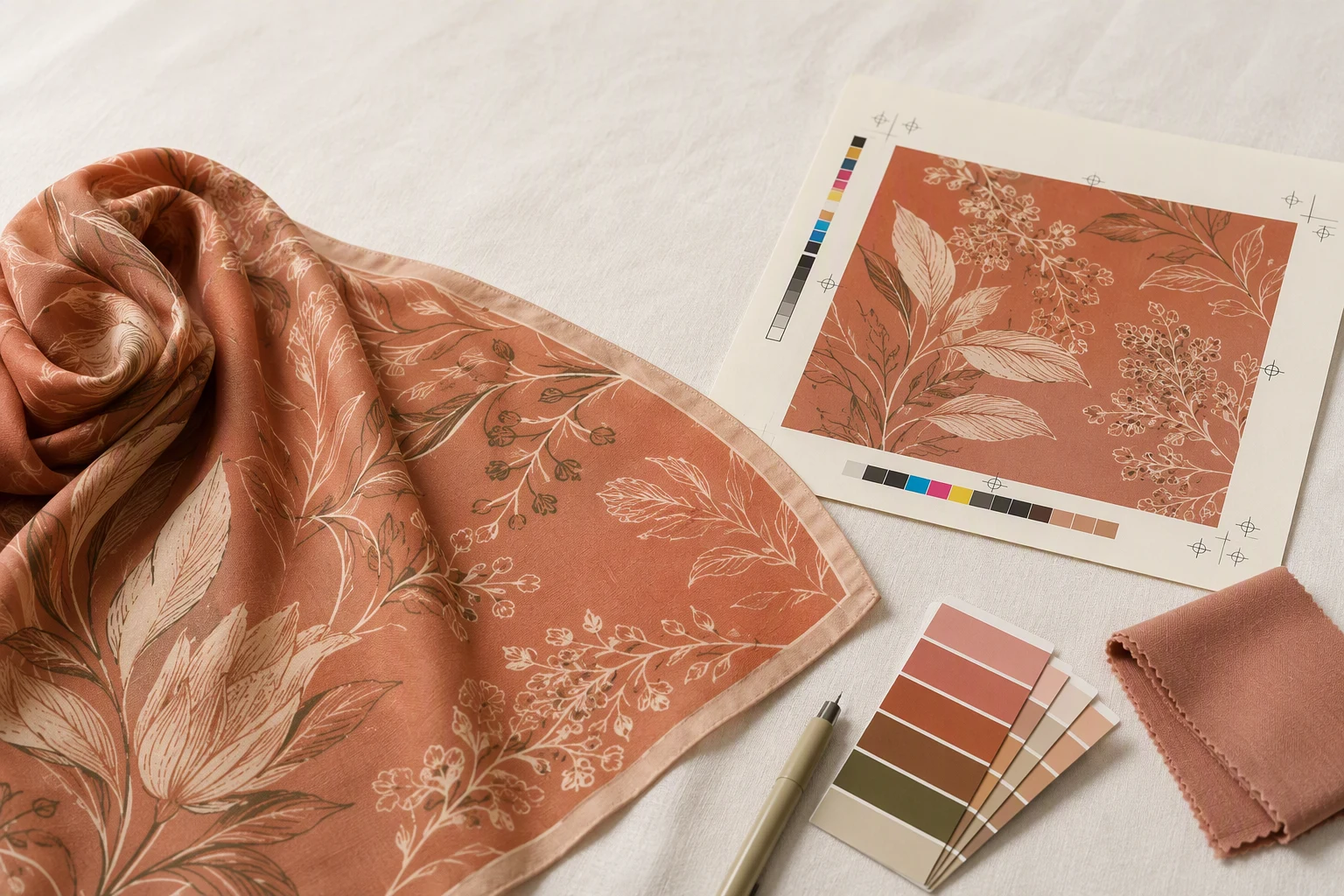
The artwork production file is the version of the print design prepared for textile production. It is in TIFF format at 150 to 300 DPI at the actual print size, in CMYK colour mode, with all layers merged and all text converted to paths. The colours in the file are tagged with the Pantone references or the L*a*b* values that the brand has approved as their colour standard. This file, not the original design file, is the reference for all production runs.
The colour standard record documents the reactive ink formulation and the fixation profile used to achieve the approved colour result on the specific fabric batch used for the approval sample. It includes the ink type, the ink concentration for each colour channel, the fixation temperature in degrees Celsius, the fixation dwell time, and the delta-E measurement between the approved result and the target colour reference. This record is retained by the factory and shared with the brand. For reorders, the factory produces a new strike-off on the reorder fabric batch and measures the delta-E against the colour standard record before releasing bulk production.
The construction specification documents the physical production parameters: finished dimensions (length and width after one wash cycle), hem width and hem type (rolled hem or overlock), edge finish standard (flat, no curl), seam allowance for any structural seams, and label placement if applicable. This document is the basis for first-article inspection and for outgoing dimension verification on every order.
The production batch record is created for each production run. It links the specific fabric roll numbers used, the ink batch numbers, the fixation equipment settings, the production date, the production team lead, and the inspection results. When a quality question arises on a delivered order, the production batch record allows the factory to trace the specific conditions under which the order was produced and identify whether any parameter deviated from the colour standard record or the construction specification.
Part 4: Our Factory Capability -- Transparent Production Available for Remote and In-Person Review
Our custom printed hijab OEM capability is open to direct review by brand partners, either through a scheduled video line tour or an in-person factory visit. We encourage brands developing a new custom printed hijab programme to schedule a video tour of the production line before confirming their first order, because seeing the equipment and meeting the production team responsible for their programme resolves more sourcing uncertainty than any written factory profile.
A video line tour for a custom printed hijab programme covers the fabric incoming inspection area, the print room with the flatbed digital print equipment, the steam fixation tunnel, the cutting and sewing section, and the outgoing QC station. The tour is conducted by the production team lead responsible for the brand account, not by a sales representative, so the brand can ask technical questions directly to the person who will manage their production.
For brands that prefer in-person visits, our facility is accessible with advance scheduling. We can arrange for the brand to observe an active production run on a similar product during their visit, so they can see the production conditions and quality checks applied to a live order rather than a prepared demonstration. We do not arrange factory visits for brands that have not completed at least an initial inquiry and product specification discussion, because a factory visit is most productive when the brand already understands their own product requirements.
Our production records for active brand accounts are available for review during factory visits and can be shared digitally on request. We maintain colour standard records and construction specifications for all active brand programmes, and we can demonstrate how a specific reorder would be prepared using the existing documentation for that brand account.
Part 5: Quality Control -- Production Record as the QC Foundation
Our QC system for custom printed hijab OEM production is built around the production record as the primary reference document. Every QC check -- from incoming fabric inspection to outgoing shipment verification -- is conducted against the parameters documented in the production record, not against a generalised quality standard that is not specific to the brand programme.
At the pre-production stage, the QC team reviews the artwork production file against the colour standard record to confirm that the file colours match the documented ink formulation targets. If the brand has provided a new artwork file for the current order, the QC team checks the file format, resolution, and colour mode against the artwork specification before releasing it to the print team. Files that do not meet the specification are returned to the brand with a specific description of the issue and the correction required.
At the production stage, the QC team conducts a first-article check after the first 20 pieces are produced. The first-article check measures the finished dimensions against the construction specification, compares the printed colour against the colour standard record using a calibrated lightbox and delta-E measurement, and inspects the hem finish against the construction specification edge finish standard. Production does not proceed to full speed until the first-article check is passed and documented.
At the outgoing stage, the QC team conducts a statistical sample inspection using AQL 2.5 for major defects. Rejected pieces are documented by defect type and either reworked or replaced before shipment. The outgoing inspection results are added to the production batch record and shared with the brand along with the shipment documentation. The brand receives a complete production record for each order: artwork file reference, colour standard delta-E measurement, first-article check results, and outgoing inspection results.
Part 6: Brand Development Advice -- Use the First OEM Order to Build Your Production Archive
The most valuable outcome of a first custom printed hijab OEM order is not the finished product -- it is the production archive that makes every subsequent order reproducible. A brand that treats the first order as a pure production exercise and does not invest in building the four documents described above will find every reorder is as difficult as the first, with the same colour negotiation, the same construction clarification, and the same risk of receiving something different from what they expected.
To build a useful production archive from the first order, the brand needs to provide their OEM factory with a production-ready artwork file (not a screen design file), a clear colour reference (Pantone codes or L*a*b* values, not a JPEG reference), and a written construction specification covering at minimum the finished dimensions after washing, the hem type, and the label placement if applicable. These inputs allow the factory to build the colour standard record and the construction specification as part of the first order production process rather than as a separate documentation exercise.
After the first order is delivered and approved, the brand should retain a physical reference set: one finished hijab from the approved production run, the colour standard record from the factory, and the construction specification. These three items are the baseline for every subsequent order. When a reorder arrives, the brand can verify the new production against their retained reference set and identify any deviations before the order is accepted.
Conclusion: Custom Printed Hijab OEM Success Is Built on Documentation, Not Luck
A custom printed hijab OEM factory that builds a complete production record for each order and makes that record available for brand review provides a fundamentally different service from a factory that produces samples and ships orders without documentation. The difference is not visible in the first sample -- it is visible in the consistency of the tenth order.
Our OEM capability for custom printed hijabs is built on four documents per brand programme: the artwork production file, the colour standard record, the construction specification, and the production batch record. These documents are created as part of the standard production process, not as a premium add-on.
If you have a custom printed hijab design ready to develop -- artwork files, colour references, and a construction direction -- send us your design brief and we will return a production proposal that includes the documentation structure we will build for your programme. The proposal will cover fabric options, colour development process, construction specification process, and production timeline so you have a clear picture of the full OEM development path before committing to a first order.
Frequently Asked Questions
What file format do you require for custom printed hijab artwork?+
We require artwork files in TIFF format at 150 to 300 DPI at the actual print size, in CMYK colour mode, with all layers merged and all text converted to paths. If the brand provides a file in a different format, our prepress team will assess whether it can be converted without quality loss. We do not recommend using JPEG files for production artwork because JPEG compression introduces colour artefacts that are visible in the finished print. If the original design was created in RGB colour mode, we will request a CMYK conversion review before printing to identify any colour shifts caused by the mode conversion.
How do you maintain colour consistency between the first order and a reorder?+
We maintain colour consistency through a documented colour standard record created during the first order. This record captures the reactive ink formulation, fixation temperature, and delta-E measurement against the brand colour reference for the specific fabric batch used in the first order. For reorders, we produce a new strike-off on the reorder fabric batch and measure the delta-E against the colour standard record. If the new fabric batch requires ink formulation or fixation adjustment to meet the approved colour standard, we make the adjustment and document it before proceeding to bulk production.
Can we visit your factory before placing a custom printed hijab OEM order?+
Yes. We welcome factory visits and video line tours for brands developing a custom printed hijab programme. For in-person visits, we ask for advance scheduling of at least five working days so we can arrange for the brand to observe an active production run on a similar product. For video tours, we can typically schedule within two to three working days. A factory visit is most productive after an initial inquiry and product specification discussion, so we can prepare a relevant production demonstration for the visit.
What is included in the production record you share with the brand?+
The production record for each order includes: the artwork production file reference (version number and file checksum), the colour standard delta-E measurement between the approved strike-off and the brand colour reference, the fabric batch numbers used in production, the fixation profile applied (temperature and dwell time), the first-article check results (dimensions and colour), and the outgoing inspection results (sample size, defects found by category, pass or fail decision). This record is shared digitally with the brand along with the shipment documentation.
What is the minimum order quantity for a custom printed hijab OEM programme?+
Our standard minimum order quantity for a custom printed hijab with a new design is 200 pieces per design. This quantity supports a complete flatbed print production cycle with a meaningful first-article check and AQL outgoing inspection. For brands developing multiple designs in a single order, each design is treated as a separate minimum quantity. We do not recommend combining multiple designs into a single production run below the per-design minimum, because print and fixation parameter adjustments between designs require production line resets that are most economical on runs above the minimum.
How long does the colour approval process take before bulk production begins?+
The colour approval process for a new custom printed hijab design typically takes 7 to 14 calendar days, depending on the number of approval rounds required. We produce an initial strike-off on the production fabric within 3 to 5 working days of receiving an approved production-ready artwork file. If the brand approves the first strike-off, we proceed to bulk production immediately. If adjustments are required, we produce a revised strike-off within 2 to 3 working days of receiving the brand feedback. Most colour approvals are completed in one or two rounds.
Need a quote for your next order?
Free samples available. MOQ from 100 pieces. Ships to 50+ countries.
Request a Quote