Quick Summary
A professional custom hijab manufacturer bridges the gap between creative design concepts and industrial textile realities through rigorous tech pack specifications and grain-aligned pattern cutting.Common offshore manufacturing failures such as skewed hems, color drifting, and seam puckering stem from uncalibrated fabric tension and inadequate incoming greige fabric inspection.Tier-one OEM facilities implement ASTM D5430 4-point visual fabric grading, pre-shrinkage stability baths, and live virtual production line audits to guarantee transparency for international buyers.Emerging fashion labels and scaling boutique retailers minimize inventory risk by executing a tiered production strategy: starting with a 100-piece pilot run to lock in pattern geometry before committing to commercial-scale volume.
Introduction: Why OEM Partnerships Define Success in Modern Modest Fashion
The global modest fashion sector has matured into a sophisticated multi-billion-dollar market. Discerning consumers across North America, Europe, Australia, and the Gulf region no longer tolerate generic, commoditized headwear sourced from trading intermediaries. Emerging fashion labels, direct-to-consumer (DTC) influencers, and established luxury boutiques are seeking direct relationships with specialized OEM (Original Equipment Manufacturer) custom hijab manufacturers capable of delivering immaculate consistency, custom fabric blends, and ethical manufacturing transparency.
However, transitioning from wholesale trading off-the-shelf items to custom industrial OEM production introduces operational complexities. Sourcing managers must communicate intricate pattern tolerances, navigate fabric shrinkage physics, and establish measurable quality control benchmarks. This technical manufacturing guide provides fashion founders and supply chain directors with an insider perspective on how professional hijab factories operate, what makes a tech pack production-ready, and how to verify factory capabilities before signing supplier contracts.
Part 1: Buyer Problems -- The Hidden Pitfalls of Offshore Scarf Manufacturing
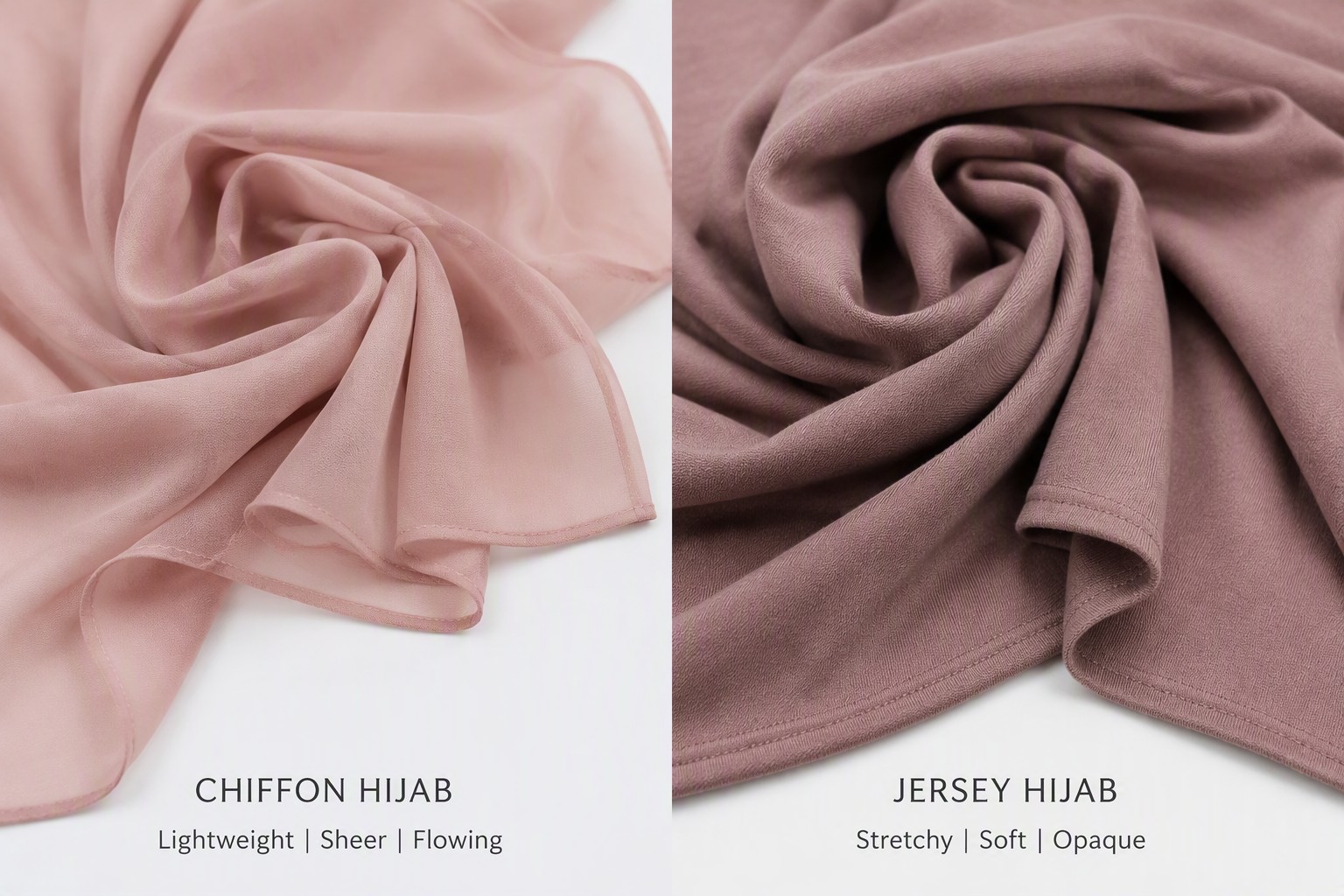
The most frequent complaint among brand directors working with overseas manufacturers is severe dimensional skewing and diagonal twisting across finished rectangular scarves. Standard luxury hijabs measure 180 cm × 70 cm or 195 cm × 75 cm. When inexperienced workshops cut lightweight micro-modal, georgette, or bamboo jersey without relaxing the fabric rolls, the cloth retains mechanical stretch from the textile mill. Once cut, hemmed, and washed, the scarf warps into a parallelogram, refusing to fold neatly or drape symmetrically around the shoulders.
A second chronic failure point is hem puckering and stitch detachment. Ultra-fine micro-modal (80s or 100s yarn counts) requires high-precision baby hemming (1.5 mm to 2.0 mm narrow rolled hems). If an OEM facility employs standard apparel sewing machines rather than specialized micro-feed edge-rolling machinery, the needle tears delicate cellulose filaments. The result is a rippled "lettuce-leaf" perimeter that curls outward after a single gentle wash, prompting negative product reviews and costly return claims.
Finally, brand buyers often face opacity regarding raw material origin and lot consistency. A supplier might send an exquisite Lenzing-certified modal sample for pre-production sign-off, but substitute lower-grade generic viscose during bulk production. Without strict incoming inspection protocols and documented fiber verification, fashion brands find their signature collections compromised by sudden hand-feel stiffness, fabric pilling, and dye bleeding.
Part 2: Industry Trends -- Direct OEM Collaboration vs. Trading Intermediaries
Historically, boutique brands relied on import trading companies to curate seasonal scarves. While convenient, this layer of intermediation adds a 25% to 40% margin markup while completely insulating the brand from the technical reality of the factory floor. When quality defects or color deviations arise, trading agents act as communication bottlenecks, offering vague excuses rather than root-cause technical resolutions.
In 2026, progressive modest fashion enterprises are disintermediating their supply chains. Working directly with an agile OEM manufacturer grants creative directors real-time access to technical colorists, pattern masters, and automated sample rooms. Brands gain the capability to engineer bespoke fabric weaves (such as custom ribbed modal or anti-microbial bamboo jersey), specify exact custom Pantones, and incorporate proprietary woven labels and eco-friendly EVA packaging at direct factory costs.
Furthermore, the contemporary regulatory landscape in Western markets -- including strict EU Corporate Sustainability Due Diligence and stringent UK/US consumer safety directives -- demands end-to-end supply chain traceability. Sourcing directly from an established OEM facility with verified OEKO-TEX Standard 100 certifications and ISO 9001 quality systems ensures compliance that trading intermediaries cannot legally substantiate.
Part 3: Technical Knowledge -- Grain Alignment, Slitting, and Thermal Stability
Understanding textile physics is essential for drafting an unambiguous technical specification sheet. Woven fabrics consist of longitudinal warp yarns running parallel to the selvedge and perpendicular weft yarns. In fine modal weaves, yarn counts frequently reach 80s/1 or 100s/1, creating a soft, fluid hand-feel. However, this fluidity means that even a 2-degree angular deviation in cutting produces a cumulative 2.5 cm bias shift across a 180 cm scarf, causing the finished scarf to twist around the neck.
To ensure absolute rectangular precision, an industrial OEM factory utilizes a standardized multi-step preparation protocol. Fabric bolts are unrolled and subjected to a 24-hour tensionless de-stressing conditioning period in a humidity-controlled environment (22°C, 65% RH). Cutting is executed using automated vacuum-assisted spreading tables where optical sensors align the laser cut-head exactly along the warp thread path. For synthetic blends or georgette, ultrasonic slitting blades seal the raw edges simultaneously, preventing fraying prior to the hemming pass.
Thermal stability is another critical parameter. Cellulosic modal fibers swell when exposed to liquid dye solutions and contract during high-heat drying. A professional OEM manufacturer applies pre-shrinkage stenter processing with dimensional overfeed (overfeeding 3% to 5% in the warp direction) to lock the fabric weave into an equilibrium state. Consequently, after digital printing and reactive steam fixation at 102°C, the finished scarf demonstrates residual shrinkage of less than 2.0% under domestic washing conditions.
Part 4: Our Factory Verification -- Real-Time Virtual Line Audits and Operational Access
Overcoming geographic distance is the cornerstone of building long-term confidence with offshore manufacturing clients. Rather than relying on curated studio photographs, our manufacturing facility provides overseas brand partners with complete, transparent operational visibility through live digital inspection infrastructure.
When a brand places an OEM production order, our management team schedules dedicated live virtual factory tours via high-definition mobile streaming. Overseas buyers can observe their specific fabric rolls moving across automated inspection machines, review real-time color matching at the digital printing console, and inspect the precision of hemming operators up close. Sourcing directors can pose immediate questions to on-duty production supervisors and view digital calibration logs in real time, recreating the transparency of being on the factory floor in person.
In addition to live virtual audits, our factory maintains an open-door policy for accredited third-party auditing firms, including SGS, Intertek, and QIMA. Whether a client commissions a comprehensive ethical factory audit (SMETA / BSCI) or mandates an on-site Final Random Inspection (FRI) prior to container stuffing, our quality management division facilitates full access to warehousing logs, machine calibration histories, and testing laboratories.
Part 5: Quality Control -- Rigorous Incoming Greige Fabric Grading and Lab Verification
Quality in textile manufacturing cannot be inspected into a garment at the final packing stage; it must be engineered from raw material intake. At our OEM plant, 100% of incoming greige fabric rolls undergo standardized inspection according to the ASTM D5430 4-Point System on backlit motorized rolling tables.
Trained fabric inspectors examine the textile web at a regulated speed of 15 meters per minute, logging defect severity points for slubs, yarn knots, broken picks, and oil stains. Any individual roll that accumulates more than 4 penalty points per 100 square yards, or any lot displaying edge-to-center shading (Delta E > 0.8), is immediately flagged, quarantined, and returned to the yarn mill. This zero-compromise intake filter prevents defective yardage from ever entering the digital print or cutting workflow.
In parallel with visual grading, our in-house laboratory conducts physical and chemical verification on every dye lot. Technicians extract 100 cm² circular specimens across three sections of the bolt (head, center, and tail) to calculate accurate GSM weight consistency, ensuring variance stays strictly within ±3% of target tech pack criteria. Fabric specimens are also subjected to ISO 6330 accelerated domestic washing cycles to verify that post-wash shrinkage and torque stability conform to international luxury standards.
Part 6: Brand Development Advice -- Structuring a Low-Risk OEM Production Pipeline
For modest wear entrepreneurs and expanding retail chains, the primary operational challenge is balancing inventory investment with production minimums. Sourcing managers often fear committing to 5,000-piece orders across untested color palettes or unfamiliar pattern scales. Conversely, ordering fragmented micro-batches from local sample makers results in exorbitant unit costs that eliminate wholesale gross margins.
The optimal approach is to execute a structured, tiered OEM scaling roadmap. In phase one, work closely with our engineering team to develop a fully standardized core silhouette -- for example, an 85 GSM micro-modal rectangular hijab with signature 1.5 mm baby-hem stitching. Produce an initial commercial pilot run of 100 to 150 pieces per colorway. This pilot batch establishes verified pattern templates, locks in ICC color profiles, and generates retail inventory for high-converting marketing photoshoots and customer feedback.
Once sell-through velocities and customer drape preferences are validated in the market, brands can seamlessly transition into phase two: volume bulk replenishment in runs of 1,000 to 5,000 pieces. Because the technical tooling, color recipes, and hemmer guide plates are already archived in our production database, repeat bulk runs deliver substantial economies of scale, lower unit costs, and expedited delivery windows of 12 to 15 business days.
Conclusion: The Advantage of Engineering-Driven Hijab Manufacturing
Selecting the right custom hijab manufacturer is one of the most critical decisions in building an enduring, profitable modest fashion brand. In an industry where tactile drape, seam straightness, and color fidelity represent the true essence of product quality, partnering with an engineering-focused OEM factory provides brands with a formidable competitive moat.
If your brand is currently planning an upcoming seasonal collection, redesigning your core hijab assortment, or looking to transition away from trading intermediaries, our production specialists are ready to collaborate. We invite you to initiate an initial 100-piece pilot manufacturing run to verify our fabric drape, stitch precision, and finish quality firsthand, establishing a solid, reliable foundation before scaling into high-volume commercial production.
Frequently Asked Questions
What core technical details must be included in a custom hijab tech pack for OEM production?+
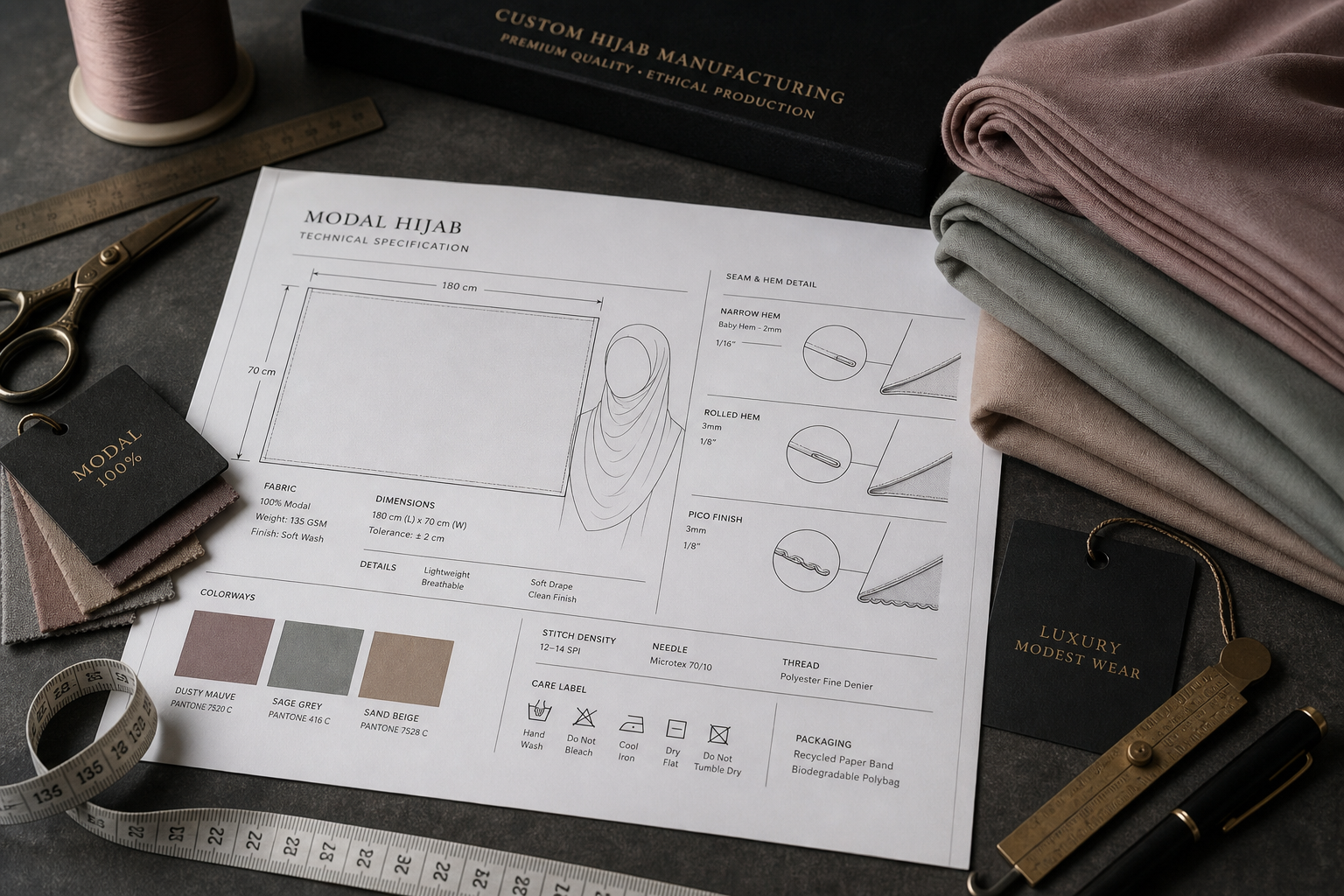
A production-grade hijab tech pack should specify exact cut and finished dimensions (length and width in cm with ±1.0 cm tolerance), raw fabric weight in grams per square meter (GSM), yarn composition percentages, target Pantone TCX color codes, edge finish type (such as 1.5 mm baby-hem or eyelash fringe), thread type (e.g., core-spun polyester #60/2), stitch density (14–16 stitches per inch), and branded trim placement specs.
How does an OEM manufacturer prevent grain skewing and diagonal twisting in long rectangular scarves?+
Grain skewing (weft bow and skew) is prevented by optical weft-straightening equipment during stentering and manual pin-alignment prior to multi-layer spreading. At our factory, fabrics are rested for 24 hours in tension-free rolling bins to release internal fiber stress before laser or automated reciprocating knife cutting along the exact warp threads.
Can international buyers conduct independent third-party quality audits at your OEM facility in China?+
Yes. We welcome accredited third-party inspection agencies such as SGS, Intertek, Bureau Veritas, and QIMA. We provide visiting auditors with unrestricted access to raw material warehouses, digital printing carousels, steaming and washing lines, and finished goods packing zones alongside complete internal quality logs.
What is the standard production lead time for an OEM custom hijab order?+
Pre-production strike-off lab dips or digital print swatches typically require 5 to 7 working days. Once the physical pre-production sample (PPS) is formally approved by the brand, commercial bulk manufacturing (1,000 to 5,000 units) requires approximately 14 to 18 working days, excluding international ocean or air freight transit.
How does your factory test incoming modal and jersey fabrics before cutting begins?+
Every roll of greige fabric undergoes ASTM D5430 4-point visual inspection to detect yarn slubs, barre marks, and snags, rejecting lots that exceed 4 penalty points per 100 square yards. We also perform multi-point GSM balance testing, ISO 6330 washing shrinkage tests, and spectrophotometer base whiteness measurements.
What is the minimum order quantity (MOQ) for custom private label manufacturing?+
Our factory supports emerging and scaling modest fashion brands with accessible entry thresholds. We offer a structured pilot program starting at 100 to 150 pieces per colorway or print design, allowing founders to evaluate retail market traction before committing to volume scaling.
Need a quote for your next order?
Free samples available. MOQ from 100 pieces. Ships to 50+ countries.
Request a Quote