Quick Summary
Working with a custom hijab manufacturer for the first time involves a series of technical decisions -- fabric specification, colour reference format, sample approval criteria, and outgoing inspection standards. Brands that approach the OEM relationship with a well-structured brief consistently achieve better first-order outcomes than those that rely on the factory to interpret a loose reference. This guide covers the briefing, sampling, and outgoing inspection process that experienced OEM hijab buyers use to protect quality from the first order through to seasonal production at scale.
Introduction: The Brief Is Where Custom Hijab Quality Is Won or Lost
The quality of a finished custom hijab order is determined less by the factory general capability and more by the clarity of the instructions the factory receives. A well-specified brief -- one that defines fabric, colour, print, dimensions, construction, and labelling without ambiguity -- gives the production team a target they can hit consistently. A brief that leaves these decisions to interpretation gives them a target that shifts with each person who handles the order.
This is the central practical reality of OEM hijab manufacturing that most first-time buyers discover after rather than before their first order. The factory that produced a beautiful sample may deliver a bulk order that is close but noticeably different -- not because their capability changed, but because the conditions that produced the sample were not documented precisely enough to be reproduced at production scale.
This guide covers the briefing, sampling, and outgoing inspection process that experienced OEM hijab buyers use to close that gap. The goal is to walk through the first order with enough process structure that the second order is a straightforward repetition rather than a new experiment.
Part 1: The Buyer Problem -- Why First OEM Orders Underperform Their Samples
The gap between sample quality and bulk quality in custom hijab manufacturing has a consistent set of causes. Understanding them before placing a first order is more useful than diagnosing them after receiving a disappointing shipment.
Cause one is colour reference format. A colour specified as an RGB value from design software will not reproduce accurately on fabric without a calibrated conversion step. Digital screens display colour using light emission; reactive dye printing on fabric absorbs light and reflects it differently depending on fibre type, GSM, and surface texture. Supplying a physical swatch or a Pantone TCX code eliminates this conversion ambiguity and its associated variation.
Cause two is fabric lot variation. Fabric from the same nominal specification can vary in GSM, optical brightness, and surface chemistry between production lots. A sample produced on one fabric lot and a bulk order produced on a different lot will produce slightly different print results even with identical ink settings. Requiring incoming inspection against the approved swatch controls this variation before printing begins.
Cause three is informal approval records. When a sample is approved by email with a general response rather than a specific record of approval criteria met, the factory has no documented standard to hold itself to in bulk. A formal approval noting the Delta E tolerance met, the dimensions verified, and the construction quality confirmed creates the reference that outgoing inspection can be measured against.
Part 2: The Market in 2026 -- OEM Hijab Sourcing Now Accessible at Independent Brand Scale
OEM hijab manufacturing was, until recently, primarily accessible to brands with the volume to justify development investment. The per-unit cost of colour development, sampling, and setup at 500 pieces or below made custom manufacturing uneconomical compared to stock product with minor customisation.
The economics have shifted. Specialist custom hijab manufacturers who have invested in digital reactive printing and streamlined development workflows can now run the full OEM process -- colour development, strike-off, production sample, bulk -- at 100 to 200 pieces per colourway. This has opened custom manufacturing to independent brands, TikTok sellers, and boutique buyers for whom a 500-piece minimum per colourway was a barrier.
This accessible entry point has also changed buyer expectations. Brands that previously accepted a stock colourway closest to their palette now expect to specify a custom colour that matches their brand identity precisely. This expectation is technically achievable with reactive dye printing on modal or jersey, but it requires the factory to have colour management infrastructure -- not just printing equipment.
Part 3: Technical Knowledge -- Writing a Brief That Removes Factory Interpretation
A complete OEM hijab brief has six components. Each component left undefined creates a decision point the factory resolves based on their standard practice rather than the brand preference.
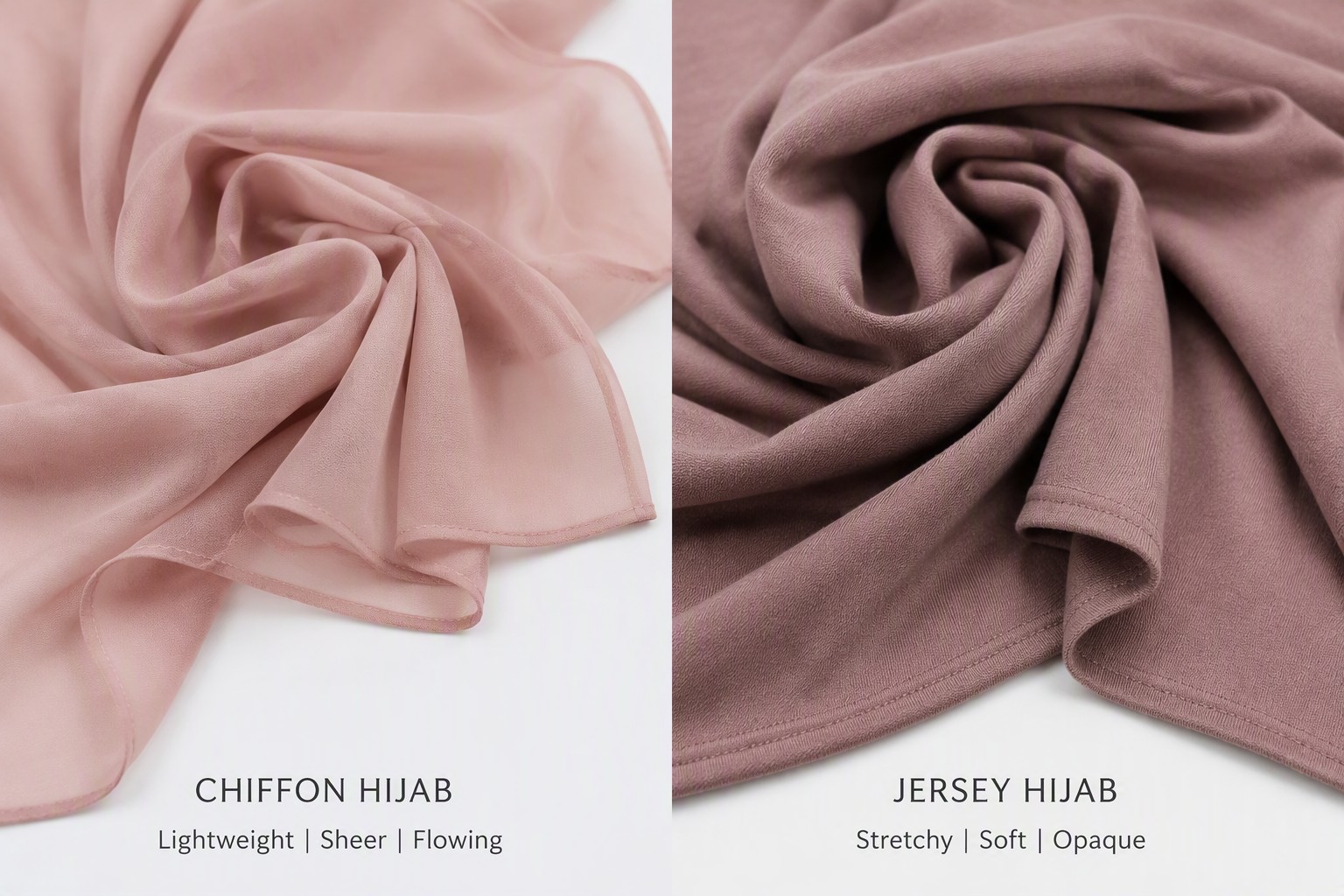
Fabric specification covers fibre composition as a percentage, GSM with tolerance, construction type (woven or jersey knit), and surface finish. If a specific fabric from a reference product should be matched, supply a physical swatch so the factory can source the closest available lot.
Colour reference should be a Pantone TCX code -- the textile version of the Pantone system, calibrated for fabric -- or a physical dyed swatch. For print designs, supply a colour-separated print file at 150 DPI minimum with a Pantone reference for each colour. Screen RGB values are not an adequate reference for fabric production.
Finished dimensions should specify length, width, seam allowance, and hem width in centimetres with stated tolerance. Hem style -- hand-rolled, machine-rolled, or overlocked -- should be explicit. Both dimension and hem style affect perceived quality in photography and wear.
Label requirements include woven label content, placement, and attachment method, plus any hang tag or packaging specification. For EU and UK markets, care labels must display fibre composition and country of origin. Confirming these requirements at the brief stage allows label production to be scheduled within the lead time.
Part 4: The People Behind the Process -- How Production Decisions Are Made
Our production team includes senior craftspeople who have worked with modal and jersey hijab production through multiple seasonal cycles. Their accumulated experience shapes how the factory handles the situations that a brief cannot fully anticipate.
When a colour reference is a custom shade that sits between two standard Pantone codes, the decision about dye formulation requires hands-on experience with how reactive dyes pull on the specific fibre in use. A technician who has formulated hundreds of custom shades on modal knows that certain dye combinations pull warmer or cooler at different concentrations on brushed versus unbrushed surfaces. This knowledge is applied at the formulation stage to reduce the number of strike-off rounds needed to reach the approved colour.
Tension control for jersey fabric printing is another area where experienced judgement matters more than fixed parameters. Jersey knit returns toward its original dimensions after stretching during the print process. The correct tension varies by GSM, elastane content, ambient humidity, and the weight distribution of the specific print design. Our team adjusts tension settings for each jersey order based on production history with comparable fabric specifications, rather than applying a standard setting that may not suit the particular combination of variables in a given brief.
Our production experience allows brands to supply a clear output brief and trust that the process decisions required to meet it will be made by people who have faced similar decisions before. The institutional knowledge accumulated through repeated production of modal and jersey hijabs is one of the practical advantages of working with a specialist manufacturer rather than a general apparel factory.
Part 5: Quality Control -- Outgoing Inspection as the Final Assurance Step
The outgoing inspection is the last checkpoint before goods are packed for shipment. Its purpose is to confirm that the bulk production meets the approved standard across the full quantity -- not just in the most carefully handled pieces.
Our outgoing process applies AQL 2.5 sampling to all custom hijab orders. The inspection team draws a statistically determined sample from the packed goods and evaluates each piece against three defect categories. Critical defects carry zero tolerance and trigger a full quantity review. Major defects -- colour deviation beyond the approved Delta E tolerance, dimensional error beyond tolerance, or construction fault affecting appearance or wear -- are assessed against the AQL 2.5 acceptance number for the specific lot size. Minor defects are assessed at a higher tolerance threshold.
For custom printed hijabs, outgoing inspection includes a dedicated colour verification step. Five pieces drawn from across the packed quantity are compared against the approved production sample under a D65 standardised light source. Both a visual comparison and a spectrophotometric measurement are recorded. The spectrophotometric result -- the Delta E between the outgoing pieces and the approved sample -- is documented in the order file and made available to the client on request. This gives the brand a verifiable record of the colour accuracy of the delivered lot.
Dimensional accuracy is checked on a cross-section of pieces against the approved template. Each key dimension is recorded. Pieces outside the approved tolerance are identified and either corrected before packing or excluded from the shipment. The outgoing inspection report, covering defect counts, colour Delta E, and dimensional results, is filed with the production record and retained for the client.
Part 6: Brand Development -- Making the First OEM Order the Foundation of Every Order After
The first OEM hijab order establishes the production standards that govern all subsequent orders. The colour approval, dimensional template, and outgoing inspection results from order one are the documents that define what a correct order looks like -- whether the next reorder happens three months or three years later.
Brands that treat the first order as a documentation exercise -- not just a product purchase -- find that subsequent orders require significantly less management time. The brief is already written. The colour standard is on file. The inspection criteria are established. Each reorder is a production run against a known standard rather than a new development project.
The path from a first order at 100 to 150 pieces to a quarterly reorder cadence at 300 to 500 pieces is straightforward when this documentation infrastructure is in place. The process capability that produced the first order holds at larger volume because the same specifications, the same approval records, and the same inspection criteria are applied consistently.
If you are at the stage of briefing a first custom hijab order, send us your design brief -- fabric direction, colour reference, print concept if applicable, and target dimensions. Our team will review it, identify any components that need clarification before sampling begins, and return a development timeline with expected strike-off and production sample dates. A complete brief at the start is the single most effective step toward a first order that meets the standard the brand is aiming for.
Frequently Asked Questions
What should a custom hijab manufacturer brief include?+
A complete OEM hijab brief should include: fabric specification (fibre composition, GSM, construction type, surface finish), colour reference (Pantone TCX number or physical swatch), print file if applicable (format, resolution, colour separation notes), finished dimensions with hem specification, label and care instruction requirements, and packaging specification. The more precisely these elements are defined upfront, the less interpretation the factory has to do -- and the closer the bulk production will be to the brand expectation without requiring multiple sample rounds.
How many sample rounds should I expect before approving bulk production?+
For a custom printed modal or jersey hijab with a new colourway, one to two sample rounds is standard when the brief is clear and the colour reference is a physical swatch or Pantone rather than a screen RGB value. The first round (strike-off) validates colour accuracy and print quality on the actual production fabric. The second round, if needed, corrects any colour deviation identified in the first. A third round typically indicates either an unclear brief or a factory with limited colour management capability.
What is the difference between a strike-off sample and a production sample?+
A strike-off is a short print run on the production fabric, produced to verify colour accuracy and print quality before cutting and sewing begin. It is a fabric panel, not a finished product. A production sample is a fully finished hijab -- cut, sewn, hemmed, and labelled -- produced after the strike-off is approved, to verify construction quality and dimensional accuracy before the bulk run proceeds. Both approvals are necessary: the strike-off protects print quality, and the production sample protects construction and dimensional quality.
What outgoing inspection standard should I request for a custom hijab order?+
AQL 2.5 is the standard outgoing inspection level for custom apparel orders. At AQL 2.5, the factory inspects a statistically determined sample of finished goods against defined defect categories (critical, major, minor) and accepts or rejects the lot based on defects found. For custom printed hijabs, outgoing inspection should also include a colour check under D65 standardised lighting against the approved production sample, and a dimensional check on a cross-section of pieces against the approved template.
How do I protect my custom print design when working with an OEM manufacturer?+
Supply the print file only after a mutual NDA or supplier agreement is signed, specify in the purchase order that the design is the exclusive property of the brand, and retain the original print file on the brand side. Most specialist custom hijab manufacturers operate on a client-exclusive basis for custom designs as a commercial norm, but a signed agreement makes this expectation explicit and provides a clear basis for resolution if it is ever breached.
What lead time should I plan for a first custom hijab OEM order?+
For a first order including colour development, strike-off approval, production sample approval, and bulk production, plan 25 to 35 days ex-factory from confirmed purchase order. This assumes the brief is complete at order confirmation and colour approval rounds proceed without delays. For repeat orders with previously approved specifications, lead time typically reduces to 15 to 20 days.
Need a quote for your next order?
Free samples available. MOQ from 100 pieces. Ships to 50+ countries.
Request a Quote