Quick Summary
A custom hijab manufacturer that builds consistency through data rather than assurances gives brand buyers a measurable basis for evaluating and trusting a production partner. This factory story covers the production metrics that define our operation -- standard lead times by order type, rework rates by defect category, wash-fastness testing frequency, and capacity thresholds that protect delivery reliability. Our production experience allows brands to make sourcing decisions based on verified numbers, not only sample impressions. Yiling Hijab tracks and shares production data with B2B partners as a standard part of the order process.
Introduction: The Numbers Behind a Consistent Custom Hijab Manufacturer
A factory story is usually told through images -- the production floor, the equipment, the team. Those images communicate atmosphere and investment, but they do not tell a brand buyer what they most need to know: whether this custom hijab manufacturer will deliver the same quality result on the tenth order that it delivered on the first.
The answer to that question lives in production data. Lead times, rework rates, wash-fastness test results, and capacity thresholds are the numbers that describe how a factory actually operates when the camera is not present. A manufacturer who can share and explain these numbers is communicating something more valuable than a polished showroom -- they are communicating process discipline.
This factory story focuses on the data behind our operation at Yiling Hijab. It is not a comparison with competitors and not a claim about scale. It is an account of how we measure our own production, what the numbers tell us, and why we believe sharing that data with brand buyers makes their planning more reliable.
Part 1: Buyer Problem -- Consistency Is Harder to Evaluate Than Quality
When a brand buyer evaluates a custom hijab manufacturer, quality is relatively easy to assess. A sample arrives, the buyer handles the fabric, checks the print, examines the hem, and makes a judgment. That judgment is often accurate about the sample itself.
Consistency is far harder to evaluate from a sample. A sample is produced under careful conditions by an experienced team member, at a time when the supplier is motivated to make a strong first impression. The bulk order is produced at production speed, by the full production team, over multiple days or weeks. The conditions are different. The result should still be the same.
The gap between sample quality and production consistency is where most sourcing problems originate. A buyer who selected a supplier based on sample quality alone has no way to predict whether that quality will hold across 500 pieces, or across five consecutive orders separated by seasonal gaps.
The information that would close this gap -- actual production data from previous orders -- is rarely offered by suppliers and rarely requested by buyers. This creates a structural blind spot in the sourcing evaluation process. Both parties would make better decisions if production numbers were part of the conversation from the beginning.
Part 2: Industry Trend -- Data-Informed Sourcing Is Becoming a Brand Standard
The most commercially successful modest fashion brands of the past three years share a pattern: they treat their manufacturing supply chain as a managed system rather than a transactional relationship. They track supplier performance metrics, maintain order history documentation, and use production data to plan buying cycles with more precision than brands that source reactively.
This approach has historically been the domain of large wholesale buyers with dedicated procurement teams. What has changed is the accessibility of data. Smaller brands working directly with OEM factories can now request production records, track wash-fastness certifications per fabric batch, and maintain a documented supplier quality history without the overhead of a formal procurement function.
The brands driving this shift are typically the same brands growing fastest on Instagram and TikTok -- not because data gives them a marketing advantage, but because it gives them operational stability. A brand that knows its supplier lead time variance can plan product drops more reliably. A brand that tracks rework rate can anticipate quality trends before they become customer complaints.
For custom hijab manufacturers, this trend means that data transparency is becoming a competitive differentiator. Suppliers who can provide production metrics alongside the product are offering something that suppliers who can only offer a good sample cannot match.
Part 3: Technical Knowledge -- What Production Data Is Worth Tracking
Not all production metrics are equally useful for brand buyers evaluating a custom hijab manufacturer. The most actionable numbers fall into four categories: lead time, rework rate, wash-fastness performance, and capacity reliability.
Lead time data is the most immediately practical. It should be expressed as a range by order type -- pilot orders versus repeat orders, simple solid-colour styles versus complex multi-print styles -- rather than as a single optimistic number. A supplier who quotes 15 days without qualification is probably quoting the best-case scenario. A supplier who quotes 25 to 35 working days for a custom print order, depending on colour approval cycles, is giving you planning information you can actually use.
Rework rate measures the percentage of pieces in a production batch that require a corrective operation before passing final inspection. A low rework rate below 3 percent for standard hijab styles indicates a stable production process. A high rework rate above 8 percent suggests either a process control problem or a quality inspection standard that is catching problems late in the production sequence rather than preventing them earlier.
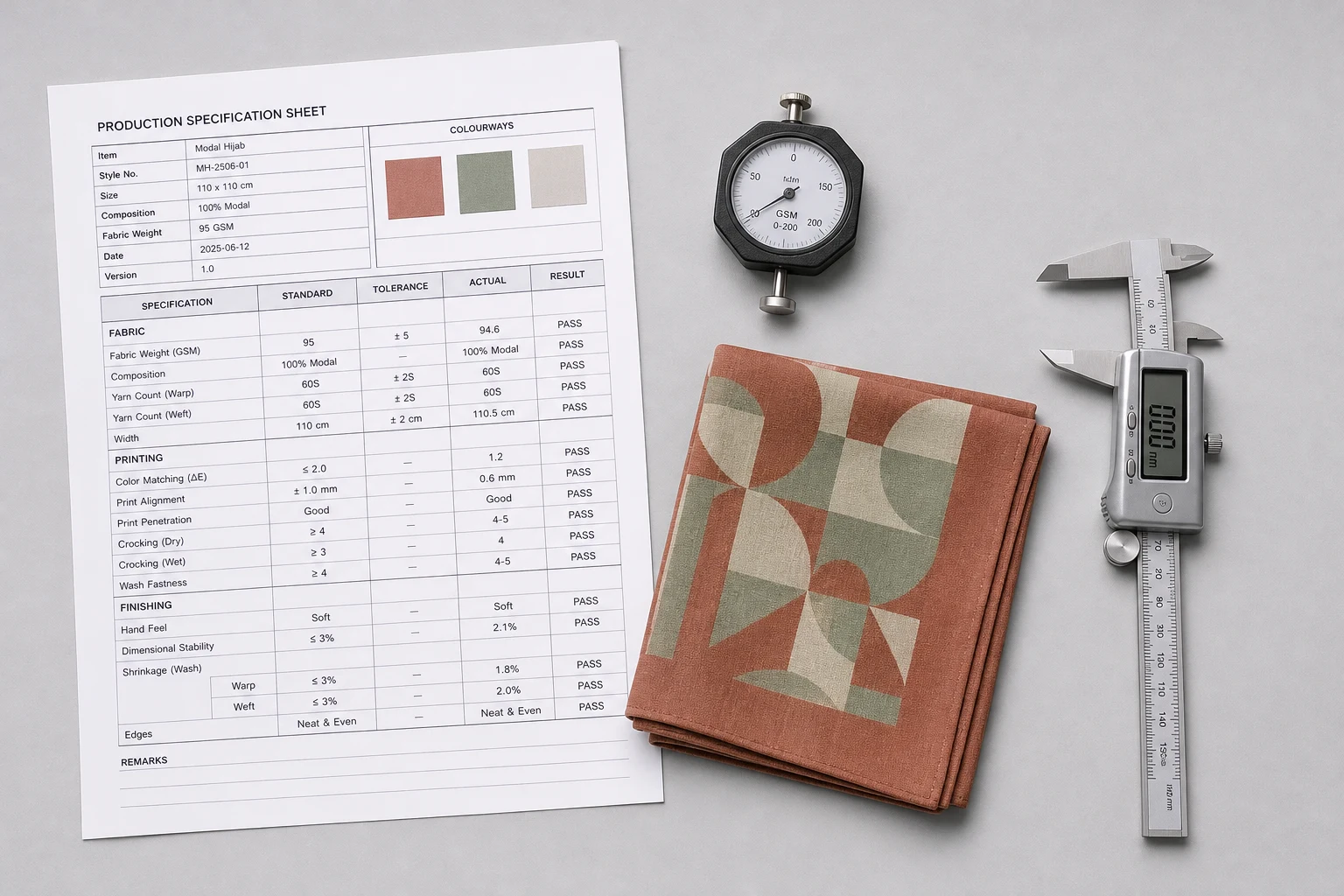
Wash-fastness data tells you whether the printed fabric will retain its colour through the wash cycles that end customers will subject it to. The relevant standard for printed hijabs is ISO 105-C06, which tests colour change and colour staining at a specified wash temperature. A result of 4 or 4-5 on the grey scale is commercially acceptable for most retail markets. Results below 3-4 indicate a fastness problem that will generate returns and complaints.
Capacity reliability is perhaps the most overlooked metric. A factory that can produce 1,000 pieces in isolation but regularly fails to deliver on time when operating at 80 percent of its stated capacity is a more disruptive supply chain partner than a factory with a lower nominal capacity that consistently meets its commitments.
Part 4: Our Factory Capability -- The Numbers Behind Our Production
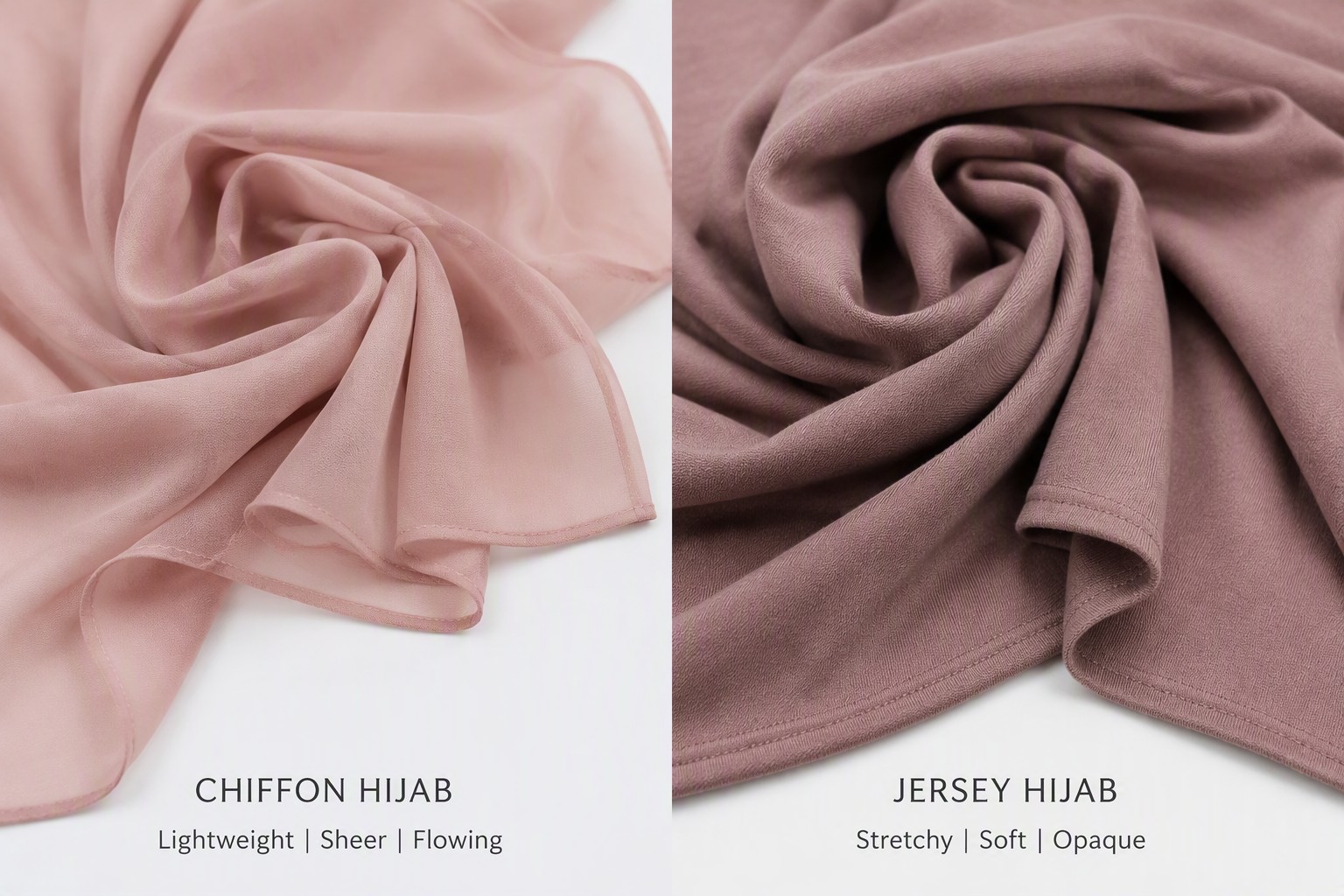
Our production experience with custom printed modal and jersey hijabs over multiple seasons has generated a body of operational data that we track internally and share with B2B partners who want a measurable basis for their sourcing decisions.
Standard lead time for custom printed hijab orders at Yiling Hijab is 25 to 35 working days from pre-production approval. This range covers the complete sequence: fabric sourcing and incoming inspection (3 to 5 days), printing and fixation (4 to 6 days), cut and sew (8 to 14 days depending on quantity and construction), trimming, label attachment and folding (3 to 4 days), and outgoing inspection and packing (2 to 3 days). Pilot orders of 100 to 300 pieces with previously approved print designs typically run at 22 to 28 working days. First-time print designs requiring an additional colour approval cycle add 5 to 7 working days.
Our internal rework rate target for standard modal and jersey hijab styles is below 3 percent per production batch. Over the past 12 months, the actual rework rate across all order types has averaged 2.1 percent, with the majority of rework concentrated in hem trim corrections rather than print or fabric issues. We review rework data weekly and investigate any batch that exceeds 5 percent before releasing it to the next production stage.
Our committed standard capacity for regular B2B partners is 3,000 to 4,500 pieces per month across modal and jersey styles combined. This range reflects realistic throughput with the current team and equipment configuration, not theoretical maximum output. We do not quote capacity numbers that require running all lines simultaneously at peak efficiency -- that approach leads to delivery failures during peak periods.
For brands building a multi-season order programme, we confirm capacity allocation at the start of each season based on forecasted order volumes. Priority partners who place consistent monthly orders have first call on scheduled capacity during peak demand periods such as Ramadan preparation.
Part 5: Quality Control -- Wash-Fastness Testing as a Production Standard
Wash-fastness is one of the most commercially consequential quality parameters for custom printed hijabs, and one that is frequently under-tested in production environments that focus primarily on visual inspection.
Our QC process includes mandatory wash-fastness testing at two points: at the introduction of any new print design, and at the start of each new fabric batch for repeat orders. Testing is performed against ISO 105-C06 using a laboratory-grade reciprocating agitator at 40 degrees Celsius, the standard wash condition for most markets where our customers sell.
Each test generates a grey-scale rating for colour change on the test specimen and colour staining on an adjacent white cotton and adjacent white polyester fabric. Our internal acceptance standard requires a minimum rating of 4 on a 5-point scale for both colour change and staining across all ink colours used in the design. Designs where any colour tests below this standard are held for reformulation or ink system adjustment before production proceeds.
For reactive-printed modal hijabs, we additionally test rubbing fastness against ISO 105-X12 (both dry and wet rubbing) as part of our standard batch qualification. Modal fabrics worn against skin and hair are subject to rubbing stress in real use, and a hijab that passes wash fastness but fails rubbing fastness will generate colour transfer complaints in the market.
Wash-fastness and rubbing-fastness test records are retained per design and per fabric batch reference. For B2B partners who require fastness documentation for import compliance or retail buyer requirements, these records are available as part of the standard order documentation package.
Part 6: Brand Development Advice -- Use Supplier Data to Plan, Not Just to Evaluate
Most brands use supplier data reactively -- they review quality records after a problem occurs. The brands that grow most efficiently use supplier data proactively, as an input to their buying and product planning cycle.
If you know your supplier lead time range, you can plan product launch dates backwards from a confirmed delivery window rather than working forward from a hoped-for order date. A 30-working-day lead time with a 5-day colour approval buffer means you need a confirmed purchase order 8 weeks before your target launch date. Most brands underestimate this requirement and then ask for expedited production, which introduces quality risk.
If you track rework rate across orders, you can identify whether a supplier quality is improving, stable, or declining over time -- and have a data-based conversation about root causes before a problem becomes a shipment you cannot sell. A supplier whose rework rate increases from 2 percent to 6 percent across three consecutive orders is showing a process control signal that is worth addressing early.
Wash-fastness data is particularly valuable for market-specific planning. Some export markets -- notably Scandinavia and Germany -- have customers who wash garments at 60 degrees Celsius rather than 40 degrees. If your supplier only tests at 40 degrees and your target market washes at 60 degrees, you are carrying an unquantified quality risk. Requesting a 60-degree wash-fastness test for designs going to these markets is a simple risk management step that most brands do not take.
Finally, use capacity data to build relationships rather than just transact. A supplier who knows your seasonal volume forecast can plan your production slot in advance and protect your delivery windows against demand peaks. A supplier who only sees your order when you place it cannot do this, regardless of how strong their production capability is.
A Data Checklist for Evaluating a Custom Hijab Manufacturer
When evaluating a custom hijab manufacturer, request the following data before placing a volume order: standard lead time by order type (pilot versus repeat, simple versus complex print); actual rework rate for the past three to six months; wash-fastness test protocol and acceptance standard, with a sample test report; on-time delivery performance for the past two seasons; committed capacity range for regular partners; and documentation format for each data type. A manufacturer who can provide all of these with evidence rather than verbal assurance is demonstrating the operational maturity that supports a growing brand programme.
Conclusion: Consistency Is Built Through Measurement, Not Through Intention
A custom hijab manufacturer that tracks its own production data and shares it openly is demonstrating that its quality results come from a controlled, measured process rather than from effort and good intentions alone. Those are two very different foundations for a supply chain relationship.
Our production experience allows brands to build their product programmes on a foundation of verified numbers. Lead times are confirmed at the pre-production stage. Wash-fastness results are documented per design and per fabric batch. Rework data is tracked weekly and available on request.
We support the complete journey from first inquiry to final delivery -- design consultation, fabric selection, pre-production approval, production monitoring, wash-fastness documentation, and outgoing inspection. If you are planning a custom hijab programme for the next season and want to understand the production timeline, capacity availability, and documentation process for your specific order type, share your brief with us and we will provide a full project timeline with confirmed commitments at each stage.
Frequently Asked Questions
What is the typical lead time for a custom printed hijab order?+
Standard lead time for a custom printed modal or jersey hijab order is 25 to 35 working days from pre-production approval, covering fabric procurement, printing, cut and sew, finishing, and outgoing inspection. Pilot orders of 100 to 300 pieces typically run at the shorter end of that range. Orders with new print designs requiring additional colour approval cycles may require 5 to 7 additional working days. The specific lead time for each order is confirmed at the pre-production stage.
What wash-fastness standard do you test custom hijabs against?+
We test colour fastness to washing against ISO 105-C06, which covers both colour change on the test specimen and colour staining on adjacent fabric. For reactive-printed modal hijabs, our internal acceptance standard is a minimum rating of 4 on a 5-point grey scale for both colour change and staining. Pigment-printed jersey styles are tested to the same standard. Wash-fastness tests are performed on production samples at the start of each new design and at the start of each new fabric batch for repeat orders.
How do you measure and track rework rates in production?+
Rework rate is tracked per production batch as the number of pieces requiring any corrective operation -- re-pressing, re-trimming, stitch repair -- divided by total pieces produced. Our target rework rate for standard hijab styles is below 3 percent. When a batch exceeds this threshold, the production supervisor reviews the root cause before the batch continues. Rework data is compiled weekly and reviewed monthly to identify patterns by style type or fabric supplier.
What production capacity can you commit to for a growing brand programme?+
Our standard committed capacity for regular B2B partners is 3,000 to 4,500 pieces per month across modal and jersey hijab styles. Brands with consistent monthly order programmes can discuss priority capacity allocation to protect delivery windows during peak periods. Single orders above 2,000 pieces are scheduled individually with a confirmed delivery date at the purchase order stage.
Do you share production data with buyers?+
Yes. For B2B partners placing regular orders, we share a production summary with each shipment that includes the actual production dates, the wash-fastness test result reference for that design and fabric batch, and the outgoing inspection record. Brands that want to build a documented quality history for their supplier management records can request full documentation packages including first-article records and incoming material inspection notes.
How does tracking production data help brands manage their supply chain?+
Production data gives buyers an objective basis for planning that verbal commitments cannot provide. Knowing a supplier lead time range tells you when to place orders to meet launch dates. Knowing the rework rate trend tells you whether quality is improving or declining before a shipment arrives. Wash-fastness data tells you which designs are safe for markets with rigorous return policies. Data replaces guesswork in supply chain planning.
Need a quote for your next order?
Free samples available. MOQ from 100 pieces. Ships to 50+ countries.
Request a Quote