Quick Summary
A successful colourway strategy requires more than choosing colours -- it requires a manufacturing partnership where the print equipment, calibration approach, and colour documentation system can reliably reproduce your colour intent across multiple orders and seasons. Custom hijab manufacturers that invest in equipment optimisation, ink calibration, and spectrophotometric colour management give brands a technical foundation for consistent colourway delivery. Our team uses calibrated print equipment and stores approved colour profiles for repeat orders, so the colours you approve in a strike-off remain stable across production runs without the need for repeated approval cycles.
Why Colourway Strategy Is a Manufacturing Question, Not Just a Design Question
Many modest fashion brands develop their seasonal colourways in isolation -- choosing palettes based on trend references, brand identity direction, and personal aesthetic judgment -- and then bring a finished colour brief to a manufacturer and hope the result matches the vision. Sometimes it does. More often, there is a gap between the intended colour and the produced colour that the brand learns to accept as "close enough." This gap is not inevitable. It is the result of sourcing from a manufacturer without the equipment calibration and colour management systems needed to translate a precise colour brief into a precise production result.
Colourway strategy for a growing hijab brand is fundamentally a manufacturing question because the constraints and opportunities of the production process determine which colours are achievable, how accurately they can be reproduced, and how consistently they can be maintained across repeat orders. A brand that understands these constraints makes better colourway decisions -- choosing references that translate well to reactive dye on modal or jersey rather than fighting the process with colourways that are technically difficult to produce accurately.
Part 1: The Buyer Problem -- Colour Drift Across Seasons Erodes Brand Identity
The most damaging colourway problem for a growing hijab brand is not a single bad order -- it is colour drift across seasons. The dusty rose that was the centrepiece of the debut collection looks noticeably different in the second season reorder. Not different enough to reject, but different enough that a customer who owns both pieces notices they do not match when worn together. By the third season, the brand's signature colour exists in three slightly different versions across its product range.
This happens when colourway approval is treated as a one-time event rather than an ongoing management process. The first order was approved against a physical strike-off. The second order was approved by the manufacturer based on their "best match to the original," without reference to a stored spectrophotometer measurement of the approved strike-off. The third order was placed as a repeat with no approval process because it was "the same colour as last time." Each order drifted slightly from the reference, and the drift accumulated into a visible difference.
The fix is a colour management system that stores the approved colour standard as a measurable reference -- typically a spectrophotometer measurement of the approved strike-off, stored with the ink formulation code used to produce it -- and uses that stored reference to calibrate every subsequent production run of the same colourway. Manufacturers with this system in place can hold colour consistency across years of repeat orders. Manufacturers without it are managing each order by visual approximation, which produces drift.
Part 2: Industry Trend -- Signature Colourways Are the Primary Brand Differentiator in Modest Fashion
The modest fashion brands that have built the strongest recognition in the UK, EU, and North American markets have done so primarily through colour identity. A specific dusty mauve, a distinctive warm ivory, a saturated forest green that reads as unmistakably "theirs" in a social media feed -- these colour signatures are more valuable to established brands than any other single design element because they are difficult to replicate exactly and they accumulate recognition value over time.
Building a colour signature requires production consistency that very few brands achieve in their first two seasons because they have not yet found a manufacturing partner capable of holding colour standards across multiple orders. The brands that reach the point of having a genuinely recognisable colour identity have almost always solved the manufacturing consistency problem first. They have a manufacturer with documented colour standards, calibrated equipment, and a repeat-order process that does not require them to reapprove the same colour from scratch every time.
The commercial value of colour consistency is increasingly recognised in the modest fashion buyer community. Brands that are known for colour accuracy -- whose products look the same in product photos as in real life, and whose repeat orders match the original purchase -- earn stronger loyalty and lower return rates. This is not just an aesthetic preference; it is a purchasing quality signal that translates directly into customer lifetime value.
Part 3: Technical Knowledge -- How Print Equipment Determines Colour Achievability
Digital reactive dye printing on modal or jersey fabric translates a digital colour specification into a physical dye deposit through a sequence of conversion steps: from the design file colour space to the printer ICC profile, from the ICC profile to the ink set gamut, from the ink set gamut to the fabric surface interaction, and finally from the fabric surface to the fixed dye after steaming. Each step introduces a translation variable, and the calibration quality of each step determines how accurately the original colour brief survives the journey to the finished fabric.
The ink set gamut is the outer boundary of achievable colour. Different reactive dye ink sets have different gamut ranges -- some produce more accurate bright saturated colours, others produce better results in the mid-range of desaturated earthy tones. A manufacturer working with an ink set optimised for the colour range their clients most commonly require will produce better results in that range than a manufacturer using a general-purpose ink set. This is why asking a manufacturer which Pantone ranges they achieve most accurately is a useful qualification question.
Print head maintenance and fabric tension control are the two equipment factors that most directly affect colour consistency within a production run. Print heads that have partial blockages produce uneven ink deposit across the fabric width, creating a colour variation band that is invisible in a single sample cut from the centre of the fabric but visible when multiple units from across the full roll width are laid side by side. Tension control on jersey fabrics prevents the stretch-induced density variation that shifts colour toward lighter values at the edges of the roll.
Part 4: Our Equipment and Calibration Approach to Colour Management
Our team has optimised our digital printing equipment specifically for the modal and jersey fabric types that represent the majority of our production. This optimisation includes fabric-specific ICC profiles developed through controlled test prints and spectrophotometer measurement across multiple colourway types, ink set configurations tuned for the colour ranges most common in modest fashion -- earthy neutrals, dusty mid-tones, and saturated jewel tones -- and print head maintenance schedules that maintain consistent ink deposit across the full print width.
Tension control on our roll-to-roll printing line uses electronic feedback monitoring rather than mechanical tension alone. The tension sensor reads the fabric resistance in real time and makes micro-adjustments to the feed speed to maintain a consistent tension profile across the full roll length. For jersey fabrics, which have variable stretch behaviour along and across the roll, this real-time adjustment is essential for colour uniformity from the first metre to the last.
Our colour archive system stores each approved colourway as a combination of the spectrophotometer measurement of the approved strike-off, the ink formulation code, the fabric lot type reference, and the pre-treatment parameters used for that specific production run. When a repeat order is placed, the production team retrieves this profile and uses it to configure the production run before any fabric is fed to the printer. Our target for repeat order colour accuracy is ΔE ≤ 1.0 against the stored approved reference, which means the repeat order colour is within the threshold that most observers cannot detect as different under controlled lighting.
Part 5: Quality Control -- Inline Colour Verification That Confirms Calibration Before and During Production
Our inline QC process for colour verification has two checkpoints. The first is the strike-off measurement: before bulk printing begins, a strike-off is printed on the actual production fabric lot and measured under D65 standard illuminant. The spectrophotometer reading is compared to the stored approved colourway reference. If the ΔE is within the agreed tolerance, bulk printing begins. If not, the ink formulation is adjusted and a second strike-off is produced. This loop continues until the measurement confirms the calibration is correct before production fabric is committed.
The second checkpoint is the mid-run verification. After the first 20 to 30 metres of a bulk run, we pull a fabric sample and measure it against the strike-off reference. This check confirms that the printing parameters have held stable as the production fabric feeds through the machine, and that the colour result at metre 25 matches the colour result at the strike-off. For large orders where the production run spans multiple hours, we repeat this check at regular intervals to catch any parameter drift before it affects a significant portion of the order.
Both verification records -- the strike-off measurement and the mid-run checks -- are included in the production documentation we provide with every order. This means the brand receives a verifiable record of the colour accuracy checks performed during their specific production run, not just a general quality assurance statement. For brands building a colourway archive, these records provide the measurement baseline for evaluating consistency on future repeat orders.
Part 6: Brand Development Advice -- Building a Colourway Archive That Makes Each Season Faster
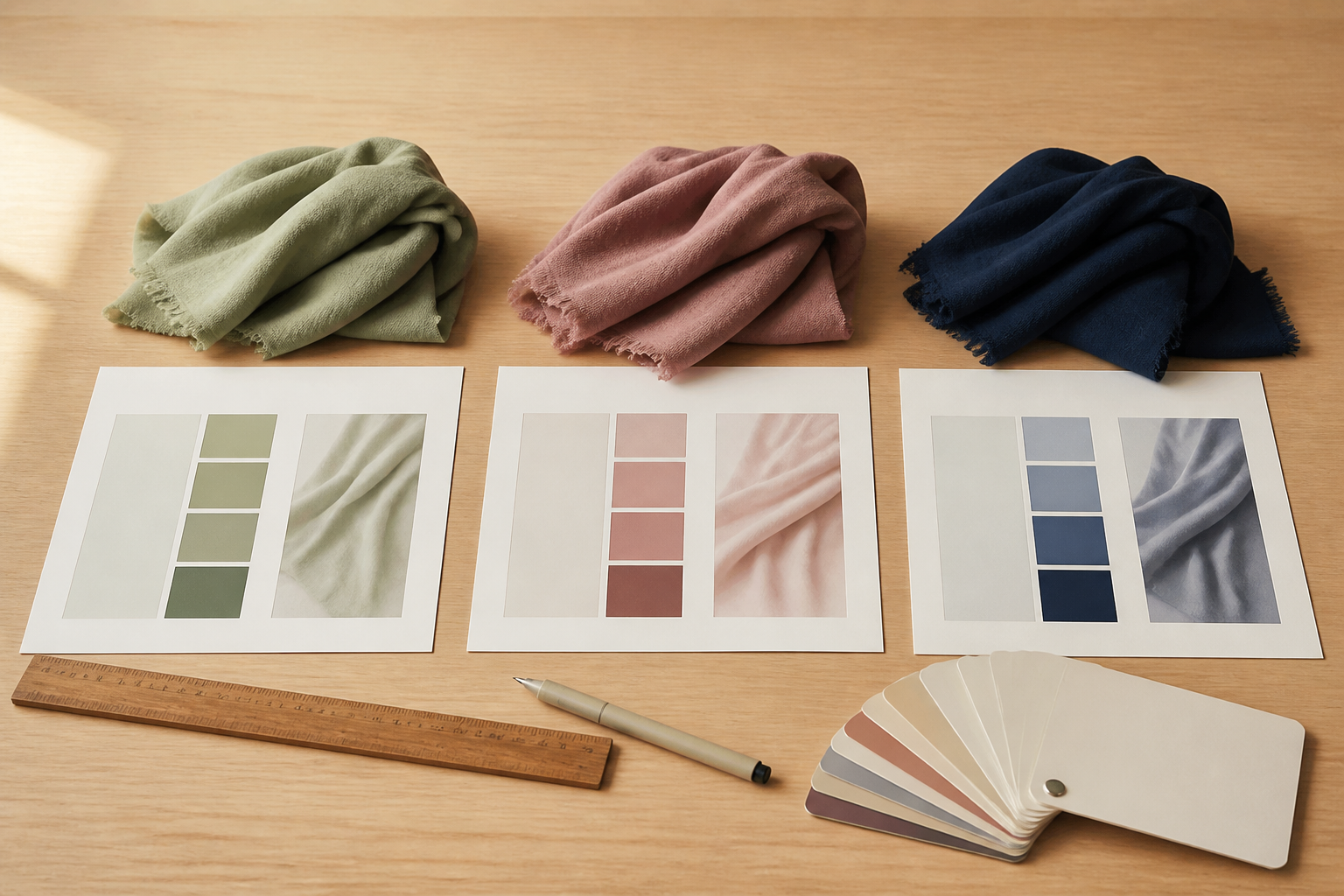
The most valuable asset a brand can build in its first two to three seasons of custom hijab production is a colourway archive: a set of approved colour standards, each documented with the spectrophotometer reference, ink formulation code, and physical strike-off sample, stored in a way that can be retrieved and used to configure any future production run of the same colourway. A well-maintained archive transforms the second and third season reorder process from a full development cycle into a configuration exercise.
Building this archive starts with the first order. Request the spectrophotometer measurements of each approved strike-off from your manufacturer. Keep the physical strike-off sample (a fabric swatch of at least 10 x 10 cm) filed with the colourway reference. Record the Pantone reference and the final agreed ink formulation code. When you place a repeat order, share this reference package with the manufacturer and request confirmation that the repeat order will be calibrated to the stored reference rather than a fresh estimation.
If you are at the stage of developing your first seasonal colourway programme and would like to test how accurately our production system can translate your colour brief into fabric, the most effective starting point is a sample order of two colourways with the full strike-off and first-piece approval process included. This gives you both the physical sample pieces and the measurement documentation you need to make a confident decision about whether our colour management approach matches your quality standard before committing to a full seasonal order.
Frequently Asked Questions
How should I brief a custom hijab manufacturer on my colourway intent?+
The most effective colour briefs provide: Pantone references from the current Pantone Fashion, Home + Interiors guide (not the graphic arts guide, which uses different colour space calibration), a physical colour reference if you have one (a fabric swatch, a painted chip, or a printed page from a design software colour palette), and a description of the mood or visual context you are designing for. Descriptions like "warm terracotta, not orange, leaning toward earthy clay" give the ink formulation team useful context alongside the Pantone number. Hex values alone are less useful because the translation from digital colour to physical dye formulation introduces variables that Pantone references handle more predictably.
What print equipment factors determine whether my colour brief translates accurately?+
Three equipment factors have the largest effect on colour brief accuracy. First, ink set quality and calibration: digital textile printers use reactive dye ink sets that need to be profiled specifically for the fabric type being printed. An ink set profiled for woven cotton will produce different results on modal than one profiled for modal specifically. Second, print head maintenance: worn or partially blocked print heads produce uneven ink deposit, which causes colour variation across the width of the fabric. Third, tension control: on jersey fabrics, inconsistent tension during printing causes the fabric to stretch unevenly, which changes the effective ink deposit density and shifts the colour toward lighter values in stretched zones.
How does a custom hijab manufacturer store approved colour standards for repeat orders?+
A manufacturer with a colour management system stores approved colourways as a combination of: the Pantone or spectrophotometer measurement reference (the target ΔE value the production must match), the ink formulation code for the specific colourway on the specific fabric type, and the approved strike-off physical sample (a fabric swatch from the approved production run, filed with the order reference). When a repeat order is placed, the manufacturer retrieves this reference package and uses it to configure the production run without requiring a new colour brief or full strike-off approval cycle, which significantly reduces the time and cost of repeat orders.
How many colourways can I realistically develop in a first season with a new custom hijab manufacturer?+
For a first season with a new manufacturer, two to four colourways is a practical range. Each colourway requires its own ink formulation, strike-off production, and approval cycle. More than four colourways in a first season increases the pre-production time significantly and raises the risk that an approval delay on one colourway holds up the entire season launch. A focused colourway selection also gives you more meaningful quality reference data per colourway on the first order, which makes the second season much faster to execute.
What is the difference between colour accuracy and colour consistency in hijab production?+
Colour accuracy refers to how closely the produced colour matches the agreed reference (typically measured as ΔE against the approved Pantone or strike-off). Colour consistency refers to how uniform the colour is across all units in a single production run and across multiple production runs of the same colourway. A manufacturer can achieve acceptable accuracy on a single strike-off while having poor consistency across the bulk run -- if the printing parameters drift during the run, individual units at different points in the run will have measurably different colour values even though they all came from the same production order. Both metrics matter for brand quality.
Should I test print with a custom hijab manufacturer before committing to a full colourway programme?+
Yes. A sample order of one or two colourways, with the complete strike-off approval and first-piece confirmation process, is the most reliable way to evaluate whether a manufacturer's colour management system can deliver your colourway intent before committing to a full seasonal programme. The sample order also gives you the physical reference pieces needed to make informed decisions about colourway selection for the full collection -- sometimes a colour that looks ideal in a Pantone reference looks different in printed fabric, and discovering this on a sample order rather than in bulk is significantly less costly.
Need a quote for your next order?
Free samples available. MOQ from 100 pieces. Ships to 50+ countries.
Request a Quote